Pfizer (NYSE: PFE) said on 26 October 2026 that the US Food and Drug Administration has expanded approval of its Talzenna-Xtandi combination to an earlier stage of metastatic prostate cancer. The FDA approval covers men with metastatic androgen pathway modulation-naive or -sensitive prostate cancer who carry HRR gene mutations, including both BRCA and non-BRCA variants.
The approval is based on the Phase 3 TALAPRO-3 trial, which showed an estimated 52% reduction in the risk of radiographic progression or death, according to a reprint of Pfizer’s release. Radiographic progression-free survival for talazoparib plus enzalutamide beat placebo plus enzalutamide with a hazard ratio of 0.48, within a 95% confidence interval of 0.36 to 0.65, OncLive reported.
From resistant disease to a frontline setting
Talzenna (talazoparib) and Xtandi (enzalutamide) first won US approval together in 2023, for metastatic castration-resistant prostate cancer with HRR mutations. The new label moves the combination into hormone-sensitive disease, a stage that precedes resistance to androgen-blocking therapy, Pfizer said in its announcement.
The FDA accepted Pfizer’s supplemental application for Priority Review on 22 July 2026, ahead of the October decision, as first reported by Reuters. Companion diagnostics FoundationOne CDx and FoundationOne Liquid CDx were cleared alongside the drug approval to identify patients with qualifying HRR alterations, the Oncology Nursing Society noted. The genes covered span ATM, ATR, BRCA1, BRCA2, CDK12, CHEK2, FANCA, MLH1, MRE11A, NBN, PALB2 and RAD51C, according to CURE Today.
Commercial stakes for two established brands
Talzenna generated $50m in US revenue in the first quarter of 2026, up from $40m a year earlier, while Xtandi brought in $444m over the same quarter, according to RTTNews. Those figures underline why a label extension into earlier-stage disease, which affects a larger patient pool than resistant cancer, matters commercially for Pfizer. The combination is already approved for resistant prostate cancer in more than 60 countries and remains under review at the European Medicines Agency, RTTNews reported, pointing to a wider rollout that could follow the US decision.
Earnings have swung sharply this year
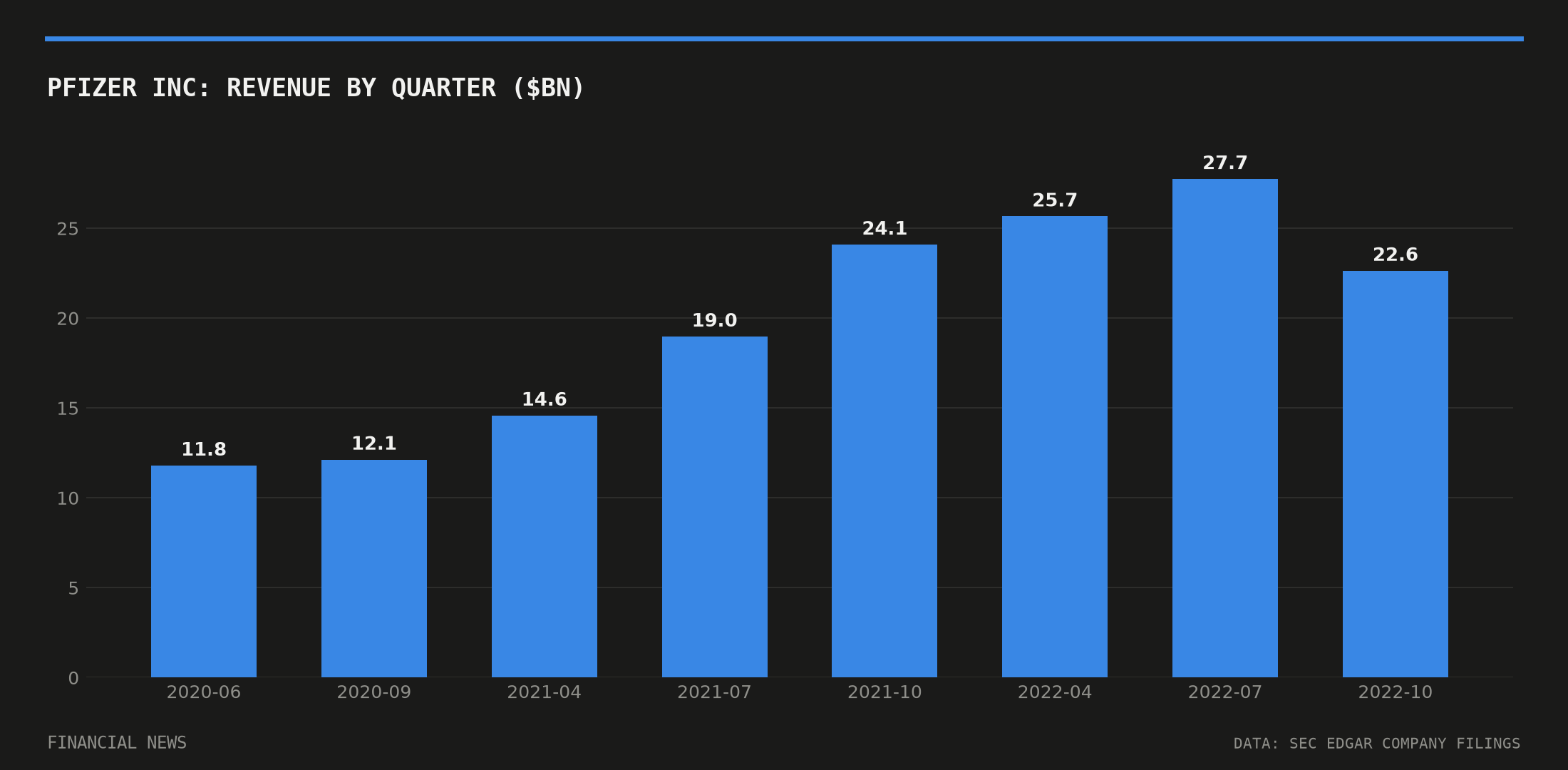
The approval lands against a volatile earnings backdrop. Pfizer reported net income of $2,687m, or diluted earnings per share of $0.47, for the first quarter of 2026, according to its 10-Q filing. The following quarter swung to a net loss of $248m, a diluted loss of $0.04 per share, the company’s second-quarter filing showed.
That reversal follows a choppier pattern through 2024 and 2025. Pfizer’s net income ranged from a low of $41m in the second quarter of 2024 to $4,465m in the third quarter of that year, before settling between roughly $2.9bn and $3.5bn across the four quarters to the third quarter of 2025, EDGAR filings show. The second-quarter 2026 loss marks the first quarterly net loss in that run, making the swing from a $2,687m profit in the first quarter to a $248m deficit three months later the sharpest single-quarter reversal in the period covered by Pfizer’s recent filings.
Pfizer shares closed at $29.74 on 26 October, down 0.12% on the day but up 7.09% over the preceding 20 trading days, according to consolidated US exchange data. Trading volume ran 15% above the 20-day average. FINRA’s daily short-sale volume ratio for the stock rose to 0.612 on approval day, up from 0.436 three sessions earlier, FINRA data show, though a single day’s ratio is not in itself a directional signal on sentiment.
What happens next
Pfizer’s sales teams can begin marketing the combination in the newly approved hormone-sensitive setting immediately in the US. Investors are likely to watch for commercial uptake figures in Pfizer’s next quarterly filing, alongside any decision from the European Medicines Agency on the equivalent expanded indication, and the company’s broader earnings trajectory after the second quarter’s loss.
This article is for information only and is not investment advice or a recommendation to buy or sell any asset. Markets move quickly; figures are correct as sourced at the time of writing. Always do your own research before making financial decisions.