Bloom Energy Corp (BE) posted record third-quarter revenue and raised its full-year guidance on 22 October 2026, beating Wall Street forecasts on both sales and profit. The shares fell anyway.
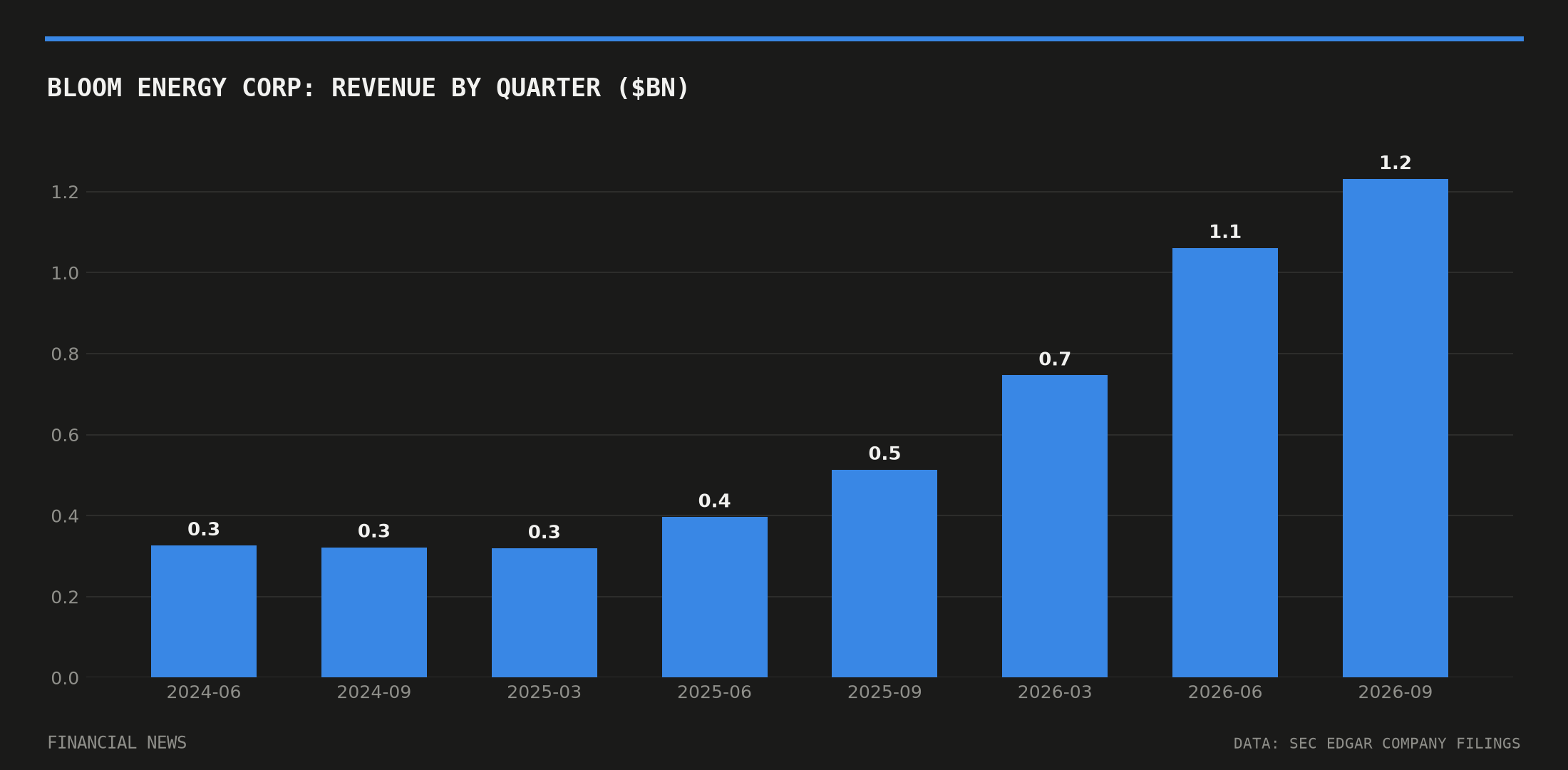
Revenue hit $1,235.8m, up 138.1% year-on-year, according to the company’s results filed with the SEC. Non-GAAP diluted earnings per share came in at $0.94, well above the $0.69 analysts had pencilled in, while GAAP diluted EPS reached $0.78, confirmed in Bloom’s 10-Q filing.
Bloom Energy Q3 earnings: the numbers behind the beat
The quarter marked the third straight period in which Bloom Energy has beaten estimates and lifted guidance. Management raised full-year 2026 revenue guidance to a range of $4.4bn to $4.6bn, the company said in its release. A year earlier the business was still loss-making on a GAAP basis, with diluted EPS of minus $0.10 in the comparable quarter, as reported by Investing.com.
Heading into the print, Zacks consensus had called for EPS of 71 cents on revenue of $1.07bn, figures Bloom cleared comfortably, according to Schaeffer’s Investment Research.
Executives pointed to a 700-megawatt carbon capture project with AEP and Google, plus the company’s first equipment shipments to Texas, as evidence the order book is broadening beyond its traditional data-centre customer base, Bloom said on the earnings call, as reported by BigGo Finance. The company also flagged its recent addition to the S&P 500 in the release.
Shares keep falling despite the beat
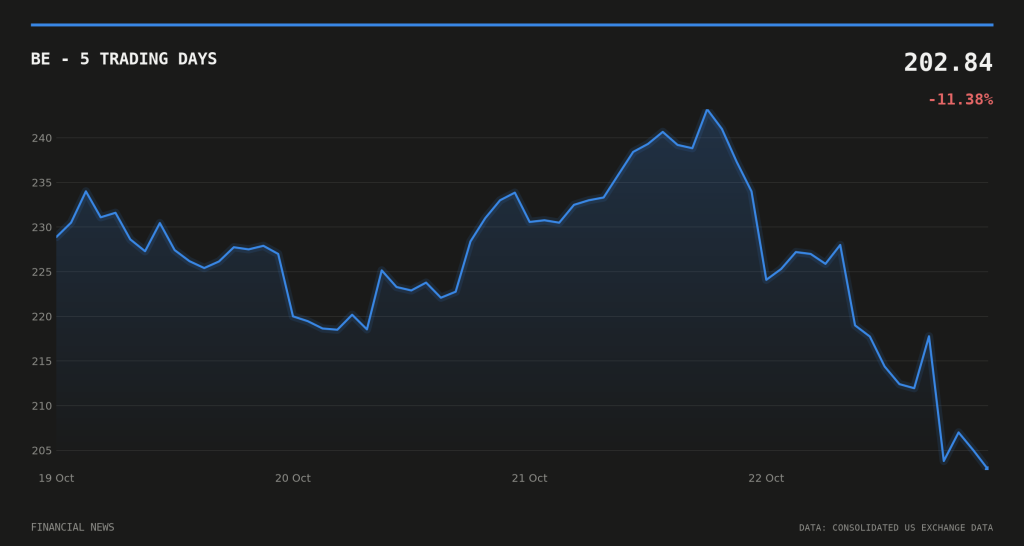
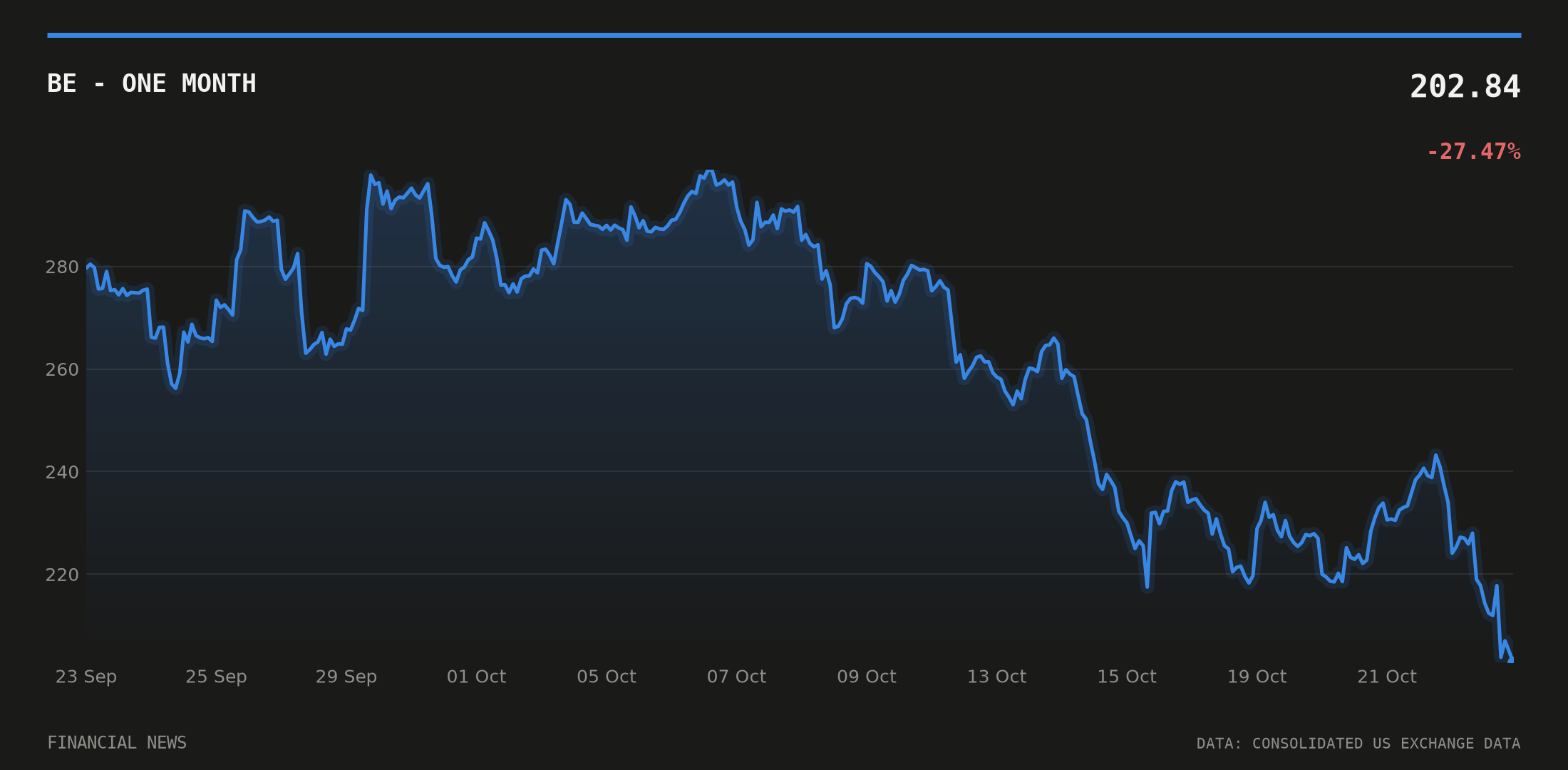
None of it stopped the slide. Bloom had already dropped roughly 10.6% to about $213 in the hours before the report, as 24/7 Wall St. tracked in a live blog of the session, with options pricing in annualised implied volatility of roughly 168%. Shares then fell a further 5% in after-hours trading once the numbers landed, the outlet reported.
By 7pm Eastern, Bloom traded at $202.84, down 5.39% on the day and 28.36% over the preceding 20 sessions, sitting at its 20-day low on volume 2.34 times the recent average. Investing.com headlined the move simply: the stock fell in regular trading and slipped further after hours, despite the beat.
The slide isn’t new. Bloom lost 21.1% over five sessions in mid-October, closing at $221.31 on 16 October against a $280.50 close the week before, according to data cited by TIKR. The stock remains up about 156% year-to-date even after the pullback, having peaked at a $345.85 close on 22 June, the Motley Fool noted.
Positioning pointed to a bruising print either way
Short-side activity had been building into the report. FINRA’s daily short-sale ratio for Bloom climbed from 0.513 on 12 October to 0.579 on 22 October, the day of the print, suggesting traders were increasingly positioning for volatility rather than a clean rally regardless of the headline numbers.
That positioning sits against a valuation that had already stretched far beyond the fuel-cell maker’s peers after a 156% run this year. A stock pricing in hypergrowth tends to be judged less on whether it beats consensus than on whether the beat is big enough to justify the multiple — a bar that gets higher every quarter revenue triples.
What happens next
Attention now turns to how analysts recalibrate price targets after the guidance raise, and whether the AEP-Google carbon capture project and the Texas shipments translate into disclosed order backlog in Bloom’s next filings. The macro backdrop offers no obvious relief for high-multiple growth names: the 10-year Treasury yield stood at 5.13% around the time of the report, data from the Federal Reserve Bank of St. Louis show, with unemployment at 4.2% in the latest reading — a combination that keeps pressure on stocks priced for years of uninterrupted growth.
This article is for information only and is not investment advice or a recommendation to buy or sell any asset. Markets move quickly; figures are correct as sourced at the time of writing. Always do your own research before making financial decisions.