Bank of Hawai’i Corporation (NYSE: BOH) reported third-quarter diluted earnings per share of $1.49 on 26 October 2026, up from $1.47 in the linked quarter.
Net income rose 0.7% sequentially to $64.3 million, the bank said in its earnings release, even as the figure fell short of Wall Street forecasts.
Bank of Hawai’i earnings beat the prior quarter, miss estimates
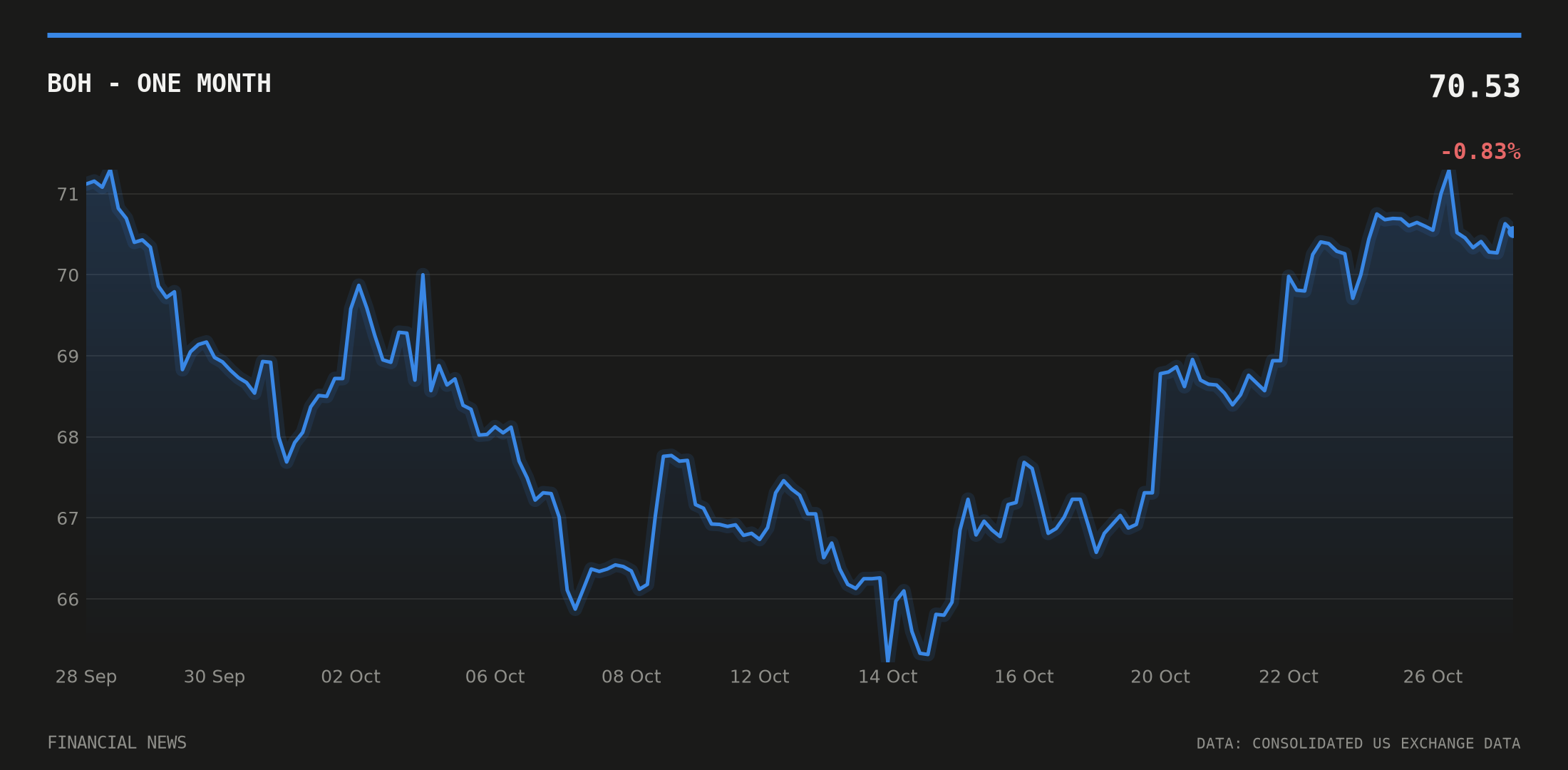
The headline numbers improved from the second quarter. Return on average common equity came in at 15.38%, against 15.47% in the prior three months, according to SEC filings.
But the quarter missed external forecasts on two counts. EPS of $1.49 fell short of the consensus estimate of $1.51, according to MarketBeat, which cited RTT News. Revenue also missed analyst expectations, according to Chartmill, which said the shortfall was partly offset by margin expansion.
Net interest margin rose to 2.82% from 2.78% in the second quarter, the bank’s earnings release shows. That marked the tenth consecutive quarter of margin expansion, according to Investing.com.
Shares under pressure despite the profit rise
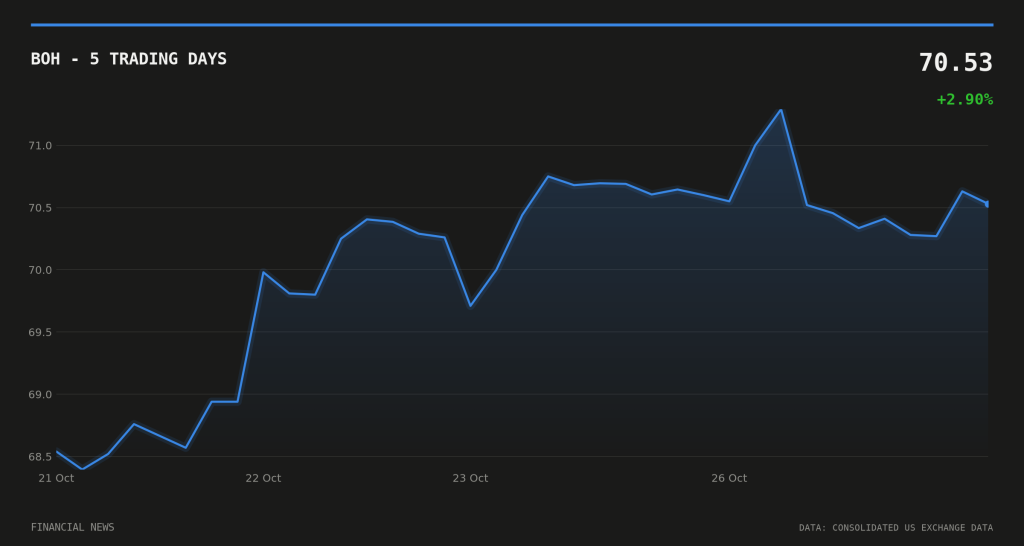
Independent reporting paints a sharper market reaction than the headline figures suggest. BOH shares tumbled more than 7% following the release, according to Investing.com, which tied the move to the earnings and revenue miss.
Trading volume on the day ran 35% above the 20-day average, consolidated exchange data show, consistent with a reaction of that scale rather than a routine print.
Net income climbs from a year earlier
Set against the same quarter last year, the improvement looks more pronounced. Net income of $64.3 million compares with $53.3 million in the third quarter of 2025, a rise of 20.5%, according to Investing.com. Diluted EPS has climbed from $1.20 in the same period a year earlier to $1.49 now, SEC filings show, a progression that also took in $1.30 in the first quarter of 2026 and $1.47 in the second.
The bank’s quarterly net income has risen in each of the past six reporting periods for which filings are available: $43.985 million in the first quarter of 2025, $47.637 million in the second, $53.345 million in the third, then $57.432 million, $63.799 million and now $64.258 million through the first three quarters of 2026, according to EDGAR filings. That steady climb sits awkwardly alongside Wall Street’s view that the pace of growth is slowing. Zacks Research had lifted its third-quarter EPS estimate for the bank to $1.52 in mid-August, up from $1.45, before trimming the figure again ahead of the print, according to MarketBeat. The final outcome of $1.49 landed short of even the revised bar.
Buybacks expand as capital returns continue
Bank of Hawai’i also disclosed it had increased its share repurchase programme by $200 million and bought back $20.2 million of stock during the quarter, according to the earnings release. The expanded buyback authorisation gives management more room to support the shares even as the stock absorbs a mixed reception to the results.
Positioning data gathered into the print point to rising caution among short sellers. The FINRA daily short-sale ratio for BOH climbed steadily from 0.505 on 13 October to 0.828 on 26 October, the day of the release, according to FINRA data. A rising ratio in the run-up to results can reflect increased hedging or bearish positioning ahead of a print whose outcome was uncertain.
Macro backdrop frames the margin story
The margin expansion comes against a backdrop of elevated US interest rates. The 10-year Treasury yield stood at 5.00% as of 23 October 2026, up from 4.96% a day earlier, according to FRED data from the Federal Reserve Bank of St. Louis. The 2-year yield sat at 4.69%, leaving the 10-year/2-year spread at 0.32 percentage points, little changed from 0.31 the prior session.
That environment has supported net interest margins across the regional banking sector, with holding periods on rate-sensitive assets repricing higher. For Bank of Hawai’i, the tenth straight quarter of margin gains has been the clearest offset to a revenue line that has disappointed forecasters two quarters running.
Investors will next watch whether the bank’s fourth-quarter guidance, typically given alongside annual results early in the new year, narrows the gap between the profit trajectory shown in its own filings and the more cautious read coming from Wall Street forecasters.
This article is for information only and is not investment advice or a recommendation to buy or sell any asset. Markets move quickly; figures are correct as sourced at the time of writing. Always do your own research before making financial decisions.