Ouster (NASDAQ: OUST) said on 10 November that Indra, the Spanish technology and engineering group, has selected its 3D digital lidar sensors for electronic toll collection projects worldwide, the companies announced jointly.
Indra has already deployed hundreds of Ouster’s Rev7 sensors across the Americas and Europe, and the new agreement extends that relationship rather than opening it, according to the companies.
Ouster lidar toll deal builds on existing rollout
Indra is best known for air traffic control, defence and mobility work, with tolling one vertical inside a much larger engineering business. The group is also evaluating Ouster’s next-generation Rev8 sensor for high-speed vehicle detection, the companies said.
No 8-K or contract-value disclosure accompanies the announcement. The only filing Ouster made with the SEC that day was a routine Form 4, leaving the financial scale of the expanded Indra relationship undisclosed.
Q3 revenue growth outpaces the toll contract news
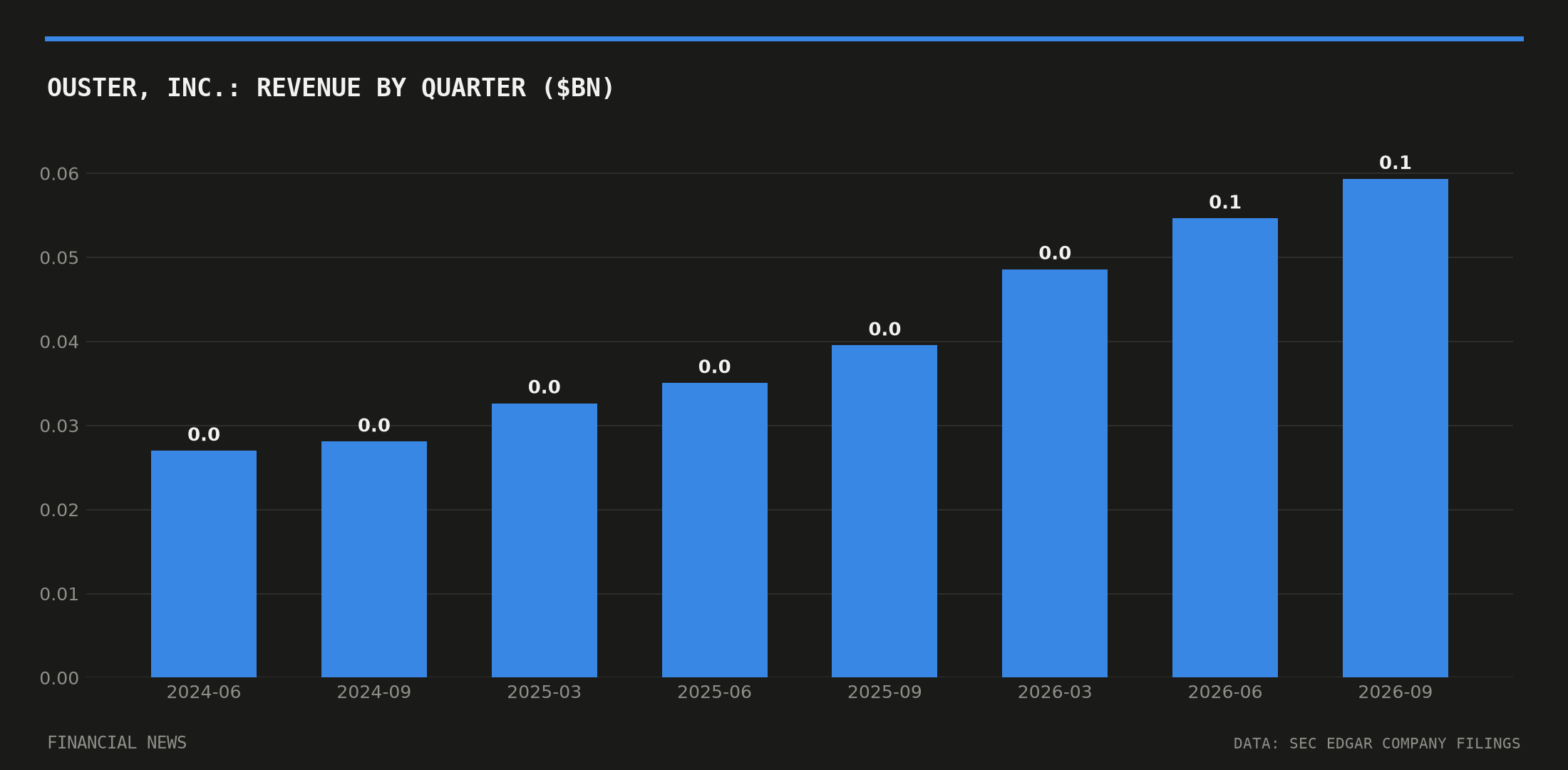
The lidar deal lands days after Ouster reported third-quarter revenue of $59.3m, up from $39.5m a year earlier, a roughly 50% increase that the company attributed to demand from robotics and drone customers, according to Benzinga.
Net loss narrowed to $14.2m in the quarter from $21.7m a year earlier, continuing a multi-quarter trend. Losses have shrunk steadily since mid-2024, when Ouster reported a $23.9m quarterly deficit, according to filings with the SEC.
Revenue has climbed every quarter across that stretch too. Ouster took in $27.0m in the second quarter of 2024, rising to $32.6m by the first quarter of 2025, then $48.6m in the first quarter of 2026 and $54.6m in the second quarter of this year before the latest $59.3m print, filings show. Diluted losses per share have narrowed in step, from 53 cents in the second quarter of 2024 to 20 cents in the third quarter of 2026.
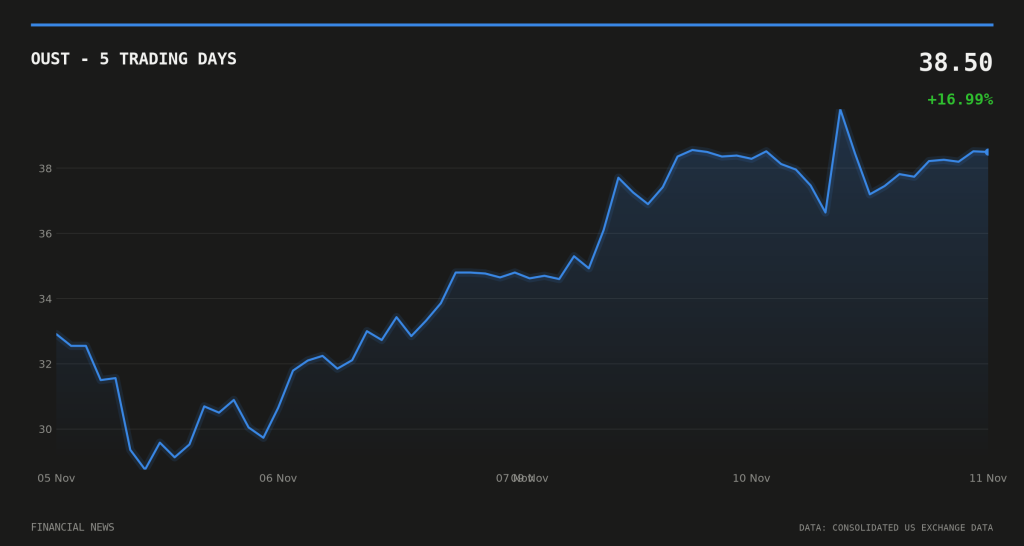
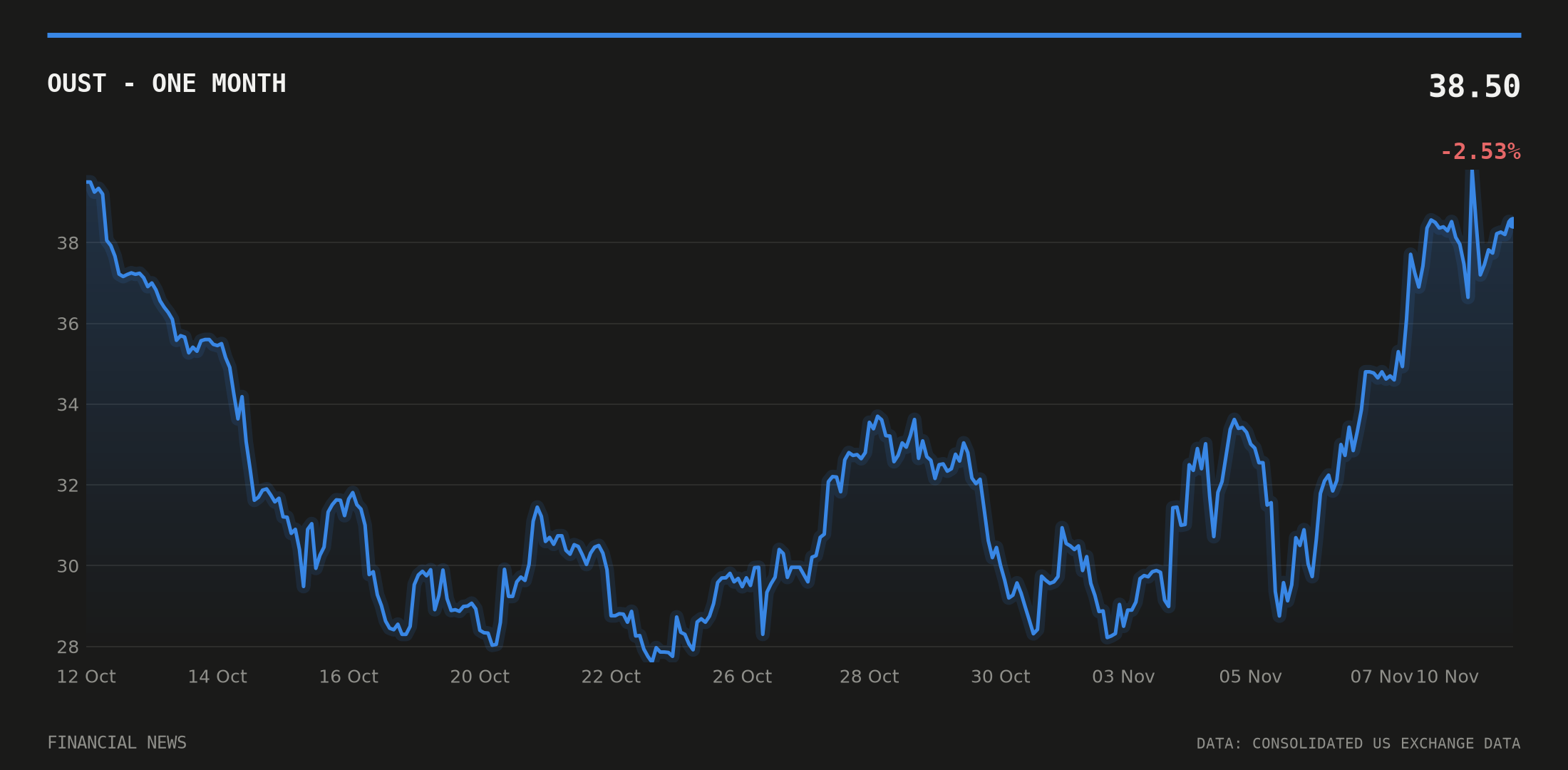
Shares closed at $38.50, up 2.79% on the day and 25.8% over the preceding 20 sessions, according to consolidated exchange data. The stock’s 20-day range ran from $27.61 to $39.81, putting the latest close near the top of that band. Trading volume ran at 74% of the 20-day average, suggesting the move has not been driven by an unusually heavy turnover day.
Short positioning eased as the stock climbed
Short-sale activity in OUST declined through the rally. FINRA’s daily short-sale ratio fell from 0.752 on 3 November to 0.469 on 10 November, according to FINRA data, indicating a smaller share of daily volume came from short sales as the shares advanced.
Insider activity has been modest. Ouster director Stephen Skaggs sold 5,000 shares at an average price of $34.00 on 6 November for $170,000, according to MarketBeat, a transaction that predates the share-price peak and represents a routine disposal rather than a signal tied to the Indra announcement.
Macro backdrop for small-cap industrial tech
The rally in Ouster shares has unfolded against a backdrop of still-elevated US borrowing costs. The 10-year Treasury yield stood at 4.88% on 9 November, up from 4.86% the prior reading, while the 2-year yield rose to 4.56% from 4.51%, according to Federal Reserve data. The 10-year/2-year spread narrowed to 0.25 percentage points from 0.32, a flattening that has historically weighed on risk appetite for small-cap growth names.
US unemployment eased to 4.1% in October from 4.2% the month before, while consumer prices rose modestly, with the all-items CPI index climbing to 337.476 from 336.298, Federal Reserve data show. Neither reading points to an economy forcing an imminent change in rate policy, a factor that has left long-dated yields elevated and kept financing costs for smaller industrial-technology companies like Ouster higher than during the low-rate years that preceded the pandemic.
Investors have treated the Indra news as confirmation of demand breadth for Ouster’s lidar business rather than a standalone catalyst, with the shares having already touched fresh highs in the weeks before the announcement on a mix of sensing-demand signals, according to Yahoo Finance. The company’s next scheduled disclosure is its fourth-quarter results, when investors will get a fuller picture of whether the revenue acceleration seen through 2026 has persisted into the final stretch of the year.
This article is for information only and is not investment advice or a recommendation to buy or sell any asset. Markets move quickly; figures are correct as sourced at the time of writing. Always do your own research before making financial decisions.