Apollo Global Management (NYSE: APO) has launched European Credit Company, a new platform dedicated to corporate and asset-backed lending across the region, the firm said on 2 November 2026.
The vehicle starts with more than €10bn of lending capacity, Apollo said, making it one of the largest dedicated European private credit launches this year.
Gulf and Asian capital behind the platform
European Credit Company, known as ECC, is backed by Apollo alongside the Abu Dhabi Investment Council, European insurer Athora, Japan’s Norinchukin Bank, Standard Chartered and Aranda Principal Strategies, according to Reuters. The platform will run offices in Frankfurt, Jersey, London, Luxembourg City and Milan.
It is led by chief executive Giacomo Petrobelli and chairman Christian Meissner. Petrobelli described the launch as capturing ‘a generational opportunity to mobilise global pools of capital to finance Europe’s long-term growth agenda,’ Reuters reported.
CNBC framed the Abu Dhabi council’s involvement as part of a broader Apollo push into Gulf wealth pools, a strategy the firm has pursued for several years as it seeks permanent capital for its lending book.
A launch against a choppy earnings backdrop
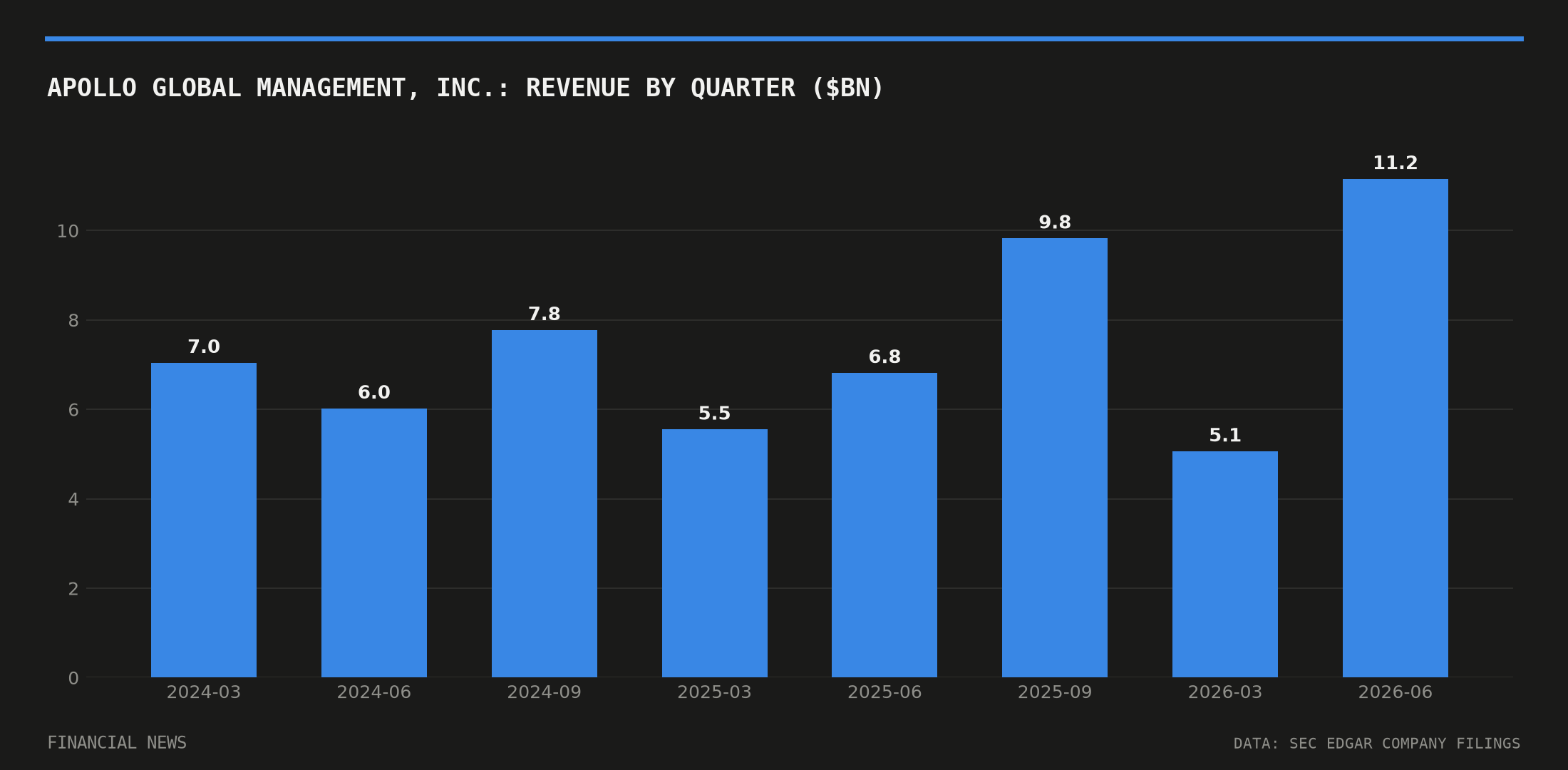
The platform arrives weeks after Apollo booked a $1,906m net loss in the first quarter of 2026, equivalent to diluted earnings per share of -$3.27, a sharp reversal from the prior three quarters of profit, according to its 10-Q filing with the SEC.
Apollo returned to profit the following quarter, reporting net income of $1,361m and diluted earnings per share of $2.15 for the three months to 30 June 2026, filings show. Revenue in that quarter reached $11.15bn, against $5.06bn in the first quarter, underlining how volatile the firm’s quarterly results can be even as its underlying lending business keeps expanding.
Assets under management stood at $1.05 trillion at the end of June, up from $1.03 trillion three months earlier, giving a sense of scale against which the new €10bn European unit sits.
Shares under pressure before the announcement
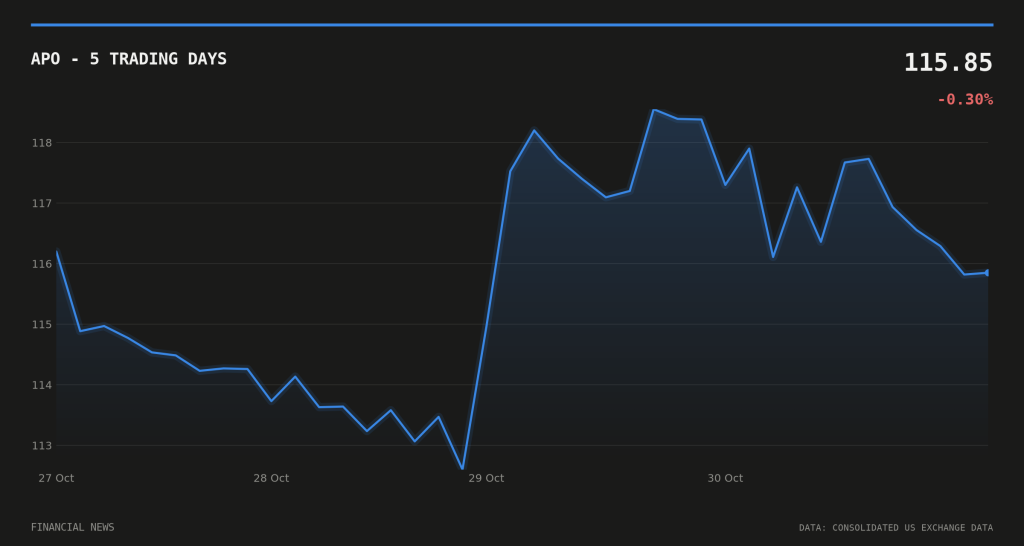
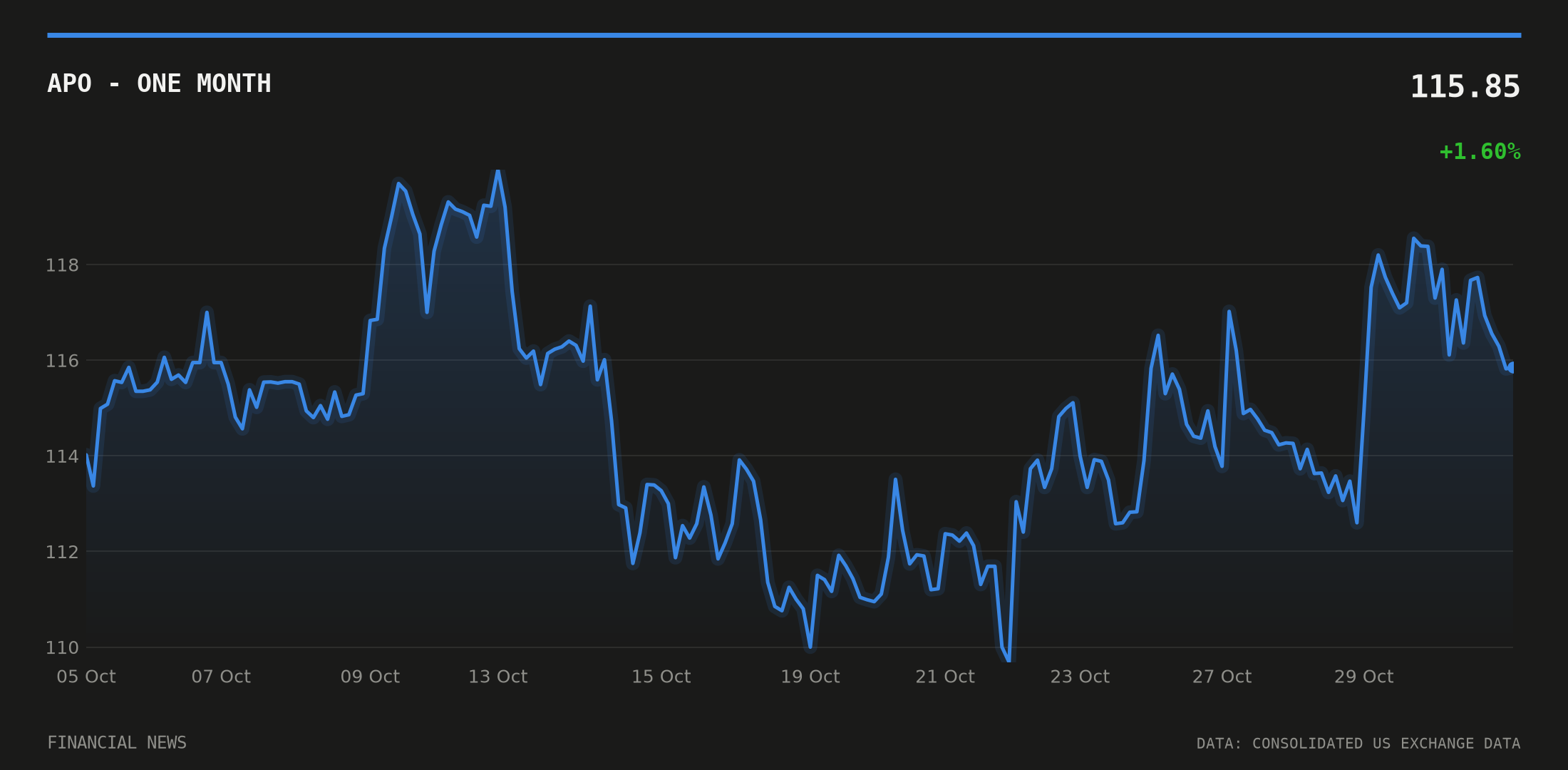
Apollo stock closed at $115.85 on 30 October, down 2.51% over the prior 20 trading days, with volume that day running at 1.84 times the 20-day average. The shares have traded between $109.68 and $119.99 over that stretch.
Sell-side analysts had already been trimming targets. BMO Capital cut its price target to $124 from $134 on 27 October, and Piper Sandler lowered its target to $145 from $159 on 19 October, according to data compiled by Benzinga. Neither note cited the European platform, which had not yet been announced.
Part of a wider private credit build-out
The ECC launch lands inside a broader private credit boom. Industry forecasts cited in coverage of the deal put global private credit assets under management above $2 trillion in 2026, with projections of close to $4 trillion by 2030 as banks retreat from parts of corporate and asset-backed lending.
For Apollo, the platform extends a model it has built in the US private credit market into Europe, pairing its own balance sheet with permanent capital from insurers, sovereign investors and banks. Standard Chartered’s involvement gives the platform a distribution and origination partner with an existing European corporate banking footprint, while ADIC and Norinchukin bring long-duration capital more typically associated with infrastructure and defence financing than conventional leveraged lending.
Whether the platform changes the market’s read on Apollo’s own earnings volatility is likely to depend less on the launch itself than on how quickly the €10bn gets deployed, and what that lending book yields once rate-cutting cycles and credit spreads move. Apollo’s next quarterly filing will show whether the platform has started contributing to fee income or remains, for now, a balance-sheet commitment.
This article is for information only and is not investment advice or a recommendation to buy or sell any asset. Markets move quickly; figures are correct as sourced at the time of writing. Always do your own research before making financial decisions.