Lam Research (NASDAQ: LRCX) told investors this week that chip-equipment demand has outrun its own capacity, with the industry now constrained by supply rather than orders. Chief financial officer Doug Bettinger said the sector is ‘fundamentally sold out’, according to TMT Breakout’s recap of his remarks at Goldman Sachs’s Communacopia & Technology conference on 10 September 2026.
The comment followed a similar line a day earlier, when Bettinger told Citi’s Global TMT Conference the industry is ‘fundamentally under-supplying demand’, with clean-room availability, not customer appetite, the binding constraint.
Capacity plans and a $3bn US build-out
Lam is backing the claim with capital. The company has committed $3bn to new US lab and engineering capacity, including a new site in Oregon, and says it is ‘deeply engaged already’ with SpaceX’s Terafab project, which it calls a ‘very high’ opportunity.
Management also raised its estimate of the global wafer fabrication equipment (WFE) market for calendar 2026 to the low $150bn range, having lifted the figure twice already this year, from $135bn to $140bn, according to the Citi conference transcript. The repeated upgrades track how quickly AI-driven fab spending has outpaced the company’s own forecasting.
Services arm hits a third straight record
Lam’s customer support and services business, which sells maintenance and upgrade parts into the installed base of chipmaking tools, posted close to $2.5bn in revenue last quarter, a third consecutive record. The company said its share of the serviceable addressable market has climbed from the low 30s to above 36% of total WFE, faster than management had expected, per the same transcript.
Gross margin reached 52% last quarter, the highest in two decades, with executives pointing to a path toward the mid-50s over time, the transcript shows. Filings with the SEC show the underlying growth: quarterly revenue rose from $3.76bn in the quarter ended 24 December 2023 to $5.84bn in the quarter ended 29 March 2026, with net income rising from $954.3m to $1.83bn over the same stretch.
Shares still lower despite the upbeat tone

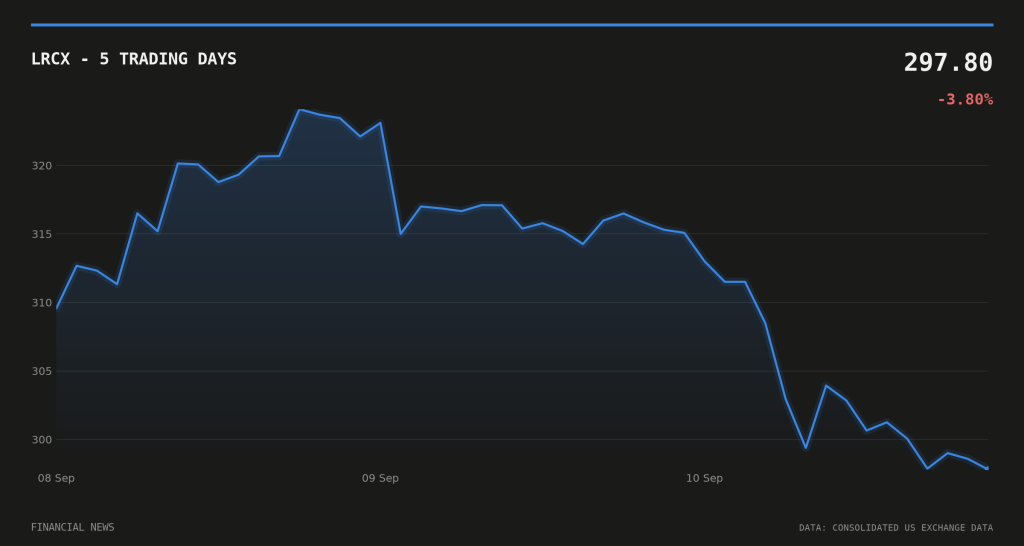
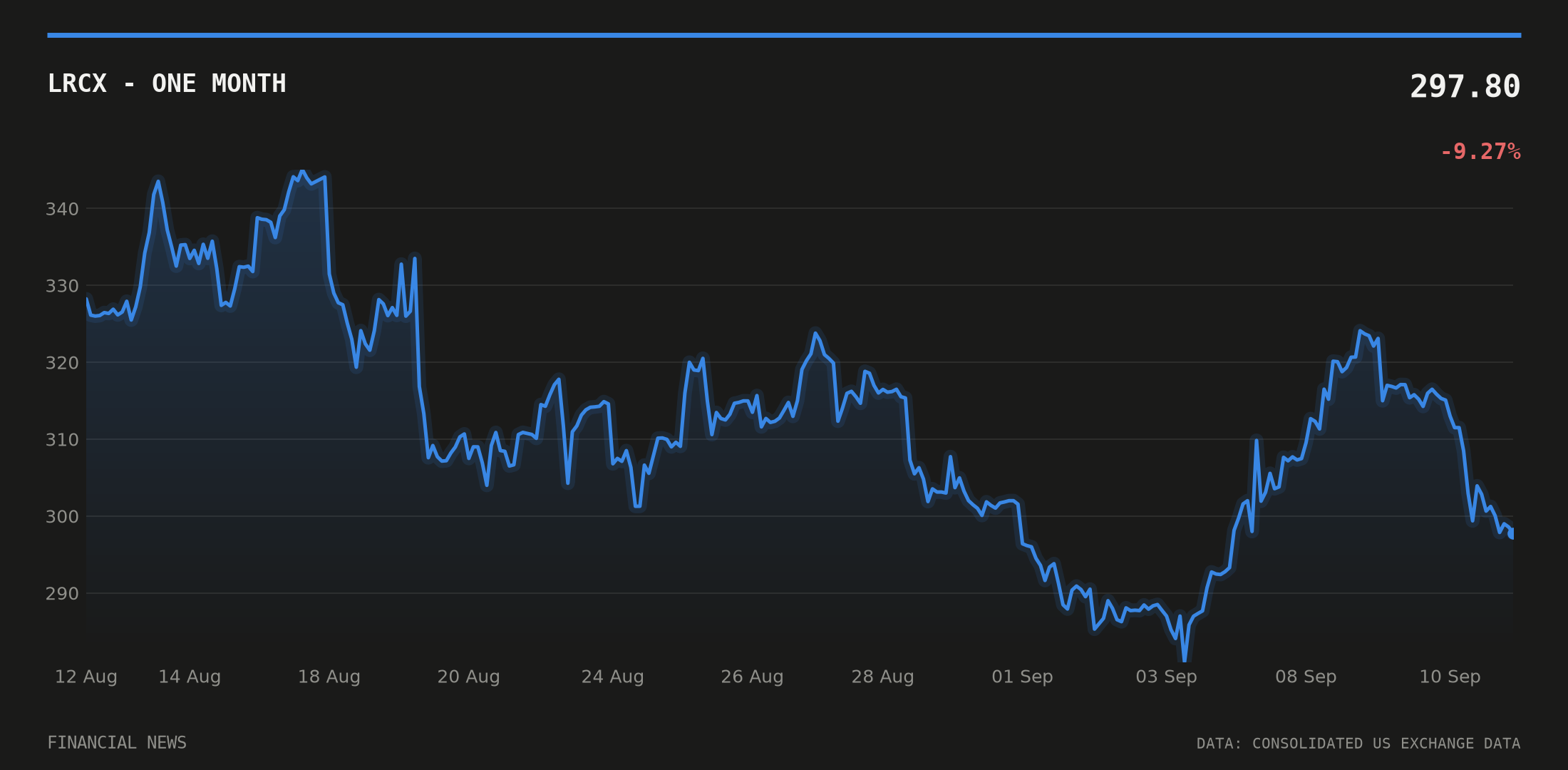
None of that has stopped the stock falling. LRCX closed at $297.80 on 10 September, down 1.66% on the day and 4.9% over the prior 20 trading days, according to consolidated exchange data, with volume running at 1.84 times the 20-day average. The shares have traded as low as $281.00 and as high as $324.10 in that window.
The pullback has coincided with a broader semiconductor sell-off and a rise in the 10-year US Treasury yield, which reached 4.83% on 9 September, up from 4.80% the prior session, per data from the Federal Reserve Bank of St Louis. The gap between operational messaging and near-term share performance is one investors are likely to watch heading into Lam’s next earnings report.
Two Form 4 filings landed the same week as the conference remarks: one for chief executive Timothy Archer, filed on 10 September, and one for director Bethany Mayer, filed the same day. Neither filing specifies whether the transactions involved share sales or acquisitions, or their size.
NAND upgrades as the next test
Beyond the current DRAM and logic cycle, Lam has flagged a roughly $40bn NAND upgrade opportunity through calendar 2027, according to the Citi transcript, a segment executives are watching to confirm the AI and high-bandwidth-memory demand thesis extends beyond the chips already in short supply. Whether that opportunity materialises at the scale management describes is likely to feature in Lam’s coming quarterly results.
This article is for information only and is not investment advice or a recommendation to buy or sell any asset. Markets move quickly; figures are correct as sourced at the time of writing. Always do your own research before making financial decisions.