U.S. Global Investors (NASDAQ: GROW) reported a return to operating profitability for its first quarter of fiscal 2027, the three months to 30 September 2026, the fund manager said on 12 November 2026.
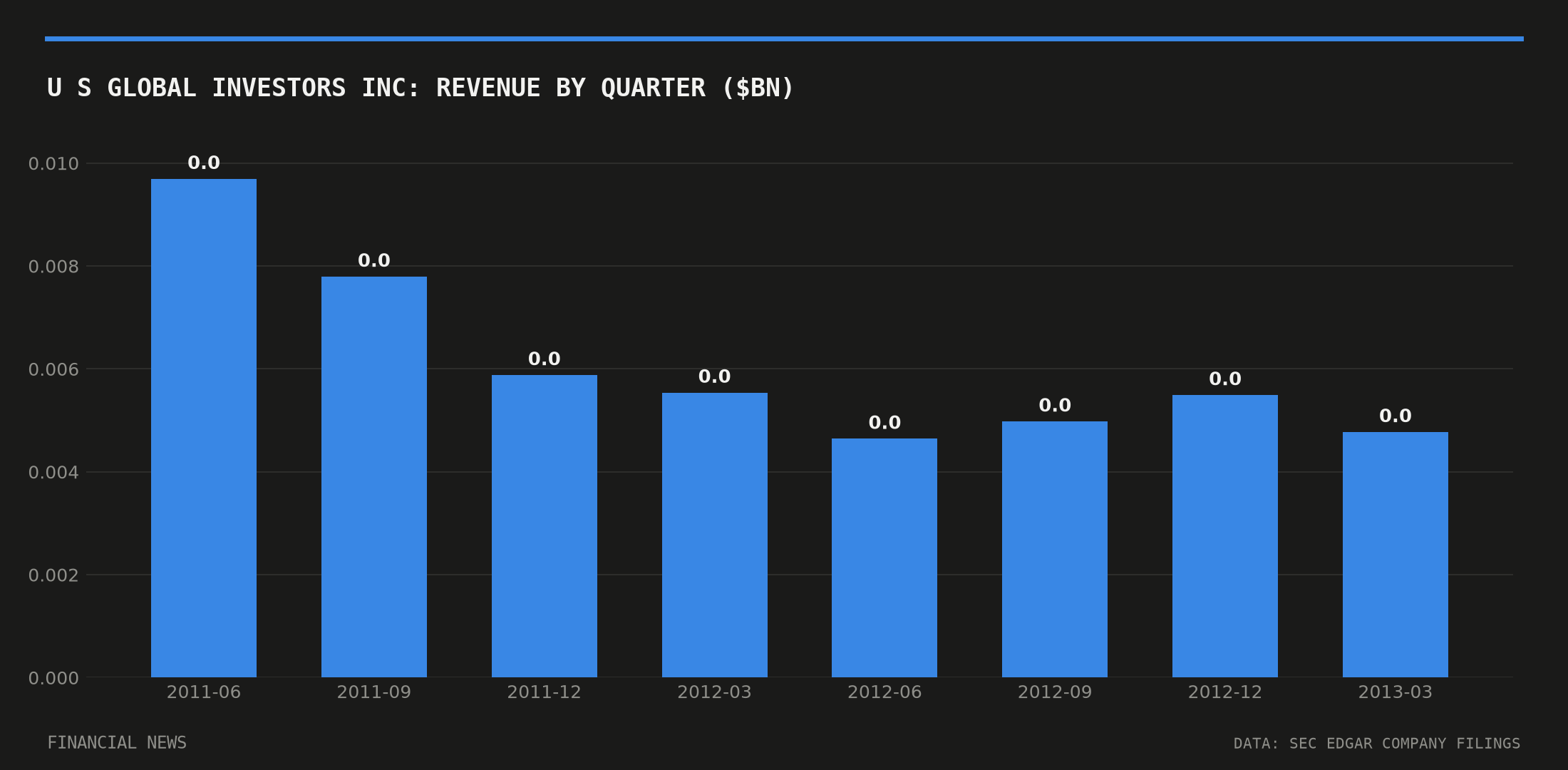
Operating income came in at $55,000, reversing a $515,000 operating loss in the same quarter a year earlier, as the company’s quarterly filing shows. Operating revenues rose 18% year-on-year to $2.7m.
Gold funds drive the operating profitability turnaround
Average assets under management climbed 14% to $1.6bn from $1.4bn, with gold and precious metals strategies the standout, according to Proactiveinvestors. The firm’s gold-focused funds, including USERX, UNWPX and GOAU, averaged $547.6m under management, up 45% on the year.
Management pointed to continued investor appetite for gold mining exposure during a volatile stretch for global markets. The company said it holds net working capital of roughly $35.4m, including $24.3m in cash and cash equivalents, a position GuruFocus also reported.
Net income tells a different story
The operating profitability headline obscures a sharper move lower down the income statement. Net income fell to $171,000, down roughly 89% from $1.507m in the same quarter last year, SEC filings show. Diluted earnings per share were $0.01, against $0.12 a year earlier.
The gap stems from other income, which dropped to $193,000 from $2.4m a year earlier. The prior-year figure was flattered by investment gains that did not repeat; this quarter included $185,000 of unrealised losses on equity and debt securities, as management detailed on the earnings call, according to a transcript published by The Motley Fool. In other words, the operating business improved while the investment portfolio that sits alongside it did not.
That split matters for how investors read the quarter. The operating turnaround reflects the fund business itself: more assets, more revenue, tighter cost control. The net income decline reflects mark-to-market swings on the firm’s own balance sheet holdings, which can reverse from one quarter to the next and say little about the underlying asset-management franchise.
A volatile run of quarters
The swing is not new to U.S. Global’s recent history. Net income has bounced between gains and losses across the past several quarters: a $2.677m profit in the quarter to March 2026, an $846,000 loss in the quarter before that, and a $382,000 loss in the quarter to March 2025, according to the company’s SEC filings. Diluted EPS over that run has ranged from a loss of $0.07 to a gain of $0.23, underlining how sensitive the bottom line is to investment-portfolio marks rather than operating performance alone.
The company continued its buyback programme through the quarter, repurchasing 105,457 Class A shares, and remains debt-free, per the Motley Fool transcript. Gator Capital Management, a holder of more than 10% of U.S. Global’s stock, filed a Form 4 on the earnings date showing it bought 33,034 shares at $2.5032 each, lifting its indirect stake to 1,162,333 shares.
Market and macro backdrop
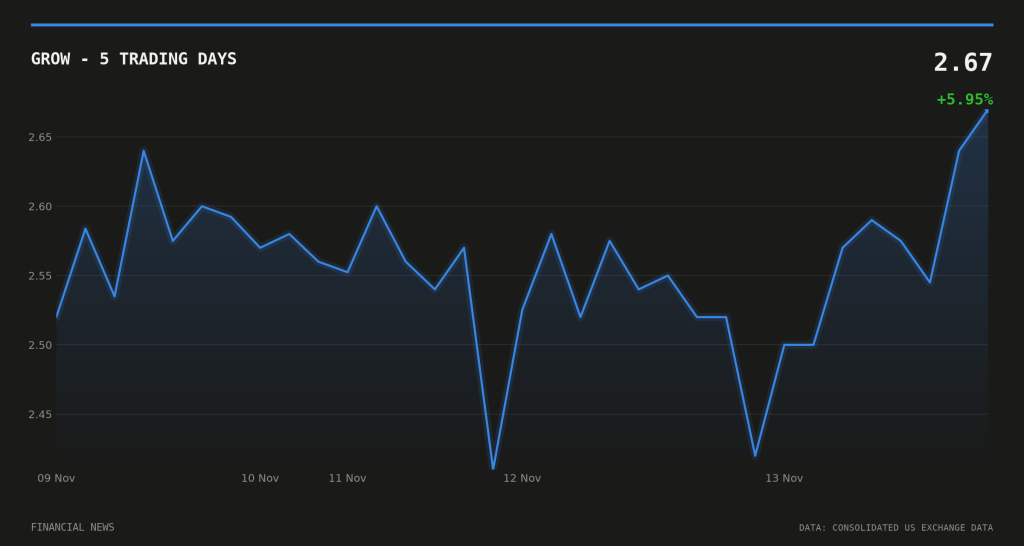
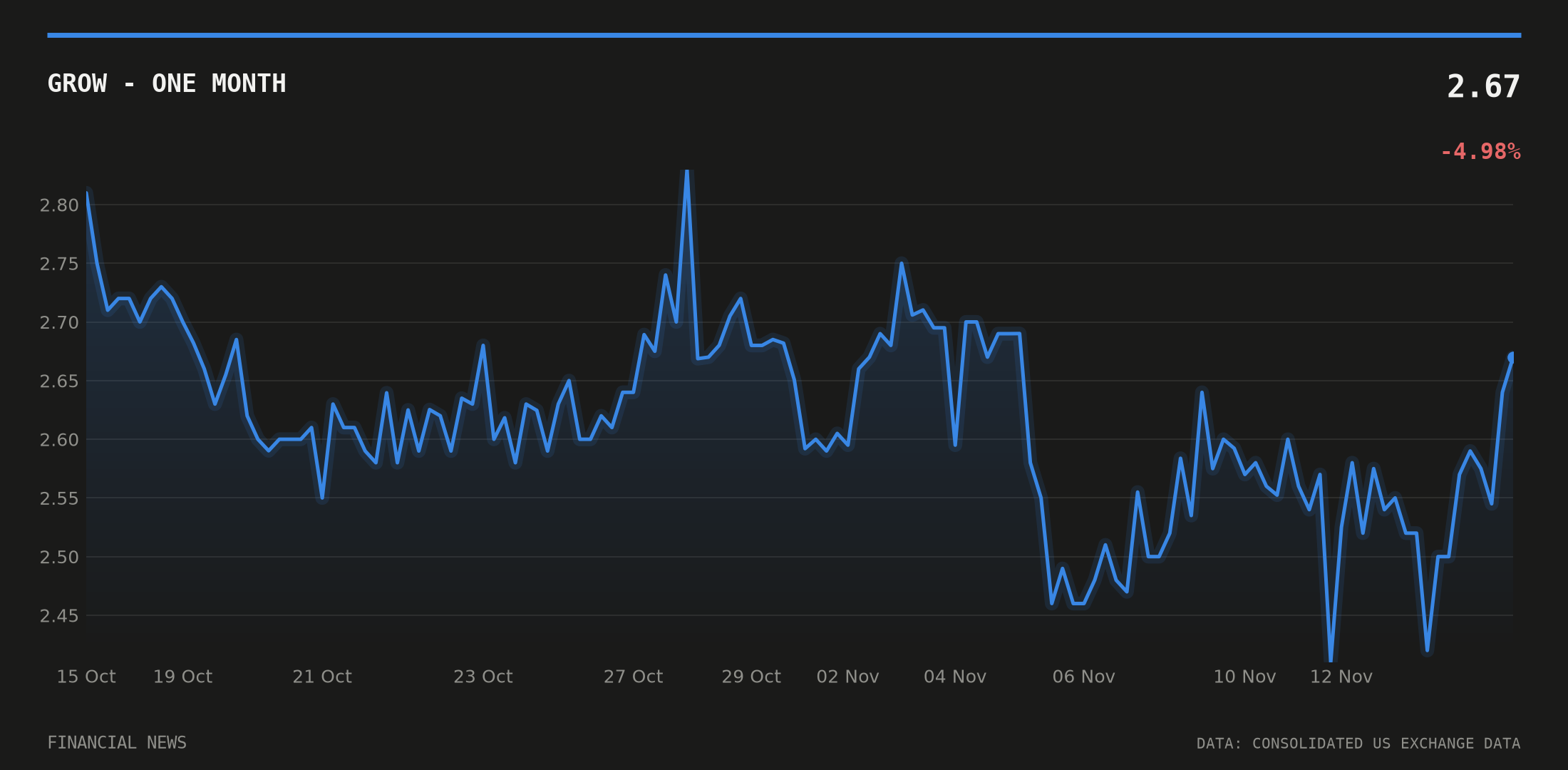
Shares in GROW closed up 6.8% on the day, at $2.67, within a 20-day trading range of $2.41 to $2.83, according to consolidated exchange data. Trading volume ran modestly above the 20-day average. FINRA daily short-sale data show the stock’s short ratio jumped to 0.602 on the earnings day, from just 0.069 two trading sessions earlier, pointing to a sharp rise in short-side activity around the release.
The results also landed against a backdrop of rising long-term US borrowing costs. The 10-year Treasury yield stood at 5.10% on 12 November 2026, up from 4.98% previously, according to data from the Federal Reserve Bank of St. Louis. Higher yields are typically a headwind for asset managers broadly, though U.S. Global’s tilt toward gold and precious metals strategies has historically drawn flows during periods of market volatility rather than being deterred by rate moves alone.
The firm’s next quarterly filing, covering the three months to 31 December 2026, will show whether the operating improvement holds and whether the swings in other income settle into a steadier pattern.
This article is for information only and is not investment advice or a recommendation to buy or sell any asset. Markets move quickly; figures are correct as sourced at the time of writing. Always do your own research before making financial decisions.