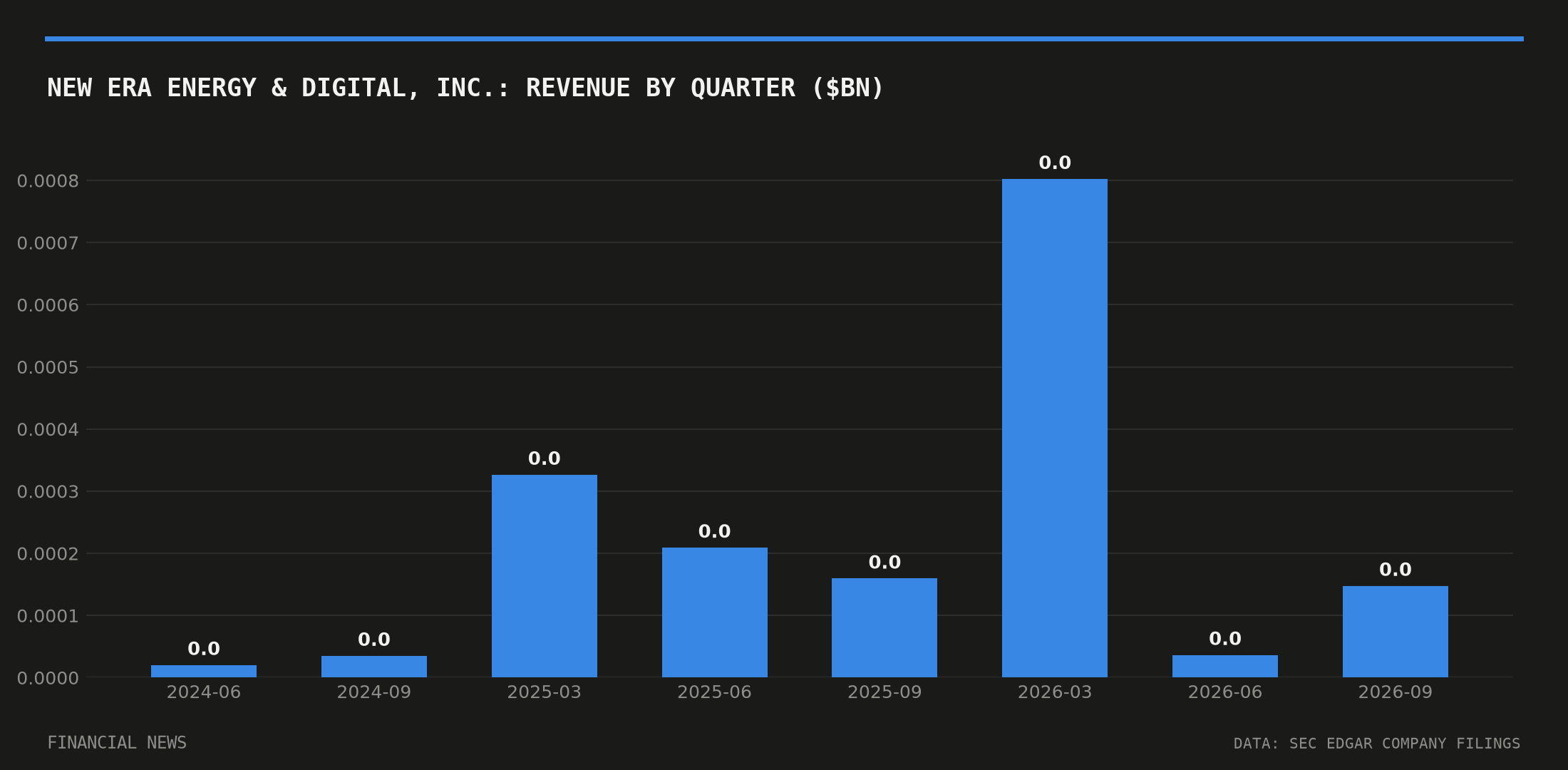
New Era Energy & Digital (NASDAQ: NUAI) reported third-quarter 2026 results on 12 November, posting a net loss of $16,599,408 on revenue of $147,674.
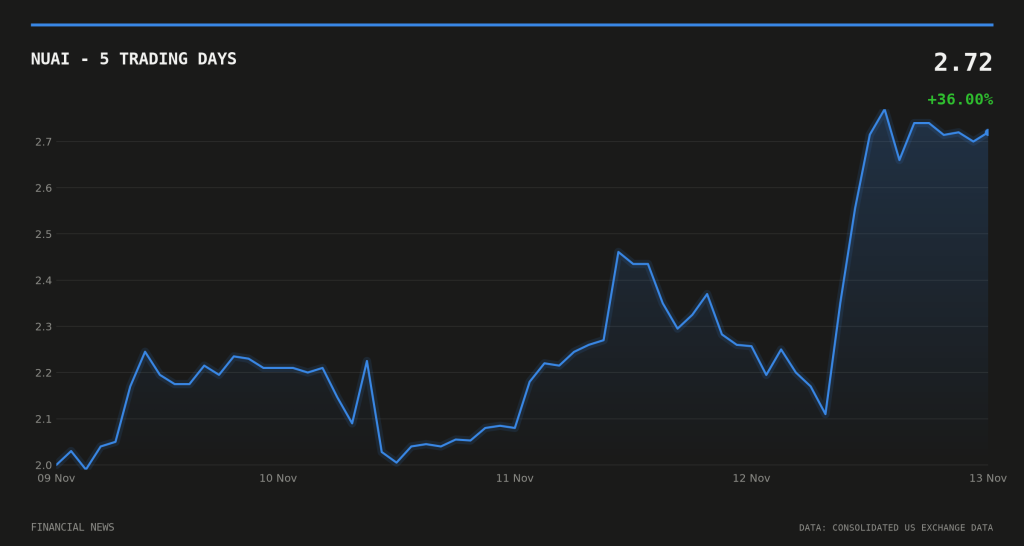
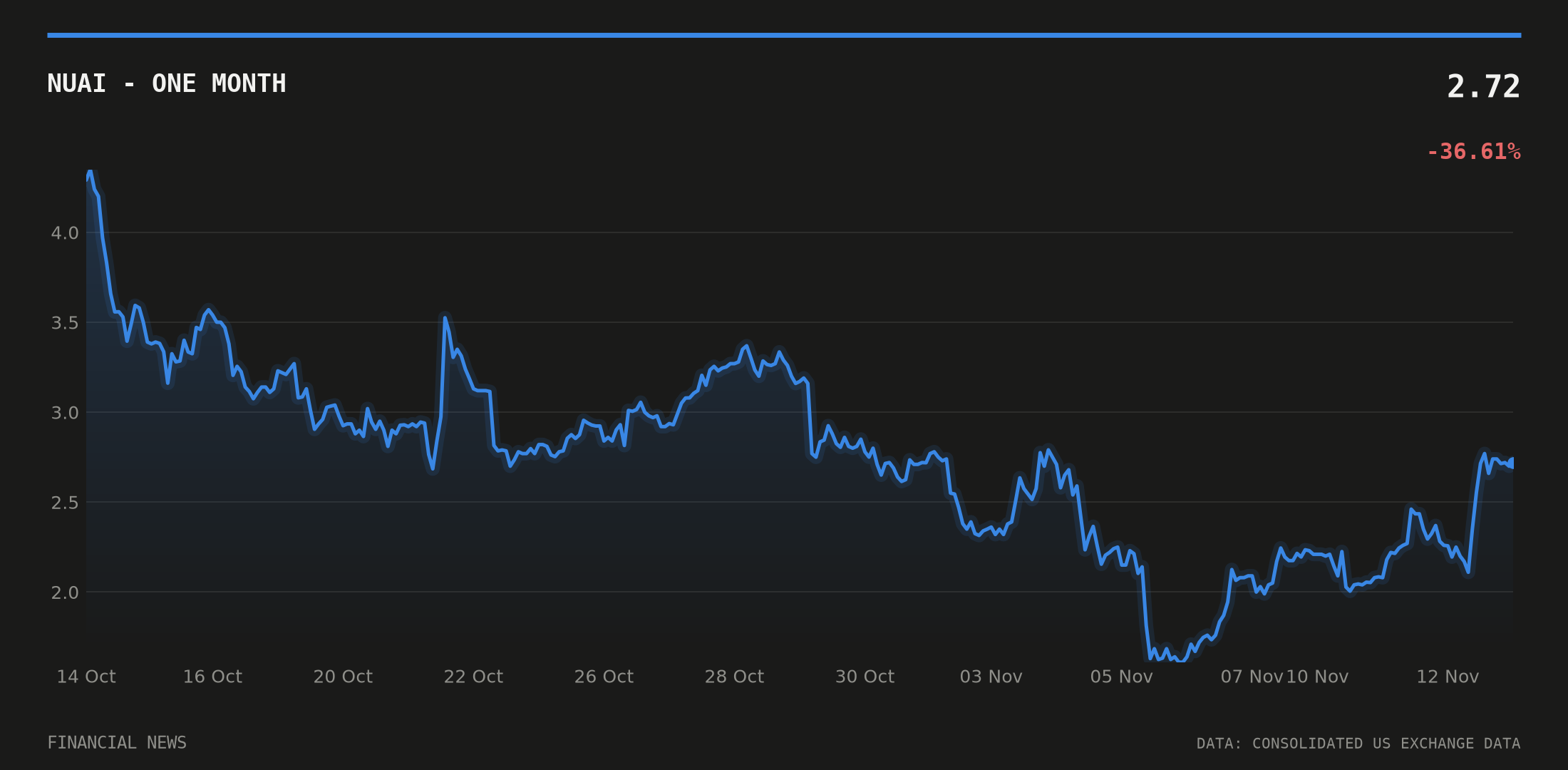
The loss was nearly triple the $5,783,173 the company lost in the same quarter a year earlier, even as revenue slipped from $159,411. Shares closed up 16.74% at $2.72 after falling as much as 9.87% premarket to $2.10, according to Investing.com.
Alongside the results, the former oil-and-gas explorer, now pivoting to AI-focused digital infrastructure, disclosed a 20-year power purchase agreement with Luminant, ET Services Company, an affiliate of Vistra Corp. The deal secures a minimum of 200 MW and up to 207 MW of firm power for Phase 1 of its TCDC site, with availability expected in the third quarter of 2027, as reported by GlobeNewswire.
The company also said it completed a $64m private placement to repay Macquarie borrowings and fund PPA collateral, leaving total cash of $187m as of 31 October – $49m unrestricted and $138m restricted – with its remaining $20m of debt fully cash-collateralised, according to the exhibit filed with the SEC.
The per-share loss narrowed – but not for the reason it looks
Diluted loss per share came in at $0.15, narrower than the $0.20 lost per share in Q3 2025. Taken alone, that reads as improvement. It isn’t.
Shares outstanding have grown roughly 239% over the past year, according to StockAnalysis.com. Spreading a dollar loss that nearly tripled across a share count that more than tripled produces a smaller per-share number even though the underlying business lost far more money. The headline EPS improvement is a function of dilution, not operating performance.
A restatement buried in the same filing
The Q3 10-Q also quietly revises the company’s first-quarter 2026 figures. New Era had previously reported a Q1 net loss of $8,991,887, or $0.16 a share. The restated figure in the latest filing puts that loss at $10,823,974, or $0.19 a share, citing accounting errors.
The correction pushes the nine-month 2026 net loss to $47,866,007, against $12,709,433 for the same period in 2025 – a near-fourfold increase that sits underneath a quarter that, on its EPS line alone, looked like it was moving in the right direction.
A single-asset bet on a 757 MW site
Management has framed the quarter as a shift to a ‘self-execution model’ for delivering Phase 1 of the Texas data centre project, which forms part of a wider plan envisaging roughly 757 MW of gross capacity across three phases on a 493-acre Permian Basin site, with long-term scaling potential beyond 1 GW, according to GuruFocus‘s summary of the earnings call.
Executives were explicit about the concentration risk. The company is ‘solely focused on the TCDC project, with no near-term diversification or other revenue-generating assets,’ management said on the call, as transcribed by The Motley Fool.
That leaves the stock’s fortunes tied almost entirely to the TCDC build-out meeting its Q3 2027 power-availability target. Analyst sentiment remains striking against that backdrop: Google Finance shows four analysts rating NUAI, all buy or strong buy, with an average 12-month price target of $9.50 against a $2.72 close – a gap that underscores how much is riding on execution rather than current financials.
Rates add to the funding backdrop
The financing math matters more in a higher-rate environment. The 10-year Treasury yield rose to 4.98% on 10 November from 4.88% previously, according to data from the Federal Reserve Bank of St Louis, raising the cost of capital for a company still burning cash ahead of first power.
New Era’s next test is operational rather than financial: whether the Vistra-backed power supply arrives on schedule for Phase 1, and whether the company can fund Phase 2’s roughly 550 MW of additional behind-the-meter generation without another round of dilution.
This article is for information only and is not investment advice or a recommendation to buy or sell any asset. Markets move quickly; figures are correct as sourced at the time of writing. Always do your own research before making financial decisions.