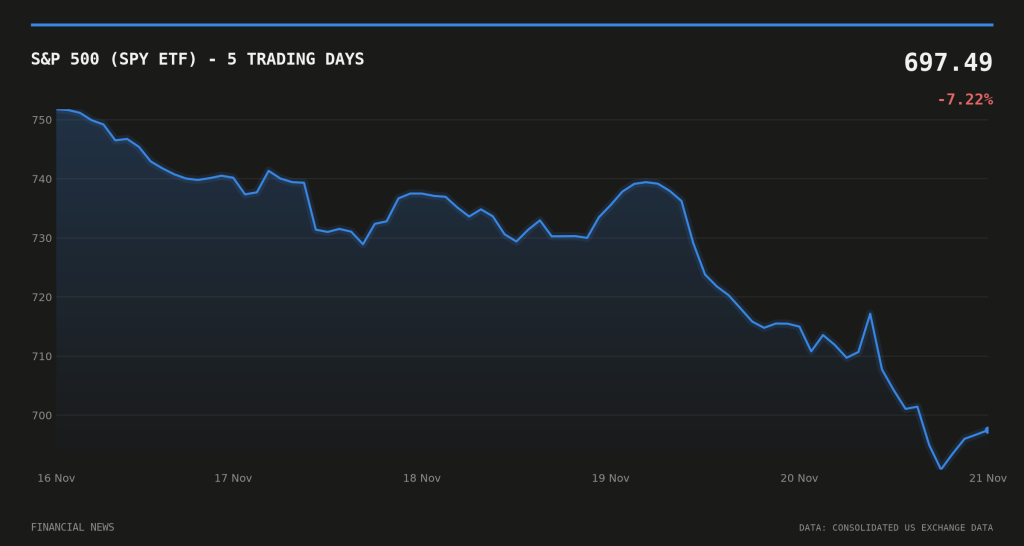
A Wall Street sell-off wiped out weeks of gains in five trading days, with the S&P 500 (SPY ETF) closing the week ending 21 November 2026 down 7.22% at 697.49.
The Nasdaq 100 (QQQ ETF) fared worse, falling 8.32% to 617.72, while the Dow (DIA ETF) shed 7.17% to end at 485.60. All three major US benchmarks posted their steepest weekly declines in months, according to consolidated US exchange data.
The scoreboard: a broad, indiscriminate drop
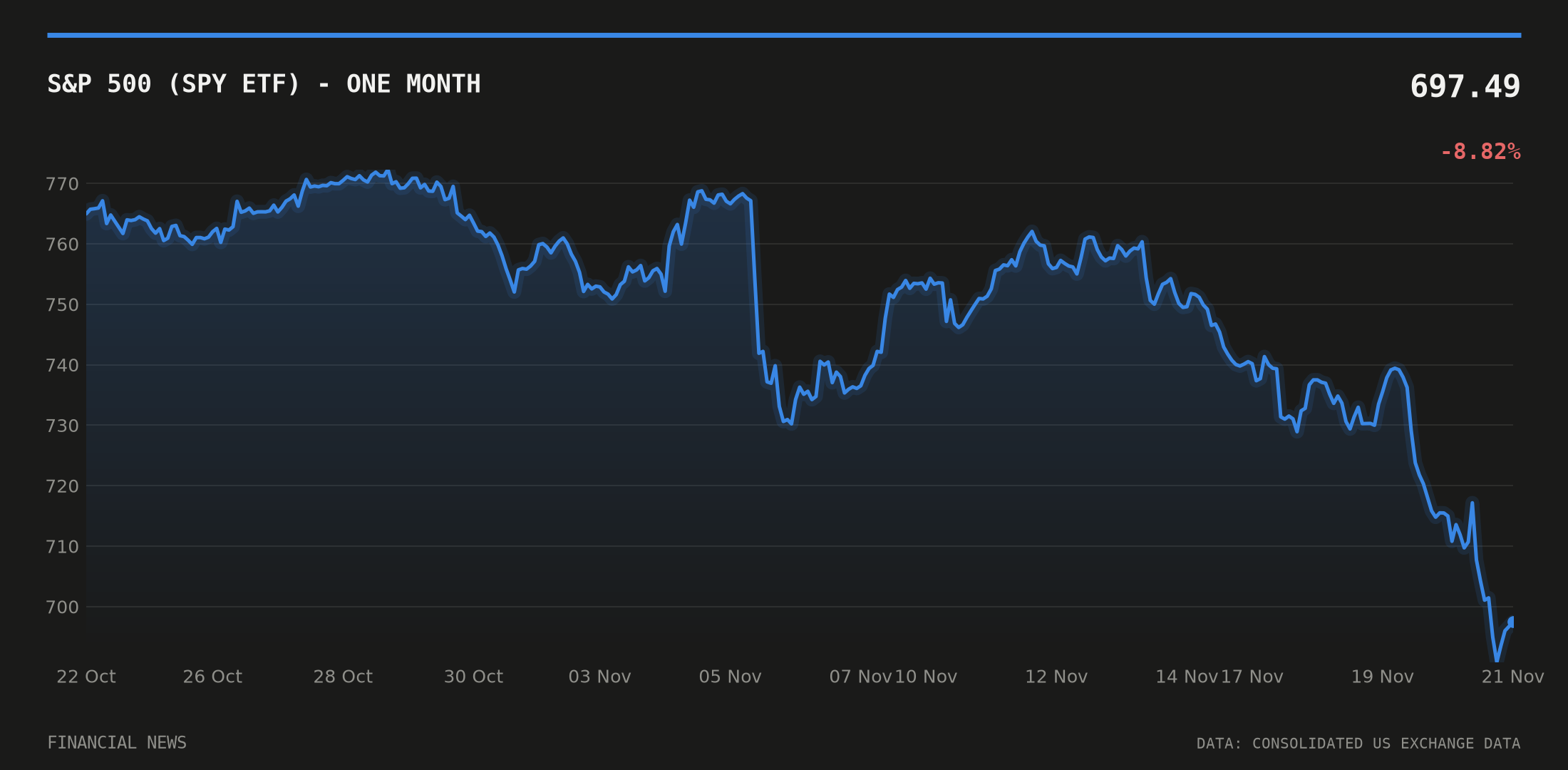
There was little room to hide. Growth and value, tech and industrials, all moved the same direction. The Nasdaq 100’s underperformance against the Dow points to concentrated selling in the high-multiple names that have driven much of this year’s rally, though the Dow’s near-identical 7.17% fall shows the damage was not confined to any single corner of the market.
Context from this site’s own coverage captures the shift in mood: just a week earlier, Financial News reported Wall Street climbing as chip stocks split. That divergence has now given way to a sell-off that touched nearly every sector.
Winners: defensives and a loss-making jump
Five stocks bucked the week’s trend. Tyson Foods (NYSE: TSN) led all gainers, up 12.29% to 65.13, extending a rally this site flagged when it examined the gap between a reported quarterly loss and a 7.2% share jump. Okta (NASDAQ: OKTA) added 10.21% to close at 197.50.
Pdd Holdings (NASDAQ: PDD) rose 6.31% to 83.69, while two household-name food producers rounded out the top gainers: Hormel Foods (NYSE: HRL) gained 5.93% to 23.45 and Generac Holdings (NYSE: GNRC) added 5.50% to 197.49. The pattern is familiar from past risk-off weeks: food and packaged-goods names, along with a handful of software stocks, held up while higher-beta names were sold.
Losers: AI infrastructure and crypto-proxy names hit hardest
The week’s biggest casualties were concentrated in artificial intelligence infrastructure and digital-asset-linked stocks. Nebius Group (NBIS) fell 23.18% to 84.43, the steepest drop of the week. Strategy Inc (MSTR), the bitcoin-holding company formerly known as MicroStrategy, dropped 22.74% to 79.40 as digital-asset sentiment soured alongside broader risk appetite.
Sandisk (SNDK) fell 22.29% to 81.08, and Intuit (NASDAQ: INTU) dropped 21.04% to 273.19, a decline that compounds a difficult stretch for the software group after it sold Mailchimp for $3.68bn and saw shares slide 9.75% in a separate move. Bloom Energy (NYSE: BE) rounded out the bottom five, down 20.31% to 144.70, as the pullback in AI-adjacent power and infrastructure names continued. The losers list reads like a roll call of the trades that had worked best this year, now unwinding together.
The macro shift: yields ease, oil steady
Government bond markets offered a modest counterpoint to the equity rout. The 10-year US Treasury yield slipped to 5.04% on 19 November, from 5.07%, according to FRED data from the Federal Reserve Bank of St. Louis. The 2-year yield eased to 4.76% from 4.80% over the same period, per the same source’s two-year series.
The 10-year/2-year spread widened marginally to 0.29 from 0.28, FRED figures show, suggesting bond investors were not pricing an imminent recession even as equities fell sharply. West Texas Intermediate crude held broadly steady, edging up to $89.53 a barrel from $89.24, according to Federal Reserve Bank of St. Louis data, offering no signal that the equity sell-off was driven by an energy shock.
The number of the week
It was a quiet week for disclosed insider transactions of the scale this column typically tracks, with no large filings standing out against the broader market move. That made the sell-off itself the story: a 7.22% weekly drop in the S&P 500, alongside an 8.32% fall in the Nasdaq 100, marks one of the sharpest two-index declines of the year. With Nebius, Strategy and Sandisk each down more than 22% in five trading days, the question for the week ahead is whether the unwind in AI-linked and crypto-proxy names has run its course, or whether Treasury markets – still pricing in a relatively calm 0.29 yield-curve spread – are reading the moment differently than equity investors are.
This article is for information only and is not investment advice or a recommendation to buy or sell any asset. Markets move quickly; figures are correct as sourced at the time of writing. Always do your own research before making financial decisions.