
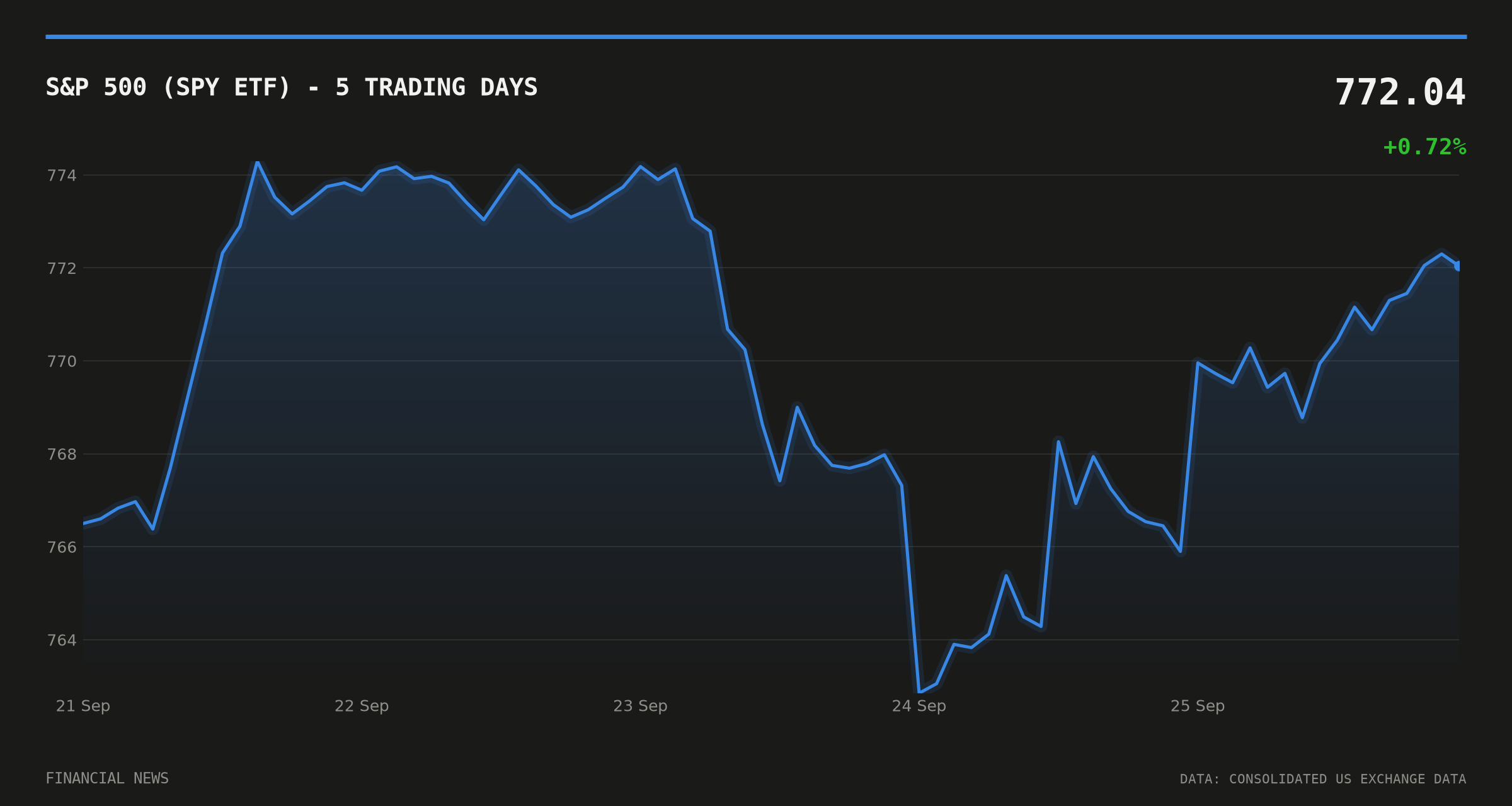

Wall Street split down the middle again this week, and the divide ran straight through the technology sector. The split market that defined recent weeks held firm into 26 September 2026, with chipmakers and AI infrastructure names doing the heavy lifting while cybersecurity and payroll software stocks took the week’s sharpest losses.
The S&P 500, tracked here via the SPY ETF, added 0.72% to close the week at 772.04. The Nasdaq 100 (QQQ) did the real work, climbing 2.36% to 745.40, while the Dow (DIA) slipped 0.38% to 517.72. This weekly market recap finds the gap between the Nasdaq and the Dow widening to its clearest point since the summer.
The scoreboard
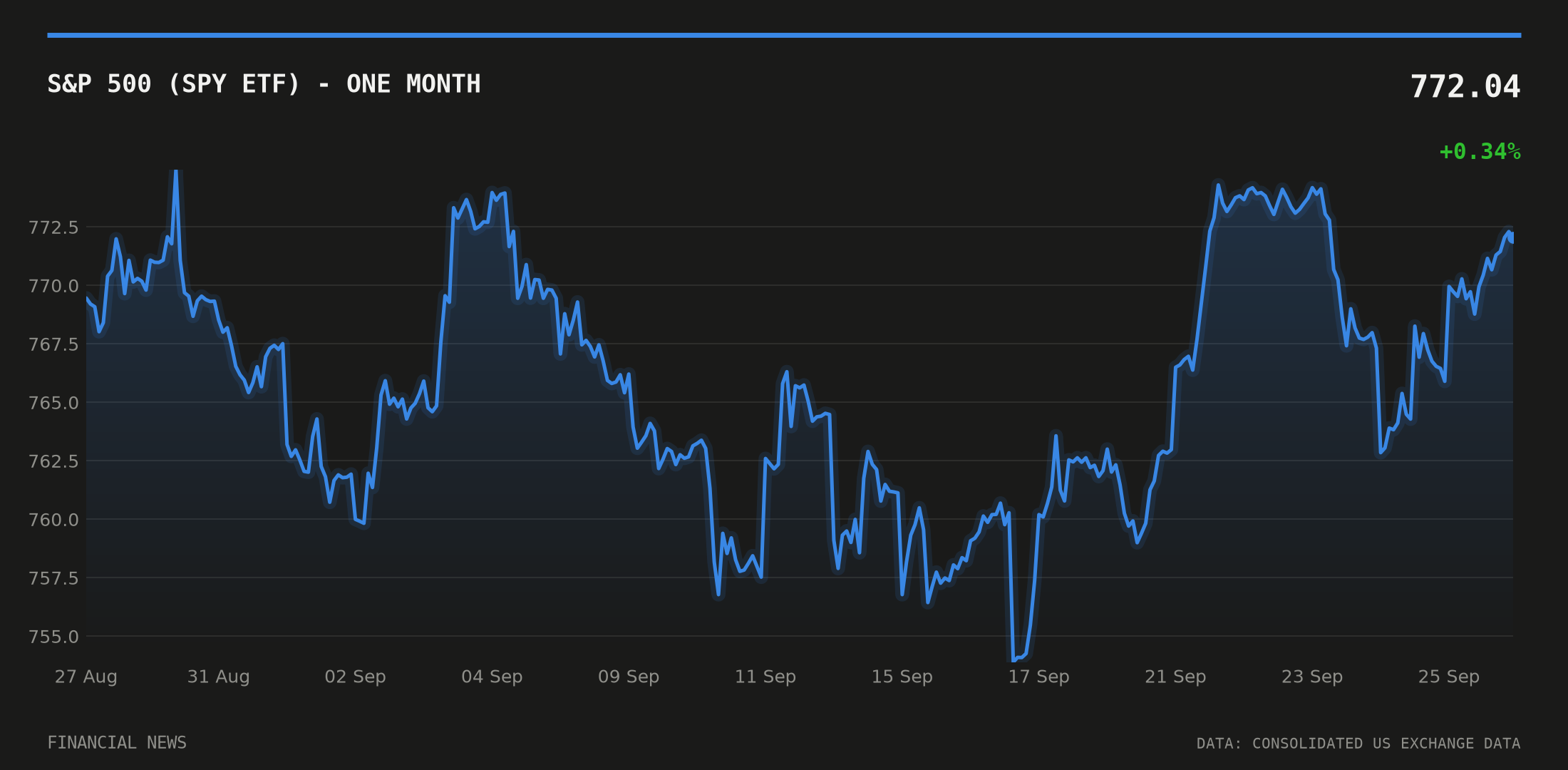
Three benchmarks, three different weeks. The S&P 500’s modest 0.72% gain masks the underlying churn: semiconductor and cloud-infrastructure names rallied hard, while a cluster of large-cap laggards dragged on the blue-chip Dow. The Nasdaq 100’s 2.36% advance was the standout print of the week, powered by the same AI-adjacent names that have carried the index for much of the year. The Dow’s 0.38% dip was modest in isolation but notable set against a Nasdaq that gained more than six times as much in percentage terms over the same five sessions.
Winners: chips, cloud and a vaccine surprise
Moderna (MRNA) led every name on the tape this week, up 25.59% to 198.15. Astera Labs (ALAB) climbed 16.93% to 366.00, and Datadog (DDOG) rose 16.45% to 268.40, both riding the same AI-infrastructure demand that has lifted chip and cloud-monitoring names through much of the year. Cadence Design Systems (CDNS) added 14.96% to close at 326.50, benefiting from the same semiconductor design-tool tailwind that has supported the group. Everpure (P) rounded out the top five, up 20.03% to 126.60.
The through-line among four of the five gainers is unmistakable: chip design, chip interconnects and the software that monitors AI workloads all found buyers this week, extending a theme this outlet has tracked in AI-adjacent listings and infrastructure dealmaking in recent weeks.
Losers: software and services take the hit
Gen Digital (GEN) was the week’s heaviest faller, down 25.89% to 21.68. MGM Resorts (MGM) dropped 13.94% to 32.70, a move that follows this outlet’s report on Barry Diller’s withdrawn takeover approach for the casino operator. Paychex (PAYX) fell 13.36% to 100.51, Charter Communications (CHTR) lost 12.31% to 113.38, and Ameriprise Financial (AMP) declined 10.91% to 490.00.
Unlike the gainers, the losers’ column has no single unifying trade. A cybersecurity name, a casino operator, a payroll processor, a cable operator and an asset manager rarely move together – their shared week of double-digit declines says more about stock-specific pressure than sector rotation.
The macro shift
Treasury yields moved higher across the curve this week. The 10-year yield rose to 5.18% as of 24 September, from 5.11% previously, according to FRED, Federal Reserve Bank of St. Louis. The 2-year yield edged up to 4.87% from 4.85% over the same window, per Federal Reserve data.
The 10-year/2-year spread widened to 0.36 percentage points from 0.31 the week before, FRED data show, a steepening that tends to accompany rising long-end yields more than any shift in near-term rate expectations. WTI crude, meanwhile, drifted the other way, easing to $96.41 a barrel from $96.97, per Federal Reserve Bank of St. Louis data. Higher long-term borrowing costs alongside softer crude is an unusual combination, and it sat awkwardly against a Nasdaq that shrugged off the move entirely.
Elsewhere on the tape
Corporate news flow ran alongside the index moves this week. Rocket Lab shares fell after the company confirmed a $1.94bn equity raise tied to its Iridium deal, while Shopify jumped after Meta’s Muse AI agent added Shop Pay checkout functionality. Nscale’s IPO filing disclosed a $1.02bn loss alongside a 1,252% revenue surge, one of the more striking prospectus figures of the month. AutoZone reported fourth-quarter earnings per share of $56.05 on $20.3bn in annual sales, and Delta held its quarterly dividend steady at $0.215 a share.
Costco’s headline earnings beat concealed a one-off tariff-related boost, as this outlet reported this week, while Google’s parent faced fresh regulatory scrutiny after Ireland’s data regulator issued a €403m fine over location data. None of these moved the broad index figures directly, but they shaped the stock-specific stories sitting underneath this week’s Nasdaq-Dow divergence.
The number of the week
Set the Nasdaq 100’s 2.36% weekly gain against the Dow’s 0.38% loss, and the resulting gap – nearly 2.75 percentage points between the two benchmarks over five trading sessions – is the cleanest single figure to describe this week’s market. Add a 10-year Treasury yield that climbed to 5.18% even as crude slipped to $96.41 a barrel, and the picture is one of a market pricing higher-for-longer borrowing costs while still finding room to bid up chip and AI-infrastructure names without hesitation.
This article is for information only and is not investment advice or a recommendation to buy or sell any asset. Markets move quickly; figures are correct as sourced at the time of writing. Always do your own research before making financial decisions.
