

CrowdStrike (NASDAQ: CRWD) unveiled the CrowdStrike SafeMind models on 1 September 2026, a new family of AI systems for cyber defence built with Nvidia (NASDAQ: NVDA). The launch came at the company’s Fal.Con conference in Las Vegas.
CrowdStrike said its own testing found SafeMind delivered a 29% higher detection rate, six times faster remediation and 99% lower cost than rival frontier and open-source models, according to SiliconANGLE’s account of the keynote.
What the CrowdStrike SafeMind models do
SafeMind is described by CrowdStrike as a family of purpose-built security models and harnesses developed by its Cyber Superintelligence Lab, according to the company’s investor relations release. The system will run natively inside the Falcon platform.
Nvidia said the defensive model underpinning SafeMind was built on its Nemotron open models, then post-trained using CrowdStrike’s own threat data, according to a blog post from Nvidia. Nvidia chief executive Jensen Huang appeared alongside CrowdStrike founder and chief executive George Kurtz to announce the system at the keynote, underscoring the joint-development framing of the launch.
Independent trade coverage of the keynote described the mechanics in more detail: SafeMind pits an offensive, or “red”, model against a defensive “blue” model in a closed loop, tested against a digital twin of a customer’s environment, per SiliconANGLE.
QuiltWorks folds in a third Nvidia tie-up
Trusted access to standalone SafeMind models and harnesses will be delivered through CrowdStrike’s Project QuiltWorks programme, the company said in its release. QuiltWorks itself is not new: CrowdStrike first launched it as an industry-wide coalition on 23 April 2026, months before the SafeMind announcement, according to a separate CrowdStrike press release.
The SafeMind launch also marks the third distinct Nvidia partnership announcement CrowdStrike has made in under a year. The two companies said in October 2025 they were building “always-on” AI agents on CrowdStrike’s Charlotte AI AgentWorks platform, integrated with Nvidia’s Nemotron and NIM microservices, according to CrowdStrike’s investor relations archive.
Kurtz files two Form 4s on launch day
Kurtz filed two Form 4 disclosures with the US Securities and Exchange Commission on 1 September 2026, the same date as the SafeMind announcement, according to SEC EDGAR records. The filings do not disclose disposed or acquired share values in the pack reviewed.
The announcement lands against a backdrop of improving, if modest, profitability at CrowdStrike. The company reported net income of $5.306m, or $0.01 diluted earnings per share, for its fiscal second quarter ended 31 July 2026, according to its 10-Q filing. That followed net income of $27.774m, or $0.11 diluted EPS, in the prior quarter to 30 April 2026, per the company’s earlier 10-Q. Both mark a swing back to profit after a run of losses through fiscal 2026, when CrowdStrike posted net losses of $110.207m, $77.675m and $33.997m across three consecutive quarters, filings show.
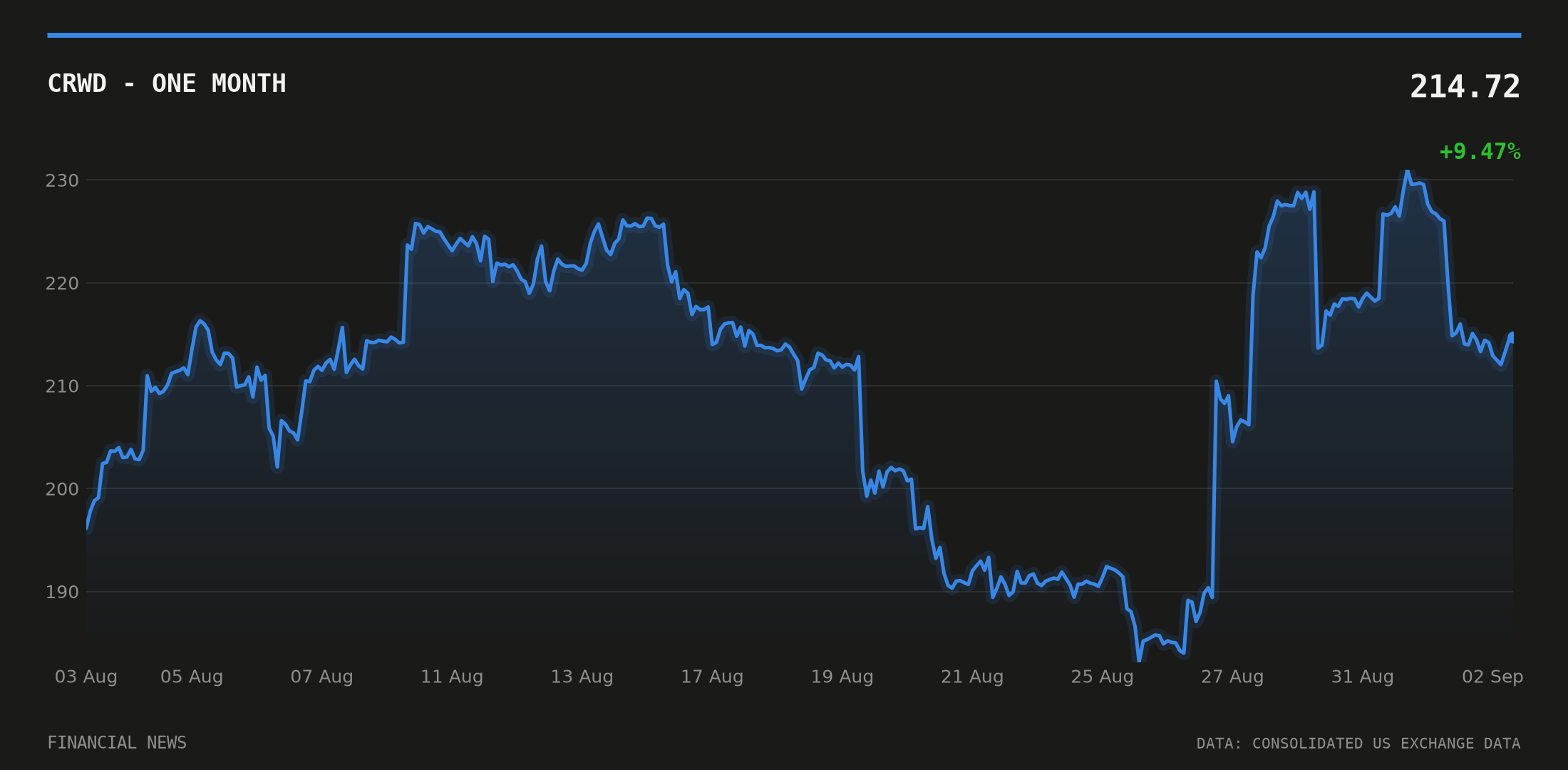
CrowdStrike shares closed at $214.19 as of 2 September 2026, up 0.41% on the session but down 3.66% over the preceding 20 trading days, according to consolidated exchange data. The stock has traded in a range between $183.12 and $231.02 over that stretch. Trading volume was broadly in line with its 20-day average.
Short-sale activity in CRWD ticked higher into the launch. FINRA’s daily short-sale volume ratio for the stock rose from 0.358 on 19 August 2026 to 0.587 on 1 September, the day of the SafeMind announcement, according to FINRA data.
The wider rates backdrop was steady around the announcement. The 10-year US Treasury yield stood at 4.75% on 31 August 2026, little changed from 4.73% the previous session, according to FRED data from the Federal Reserve Bank of St. Louis. The 2-year yield held flat at 4.34%, keeping the 10-year/2-year spread near 0.40 percentage points.
What to watch
CrowdStrike has not disclosed pricing or a general availability date for standalone SafeMind access beyond its inclusion in Project QuiltWorks. The Wall Street Journal reported separately on the collaboration on 2 September, noting the pairing of Nvidia’s model infrastructure with CrowdStrike’s security data as a template other software vendors are likely to watch, according to the Wall Street Journal. Investors will get a fuller picture of how the AI push is affecting the bottom line when CrowdStrike next reports quarterly results.
This article is for information only and is not investment advice or a recommendation to buy or sell any asset. Markets move quickly; figures are correct as sourced at the time of writing. Always do your own research before making financial decisions.
