
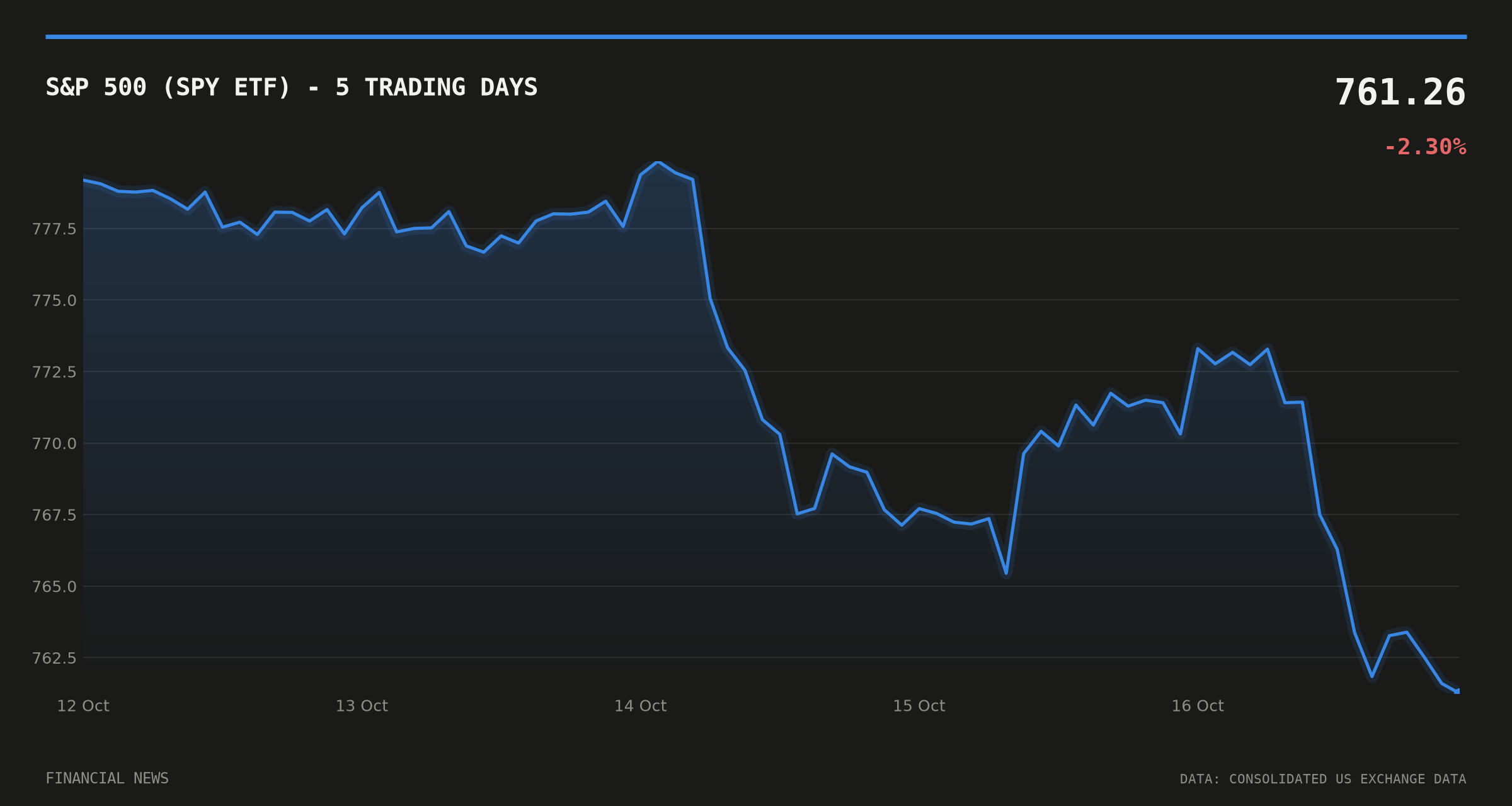

Wall Street’s weekly close for the five days to 17 October 2026 told two different stories depending on where investors looked. The S&P 500, tracked by the SPY ETF, fell 2.3% over the week to close at 761.26. The Nasdaq 100, tracked by QQQ, dropped far harder – down 5.64% to 707.87 – while the Dow, via the DIA ETF, actually rose 0.35% to 518.00.
That gap between the Dow and the Nasdaq 100 is the number that matters this week: roughly six percentage points separating the index stuffed with industrials and staples from the one dominated by technology and chip names. It is the starkest divergence of the autumn so far, and it was driven almost entirely by a rout in optical networking and AI infrastructure stocks.
The scoreboard: a tale of three indices
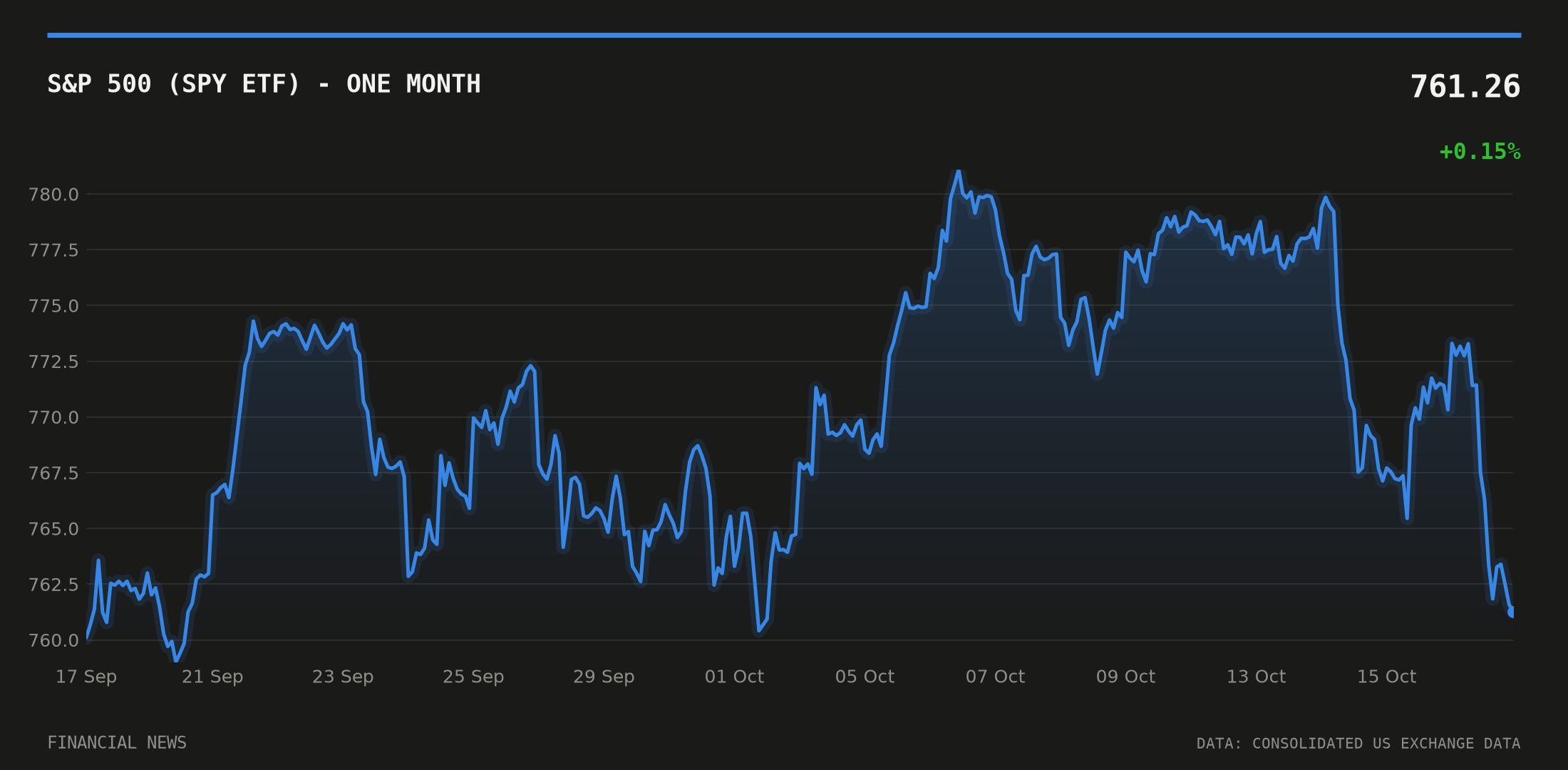
The broad market’s 2.3% weekly decline understates how uneven the week was beneath the surface. Large-cap industrials, staples and financials that dominate the Dow were broadly resilient, enough to push that index into positive territory even as the wider market slid. The Nasdaq 100’s 5.64% drop was the week’s dominant feature, dragged down by a cluster of AI-adjacent and networking names that lost a quarter of their value in five trading days. Financial News covered the early stages of that split in last week’s Weekly Close, when defensives first began outperforming chip stocks – a pattern that deepened rather than reversed this week.
Winners: credit data and comfort food
None of this week’s biggest gainers came from technology. Fair Isaac Corp (NYSE: FICO) led the market, up 14.21% to 766.10. CoStar Group (NASDAQ: CSGP) rose 10.99% to 32.31, and Equifax (NYSE: EFX) climbed 10.62% to 161.25 – a trio of credit-data and analytics names moving together. Darden Restaurants (NYSE: DRI) added 10.02% to 216.35, and Cognizant Technology Solutions (NASDAQ: CTSH) rose 9.87% to 65.88. The common thread is distance from the AI capital-spending story that dominated headlines earlier in the year, including Financial News’s reporting on warnings from Broadcom and Intel’s chiefs over an AI capital crunch.
Losers: the optical and AI infrastructure rout
The week’s bottom five all came from the networking, optical and AI-infrastructure complex, and all fell by roughly a quarter. Lumentum Holdings (NASDAQ: LITE) dropped 25.59% to 821.40. Ciena Corp (NYSE: CIEN) fell 25.51% to 330.00. CoreWeave (NASDAQ: CRWV) lost 25.37% to 61.03, continuing a difficult stretch for the cloud-computing firm that Financial News reported on in connection with the Nvidia chip-smuggling case involving a Super Micro contractor. Hewlett Packard Enterprise (NYSE: HPE) fell 25.28% to 54.41, and Rocket Lab Corp (NASDAQ: RKLB) dropped 25.03% to 50.85. The uniformity of the decline – five stocks all falling within half a percentage point of each other – points to a sector-wide repricing rather than company-specific news, coming in the same week Financial News covered Marvell’s new CXL chip launch alongside a 3.47% share slide.
The insider ledger
No large disclosed insider sales stood out across this week’s filings among the names that moved the index. That is itself notable given the scale of the selloff in networking and AI-infrastructure stocks – executives at the week’s biggest losers were not filing disclosed share sales into the decline, based on the week’s public record.
The macro shift: yields ease, oil creeps higher
Treasury yields moved modestly lower over the week. The 10-year yield eased to 5.1% on 15 October, down from 5.19% the prior reading, according to data from the Federal Reserve Bank of St. Louis. The 2-year yield fell to 4.77% from 4.82%, per the same source. The 10-year/2-year spread widened slightly to 0.35 from 0.33, according to FRED figures dated 16 October – a mild steepening that sits oddly alongside the week’s equity turbulence. WTI crude, meanwhile, ticked up to $101.91 a barrel from $100.86, based on Federal Reserve Bank of St. Louis data for 14 October.
Lower long-end yields would typically support growth and technology valuations, yet the Nasdaq 100 posted its worst week since the spring. That disconnect underlines how concentrated this week’s damage was: a handful of optical and AI-infrastructure names driving the index lower even as the broader rate backdrop turned marginally friendlier for risk assets.
The number of the week
Six percentage points. That is roughly the gap between the Dow’s 0.35% weekly gain and the Nasdaq 100’s 5.64% weekly loss – the widest split between the two indices this autumn, and the clearest signal yet that this week’s Wall Street weekly close was a story about sector rotation, not a broad-based market retreat. Whether that gap narrows or widens will depend on how the optical and AI-infrastructure names that dragged the Nasdaq lower trade into month-end, alongside any shift in the Treasury market that has, so far, moved independently of the equity turmoil.
This article is for information only and is not investment advice or a recommendation to buy or sell any asset. Markets move quickly; figures are correct as sourced at the time of writing. Always do your own research before making financial decisions.
