

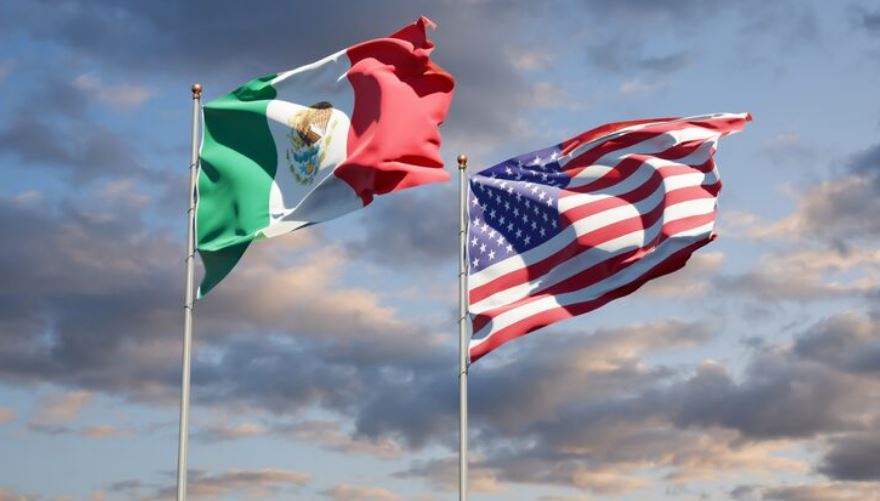
American and Mexican flags fly side by side over the Lerdo-Stanton International Bridge in Ciudad Juárez early on a July morning, where daily cross-border trade moves in both directions without most people noticing. trucks that transport electronics, agricultural products, and auto parts. The machinery of a decades-long relationship that is currently functioning under conditions that are, at the very least, subject to formal renegotiation.
The United States declared on July 1, 2026, that it would not extend the current U.S.-Mexico-Canada Agreement. Technically, USMCA, which replaced NAFTA and went into effect in 2020, is still in effect, though it is reviewed every year. However, the Trump administration opened the door to new demands from Mexico and Canada by using the renewal process as leverage. Canada retaliated. The negotiations broke down. Dairy products, motorcycles, and alcohol are currently subject to trade tariffs between Ottawa and Washington. After observing all of that, Mexico came to a different conclusion.
Due in part to scheduling issues surrounding Chinese President Xi Jinping’s anticipated visit to Washington that same week, the fourth round of official bilateral talks between the United States and Mexico has been rescheduled for September 28–29 in Washington. On paper, the delay is insignificant, but it makes the timeline more precise. November 3 is the date of the U.S. midterm elections. Speaking under the condition of anonymity, officials from both nations have confirmed what the public statements are cautious not to explicitly state: both sides want a deal before then.
According to one source, Mexico’s stance has been to “play nice and continue to cooperate.” That isn’t a sign of weakness. It’s a tactic. Since the United States accounts for more than 80% of Mexico’s exports, conflict has an economic cost that Canada, with a bigger domestic market and a different political calculus, might be better able to bear. Mexico will cooperate, but President Claudia Sheinbaum has made it clear that the country will not sign any agreements that jeopardize its sovereignty. That line is important as a negotiating boundary as well as domestically. As discussions become more detailed, that line might be put to the test.
The content of the negotiations is complex. Section 232 national security provisions currently impose a 50% tariff on steel and aluminum exports from Mexico. Automobiles are 25%. In the meantime, the United States has already negotiated lower auto tariffs of between 10 and 15 percent with South Korea, Japan, the EU, and the UK. Mexican automakers are keeping a careful eye on that disparity.
According to a number of industry insiders, Washington may present Mexico with a framework akin to the one that was almost reached with Canada: a 15% vehicle tariff that would be further lowered based on U.S. content, potentially lowering the effective rate to about 7%. Mexico would be expected to raise the requirements for American content in automobiles, especially in the areas of software, electronics, and engines.
Then there is the China issue, which permeates almost every topic being discussed. In an attempt to restrict the amount of Chinese-made content that enters the American market through Mexican supply chains, the United States is advocating for stringent rules of origin pertaining to medical devices, appliances, and AI equipment. In response to American pressure on Chinese investment in Mexico, Sheinbaum’s government recently proposed legislation to establish an investment-screening system akin to those in the United States and Canada. It remains to be seen if Washington will be satisfied with that step.
The political stakes on both sides are difficult to ignore. A deal with Mexico prior to the midterm elections would be a concrete victory for the Trump administration and a means of portraying Canada’s collapse as Ottawa’s issue rather than Washington’s. According to Sheinbaum, a trade agreement is becoming more and more dependent on economic credibility. Mexico’s credit ratings have been under pressure, and her government sees a stable trade relationship with the United States as an indication to investors and markets that the nation is stable. Neither party wants to leave empty-handed. Although it doesn’t ensure a deal, this shared interest gives negotiators something tangible to work with.
