

Nike (NYSE: NKE) will drop out of the S&P 100 before the market opens on Monday, 21 September 2026, the same day Sandisk (NASDAQ: SNDK) joins the index. S&P Dow Jones Indices announced the changes on 4 September, alongside additions of Dell Technologies, Palo Alto Networks and Arista Networks, according to TipRanks/The Fly.
Colgate-Palmolive, Simon Property Group and Honeywell Aerospace also leave the S&P 100 that day, as reported by The Motley Fool. Nike keeps its place in the broader S&P 500, according to FinanceFeeds.
An 18-year run ends
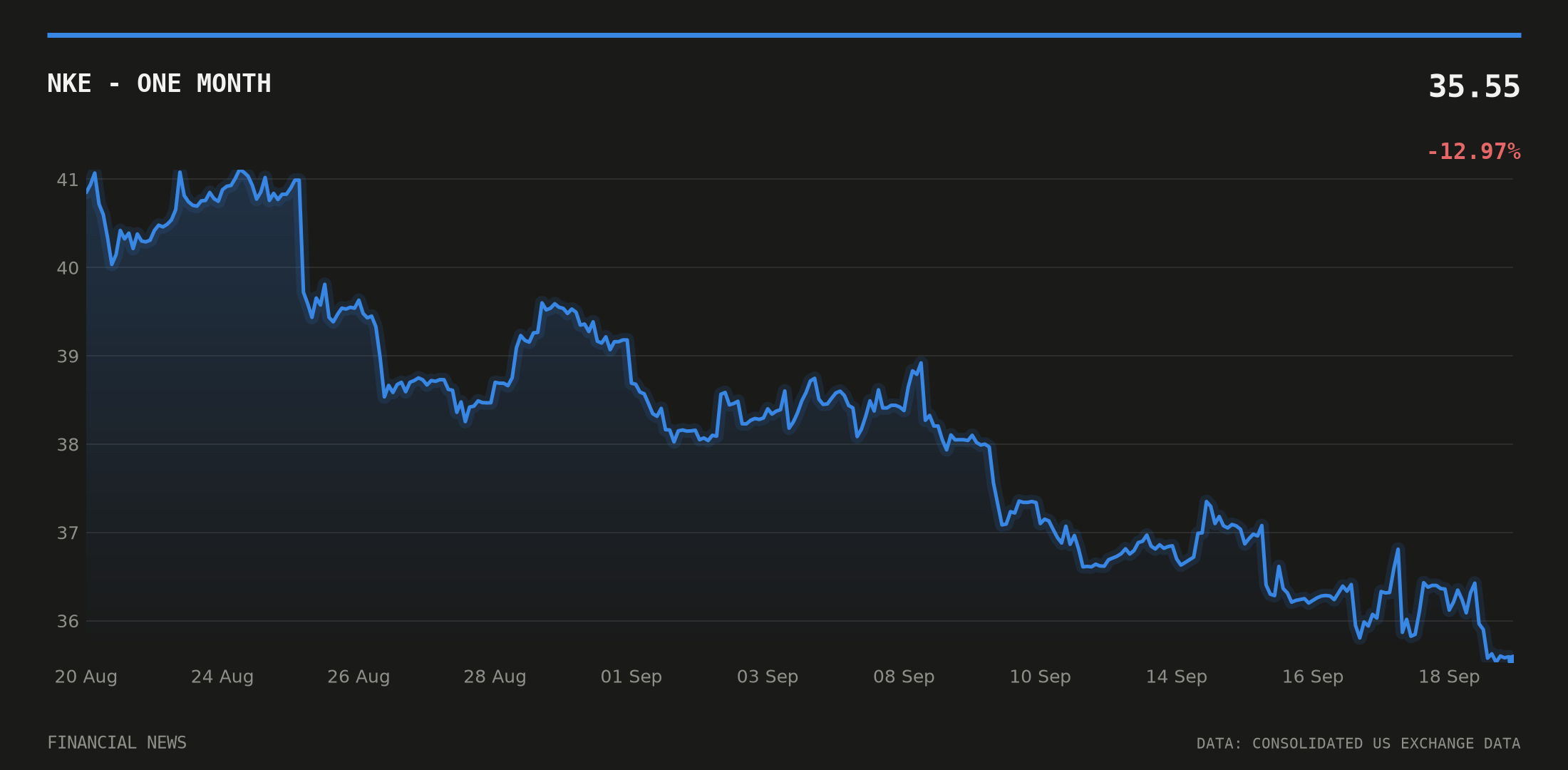
Nike had held its S&P 100 seat for 18 years before the removal, Yahoo Finance reported. The stock trades close to 80% below its November 2021 peak, a decline that has erased roughly $200bn in market value, according to TheStreet.
All four incoming names are information-technology companies, TheStreet noted, underscoring a broader tilt in index composition toward AI-linked businesses at the expense of consumer brands like Nike.
Shares under pressure, shorts building
Nike shares closed at $35.5501 on 18 September, down 0.97% on the day and 10.08% over the trailing 20 sessions, with volume running 2.57 times the 20-day average, according to consolidated US exchange data. The stock’s 20-day range has run between $35.53 and $39.5371.
FINRA’s daily short-sale ratio for Nike climbed from 0.319 on 4 September – the day the rebalance was announced – to 0.635 by 18 September, just before the removal took effect, per FINRA data. The ratio rose steadily through the fortnight: 0.489 on 8 September, 0.561 the next day, then a dip to 0.42 on 10 September before climbing again to 0.55, 0.578, 0.513, 0.526 and 0.598 through the following week. The near-doubling over two weeks coincided with a known, dated catalyst – forced selling from index-tracking funds that must rebalance to match the S&P 100’s new roster.
Earnings trend adds to the pressure
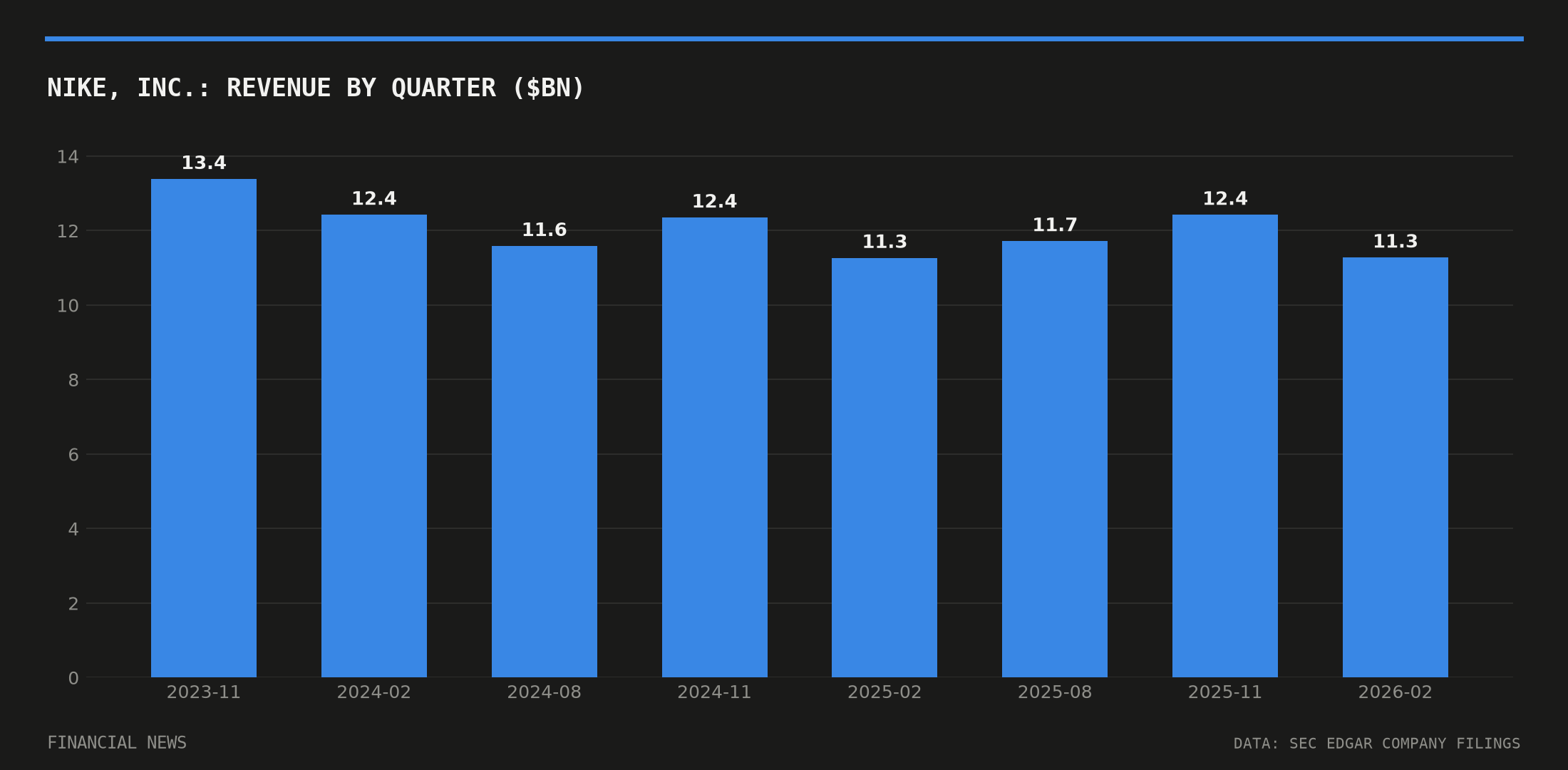
Nike’s quarterly results have weakened steadily over the period covered by its recent 10-Q filings. Net income fell from $1,578m in fiscal 2024’s second quarter to $520m in fiscal 2026’s third quarter, according to filings lodged with the SEC. Diluted earnings per share tracked the same path, dropping from $1.03 to $0.35 across the same six reporting periods.
Revenue softened alongside profit. Nike booked $13,388m in the 2024 fiscal second quarter; by the third quarter of fiscal 2026 that figure had slipped to $11,279m. The path was not a straight line – revenue recovered to $12,354m and then $12,427m in the intervening second-quarter periods of fiscal 2025 and 2026 respectively – but each of those rebounds gave way to a lower third-quarter print, with net income falling to $794m and then $520m in the corresponding periods. The pattern points to a business still generating multi-billion-dollar quarterly sales but doing so at thinner margins than two years ago.
Board addition ahead of the exit
Nike expanded its board to 12 members on 15 September, adding Alexandre Arnault of LVMH days before the S&P 100 removal took effect, according to a company announcement carried by TipRanks. A Form 4 filed with the SEC on 17 September recorded Arnault’s related share grant; the filing reflects the board appointment rather than any transaction tied to the index change.
The governance move and the index reshuffle are unconnected in timing origin but land in the same week, giving Nike two separate storylines – one about who sits on its board, another about who holds its shares passively – as the stock heads into a rebalance that index funds must execute mechanically regardless of price.
Macro backdrop
The removal comes as US Treasury yields have eased modestly, with the 10-year yield at 4.94% on 17 September, down from a recent 5.01%, and the 2-year at 4.67%, according to FRED data from the Federal Reserve Bank of St. Louis. The 10-year/2-year spread stood at 0.25 percentage points. US unemployment held at 4.1% in August, unchanged from July, while consumer prices continued to rise, with the CPI index at 334.131 in August against 332.813 the prior month.
Monday’s open will show how much of the anticipated index-fund selling in Nike shares has already been absorbed by the rise in short positioning over the preceding fortnight.
This article is for information only and is not investment advice or a recommendation to buy or sell any asset. Markets move quickly; figures are correct as sourced at the time of writing. Always do your own research before making financial decisions.
