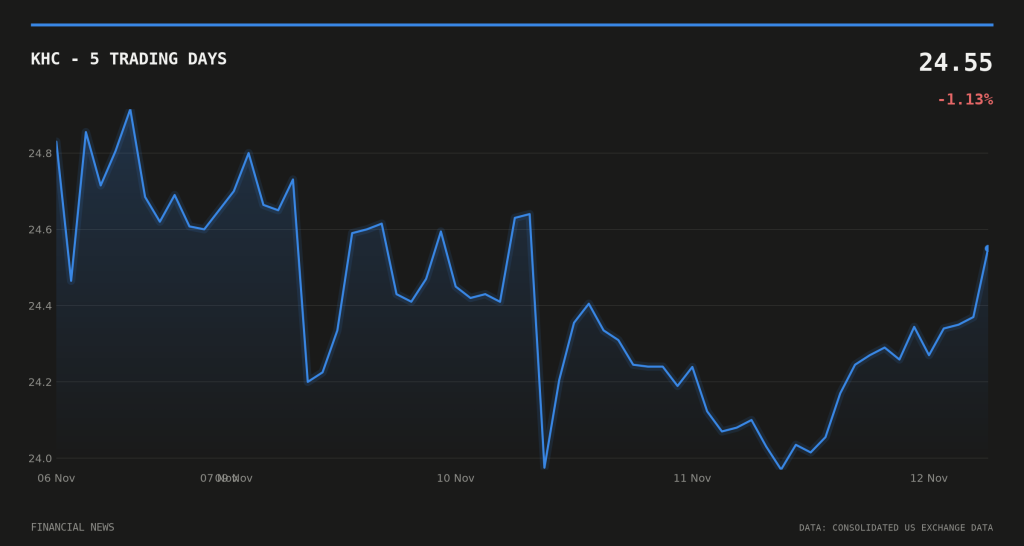
Kraft Heinz (NASDAQ: KHC) held its investor day in New York on 12 November 2026, setting out a phased turnaround that asks shareholders to wait until the second half of 2027 for growth to resume.
The company targets double-digit total shareholder return by 2029, split between earnings growth and cash returned to investors, according to an 8-K filing with the SEC.
Kraft Heinz investor day sets out a slower path first
For 2027, management expects organic net sales to be roughly flat for the full year, with top- and bottom-line growth returning only in the second half, according to Investing.com. Formal 2027 guidance will come with the fourth-quarter earnings call.
Chief executive Steve Cahillane told the gathering the company is moving to a business-unit-led operating model with heavier brand investment, positioning itself for what management called sustainable, volume-led growth, per the SEC filing.
The pitch follows a preview at the Barclays consumer conference, where management flagged 2026 as a reinvestment year and likely margin trough, and said it would hold back fuller 2027 detail for the investor day, according to Investing.com.
A turnaround built on top of outsized losses
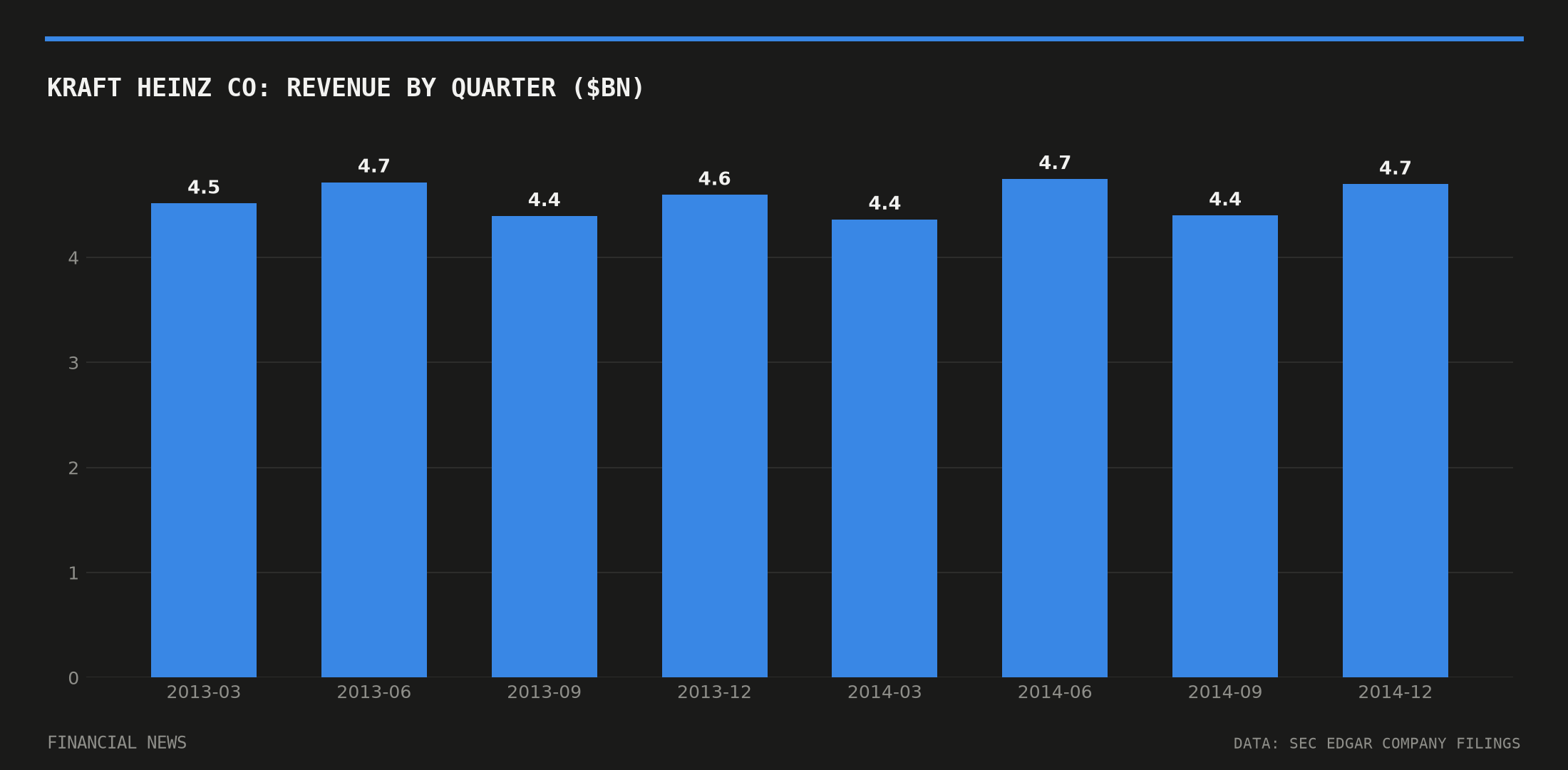
The strategic reset follows two quarters of unusually large net losses. Kraft Heinz posted a net loss of $7.82bn in the quarter ended 28 June 2025, and a further net loss of $5.46bn in the quarter ended 27 June 2026, according to 10-Q filings with the SEC.
Those losses sit against a backdrop of corporate upheaval: Kraft Heinz confirmed in September 2025 that it would split into two separately listed companies, a process spanning the period of the large swings in reported earnings, according to FoodNavigator.
More recent quarters have been calmer. Kraft Heinz reported net income of $798m in the quarter ended 28 March 2026 and $544m in the quarter ended 26 September 2026, filings show. The contrast underlines how far the impairment-driven losses of mid-2025 and mid-2026 stood outside the company’s normal run rate.
Market reaction muted so far
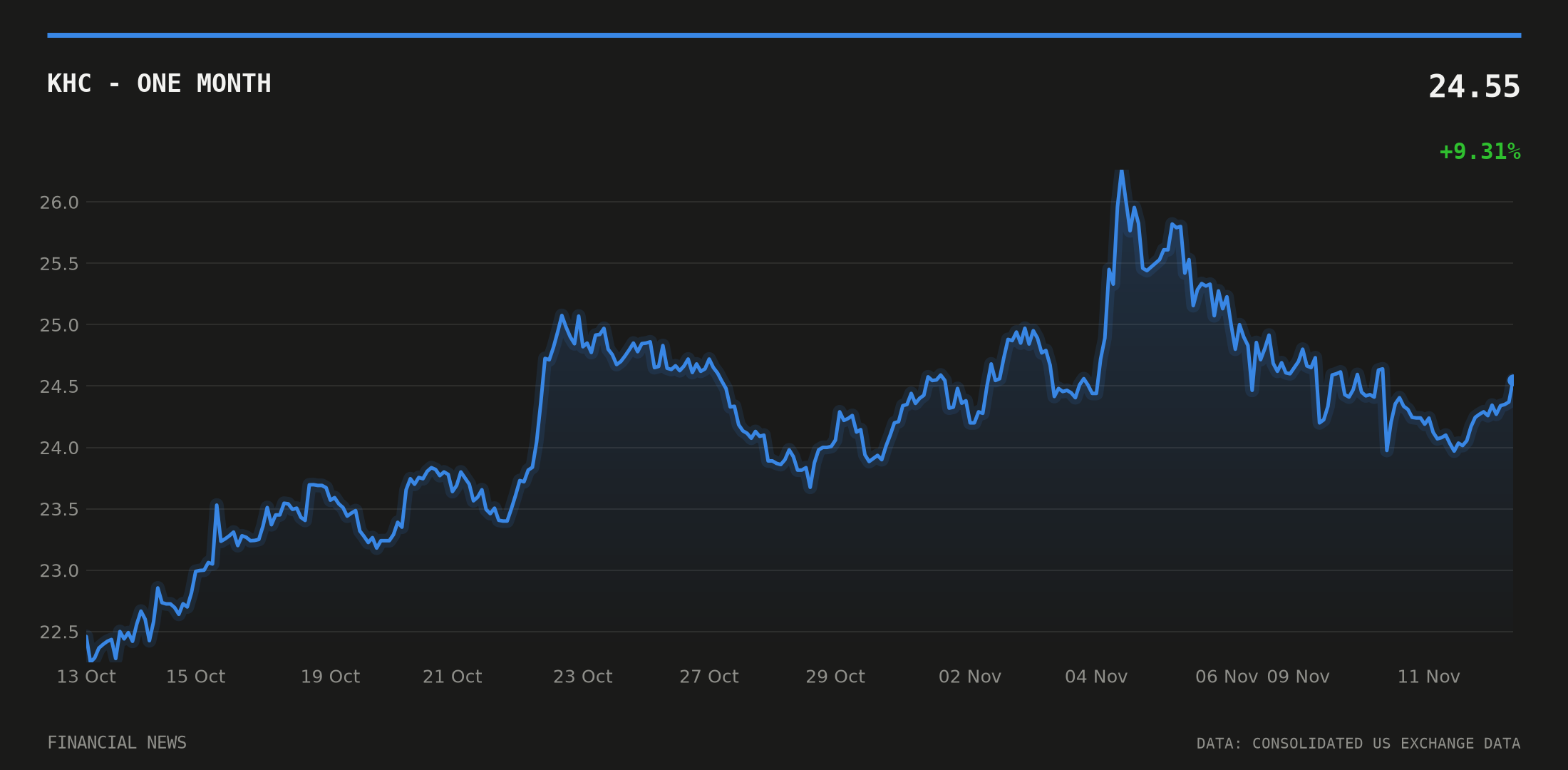
Shares closed at $24.68 as of 12 November 2026, up 1.61% on the day and 2.64% over the prior 20 trading days, according to consolidated US exchange data. The stock has ranged between $23.68 and $26.27 over the past month.
Trading volume around the event ran well below recent norms, at 39% of the 20-day average. FINRA daily short-sale data show the short ratio for KHC oscillating between roughly 0.40 and 0.59 in the fortnight around the event, with no outsized short-covering spike evident on the day itself, according to FINRA.
The event also landed against a macro backdrop of a narrow but modestly steepening Treasury curve: the 10-year yield stood at 4.88% on 9 November 2026, against 4.56% on the 2-year, leaving the 10y-2y spread at 0.25, down from 0.32 the prior reading, according to FRED data from the Federal Reserve Bank of St. Louis. US unemployment eased to 4.1% in October, from 4.2% the month before, separate Federal Reserve data show — a backdrop relevant to consumer sentiment broadly rather than to Kraft Heinz specifically.
What investors are watching next
The company’s own timetable points to the fourth-quarter earnings call as the next hard marker, when management has said it will issue formal 2027 guidance covering organic sales, operating income and the pace of the promised second-half recovery, according to Investing.com.
Until then, the gap between the long-dated 2029 shareholder-return target and the flat 2027 outlook leaves Kraft Heinz asking investors to take the destination on faith while the company continues working through the costs of splitting itself in two.
This article is for information only and is not investment advice or a recommendation to buy or sell any asset. Markets move quickly; figures are correct as sourced at the time of writing. Always do your own research before making financial decisions.