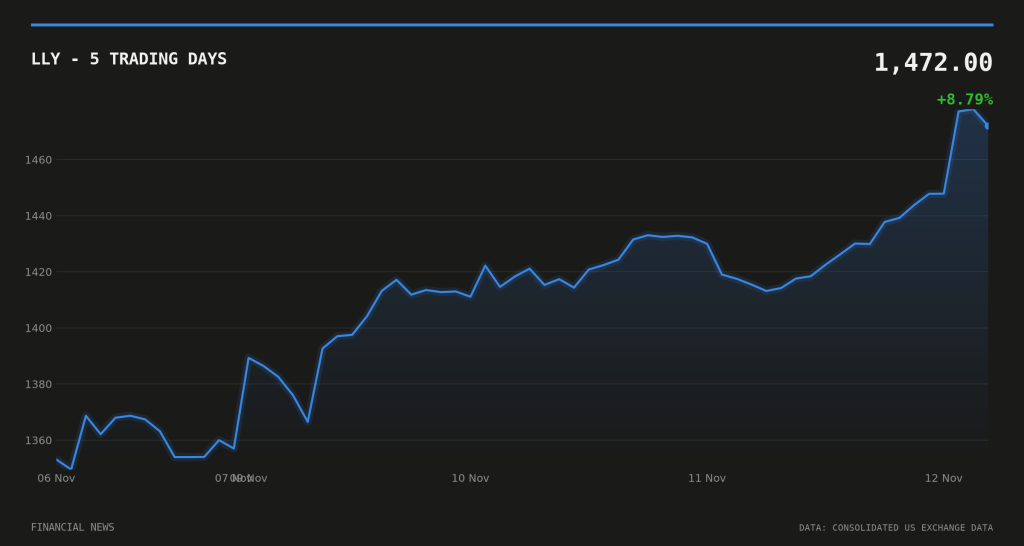
Eli Lilly (NYSE: LLY) has secured Chinese regulatory approval for orforglipron, its oral weight-loss pill, the company said on 12 November 2026. The clearance makes Lilly the first drugmaker with a GLP-1 weight-loss pill approved in China, ahead of rivals including Novo Nordisk, Pfizer and Innovent Biologics, as Reuters reported.
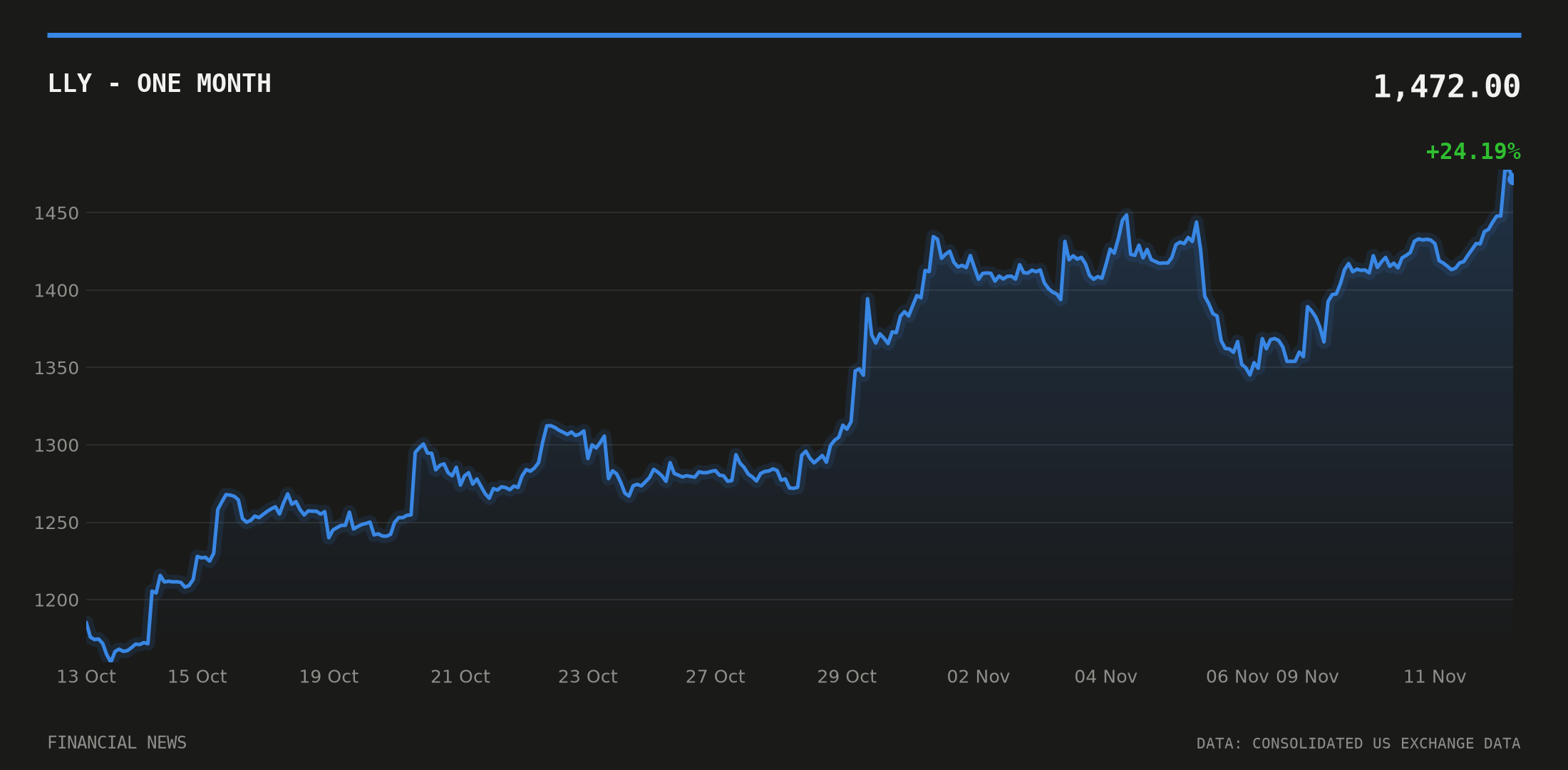
Lilly shares rose 2.38% to $1,472.00 as of 11:00 UTC, having climbed 14.24% over the prior 20 trading days, according to consolidated US exchange data.
China weight-loss pill approval beats Novo to market
The approval gives Lilly a first-mover position in China’s fast-growing obesity-drug market. Novo Nordisk, Pfizer and local player Innovent Biologics are all developing rival GLP-1 treatments, but none has yet cleared China’s regulator, according to Seeking Alpha.
Orforglipron is the first oral GLP-1 agonist to enter the Chinese market, Lilly’s Chinese subsidiary said, a distinction that matters in a country where injectable GLP-1 drugs already carry heavy demand but face distribution and compliance hurdles that a pill avoids.
Timing matches what Lilly flagged months ago
Patrik Jonsson, an executive vice president at Lilly, told Reuters in June 2026 that Chinese approval could arrive ‘as soon as 2026’, with launch timing expected anywhere from late 2026 to early 2027. November’s clearance lands close to that window. Jonsson filed a Form 4 with the SEC on 10 November, two days before the approval was announced.
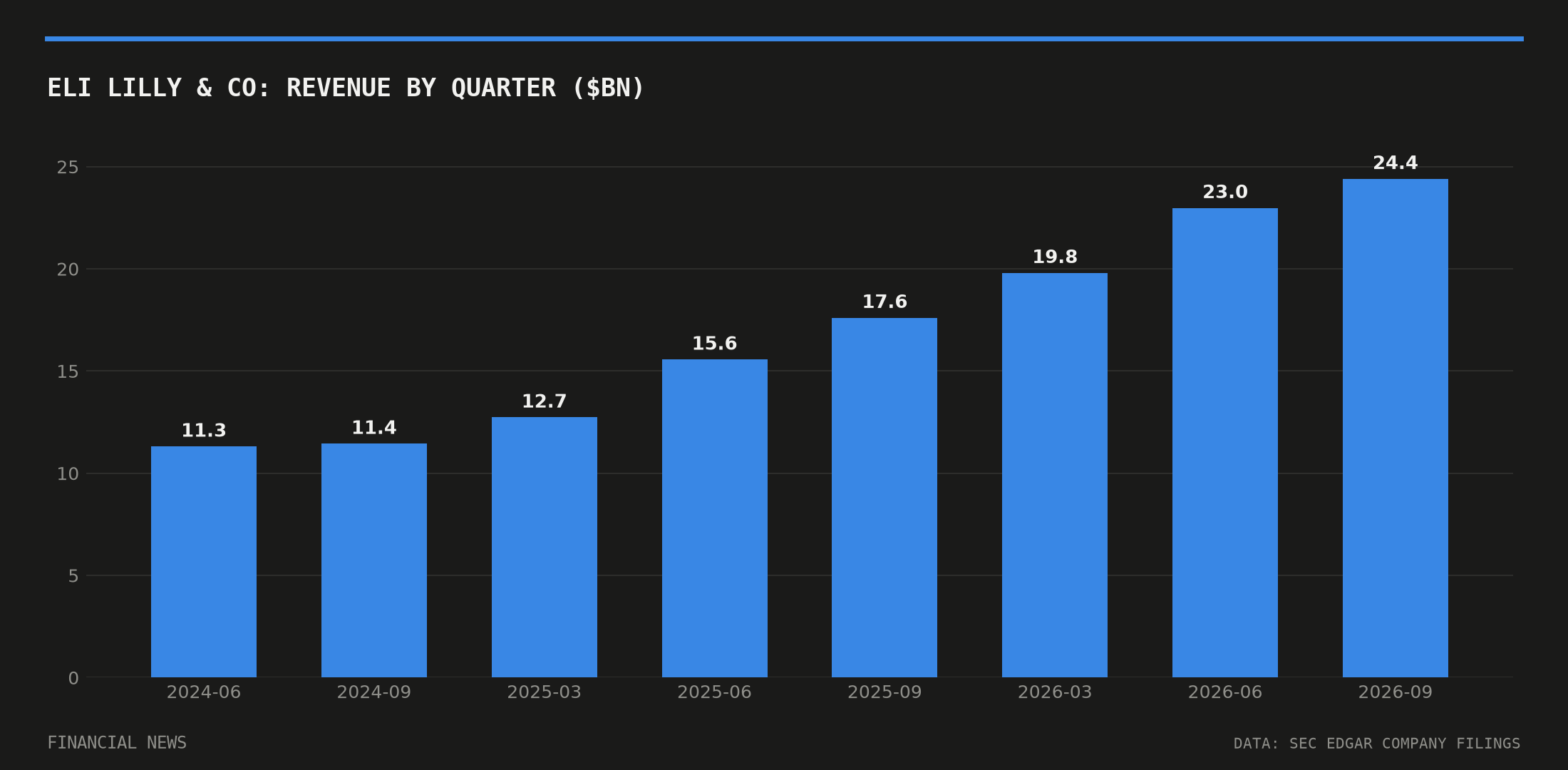
The approval arrives against a backdrop of sustained revenue growth at Lilly. Third-quarter 2026 revenue reached $24.397bn, with net income of $6.451bn, according to the company’s 10-Q filing. That followed second-quarter revenue of $22.974bn and first-quarter revenue of $19.799bn, a trajectory that has pushed quarterly sales up by more than a quarter over the course of 2026. A year earlier, in the third quarter of 2025, revenue stood at $17.601bn with net income of $5.583bn — meaning quarterly sales have risen by close to 40% year-on-year, driven largely by Mounjaro and Zepbound demand in the US and Europe.
Diluted earnings per share also climbed through the year, from $8.26 in the first quarter of 2026 to $7.94 in the second and $7.22 in the third, each well above the $3.06 and $6.29 posted in the equivalent 2025 quarters, filings show. The growth run has already lifted Lilly’s market capitalisation past $1 trillion, a milestone reached before this specific China clearance and tied more broadly to upgraded 2026 guidance on its GLP-1 portfolio, according to a report from Startup Fortune.
Positioning data shows a pickup before the news broke
FINRA short-volume data show the share of LLY trading tied to short sales rose from a ratio of 0.296 on 9 November to 0.417 on 10 November, the day before the China approval became public, before easing to 0.341 on 11 November. A short-volume ratio alone does not confirm informed trading ahead of news, but the spike sits squarely in the session before the announcement.
The approval also lands against a wider market backdrop. The 10-year US Treasury yield stood at 4.88% on 9 November, against 4.56% on the 2-year note, leaving a 10-year/2-year spread of 0.25 percentage points by 10 November — narrower than the 0.32 points recorded a session earlier, according to Federal Reserve data. US unemployment ticked down to 4.1% in October from 4.2% the prior month, while headline CPI edged up to 337.476 from 336.298, FRED figures show. None of that macro backdrop is specific to Lilly, but it frames the risk appetite into which the China news landed.
What investors are watching next
Attention now turns to how quickly Lilly can convert the Chinese approval into prescriptions and pricing agreements with the country’s national reimbursement scheme, a process that has shaped uptake speed for GLP-1 drugs in other large markets. Novo Nordisk’s competing oral candidate and Innovent’s locally developed GLP-1 pipeline remain the nearest rivals for Chinese market share, with neither yet holding an equivalent domestic approval, according to Reuters’ reporting on the decision.
This article is for information only and is not investment advice or a recommendation to buy or sell any asset. Markets move quickly; figures are correct as sourced at the time of writing. Always do your own research before making financial decisions.