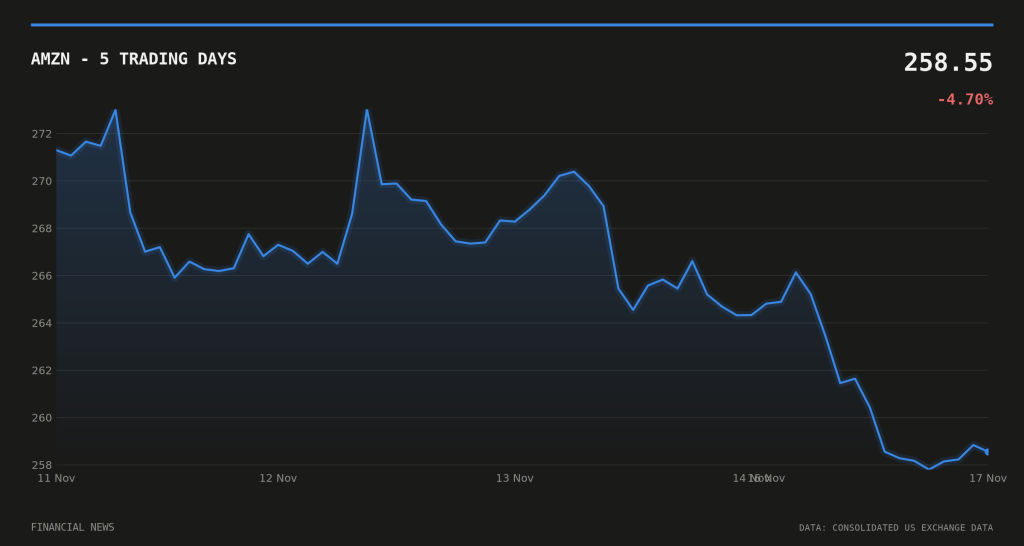
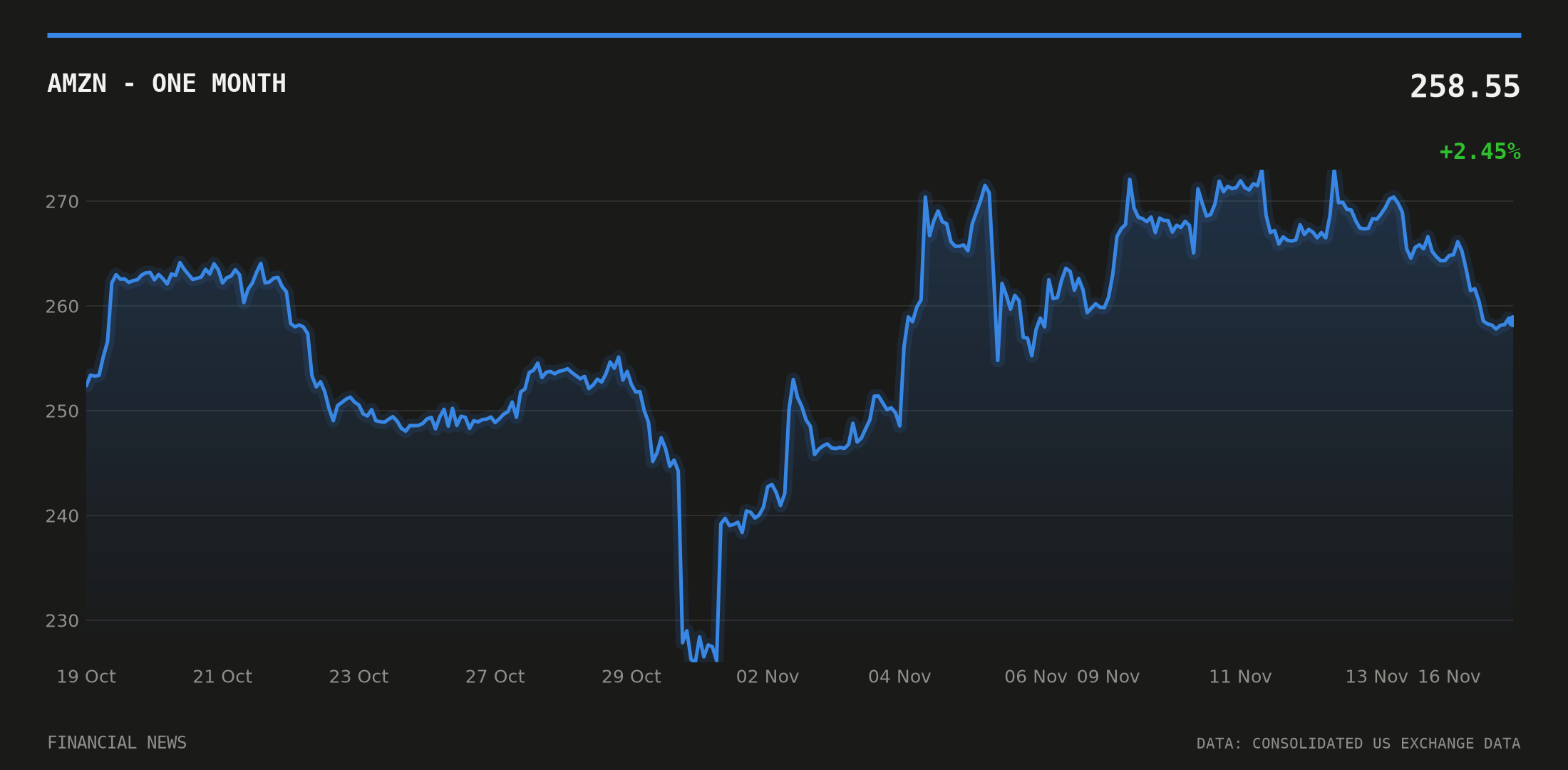
Amazon.com (NASDAQ: AMZN) shares closed down 3.34% at $257.75 on 16 November 2026, as a new US export rule on AI chips collided with the loss of 40 satellites in a rocket failure the day before, according to The Motley Fool.
Trading volume reached 47.3 million shares, well above the 39.4 million three-month average, the Fool reported. Benzinga put the drop at roughly 3.5%, or about $101bn in market value, within a broader AI chip stock selloff it estimated at $960bn across 19 major technology names that day.
What the new AI chip export rule actually covers
The US Bureau of Industry and Security issued an interim final rule on 16 November requiring export licences for advanced AI chips shipped to five countries – Singapore, Malaysia, Thailand, Indonesia and Brazil – and restricting remote access to such chips via overseas data centres, according to Yahoo News. The scope was independently confirmed by qz.com, which named the same five jurisdictions.
The rule carries an exemption for chip shipments to US-headquartered companies, or those with a US-headquartered ultimate parent, provided reporting requirements are met – a carve-out that limits the direct impact on Amazon’s own AWS chip exports, Yahoo News noted.
Satellite failure adds to the pressure
Separately, a United Launch Alliance Vulcan rocket failed about ten minutes after lift-off from Cape Canaveral on 15 November, destroying the 40 Amazon Leo satellites it was carrying, according to Spaceflight Now. SpaceNews confirmed the satellites failed to reach orbit. Amazon’s next Leo launch attempt, designated LE-04 and carrying 36 satellites aboard an Ariane 6 rocket, was targeted for no earlier than 23 November, according to applescoop.org.
A third development compounded the day’s news flow: Blackstone Digital Infrastructure Trust agreed to acquire a 75.1% controlling interest in two AWS data-centre joint ventures valued at $5.0bn gross, under an 8-K filed with the US Securities and Exchange Commission with an event date of 11 November and announced on 16 November. Blackstone’s chief executive framed the arrangement as a template, saying the firm aimed to ‘do more such deals with hyperscalers or developers’, according to PYMNTS.
AWS chip ambitions and the wider earnings picture
The export-rule hit lands against a backdrop of rapid growth in Amazon’s custom AI chip business. The Fool’s investing desk reported separately that AWS’s Trainium chip line was reaching a $25bn annual revenue run rate in the second quarter of 2026, underscoring how central AI silicon has become to the cloud unit’s growth story.
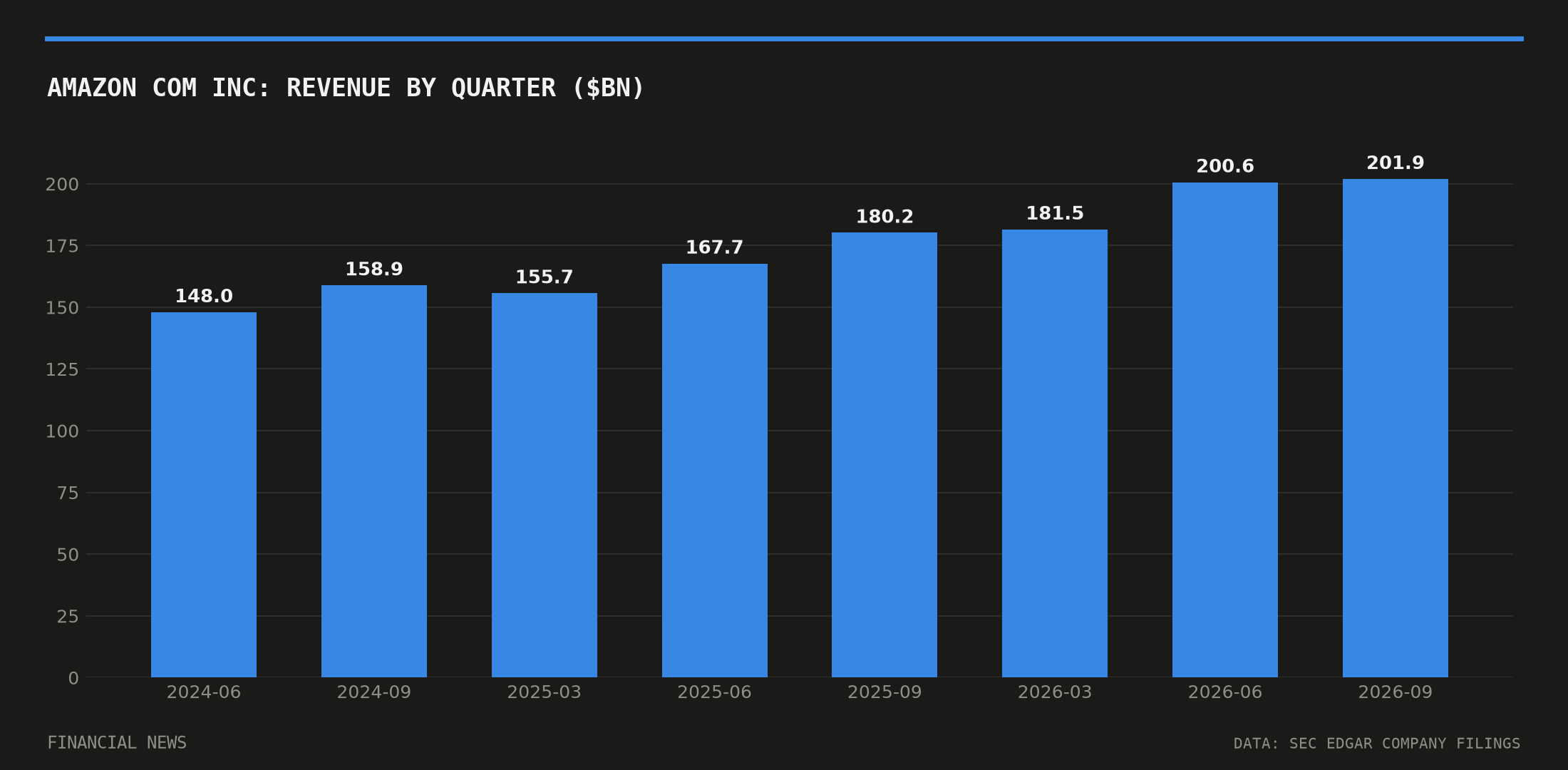
That growth shows up in Amazon’s own filings. Quarterly revenue climbed from $147.98bn in the second quarter of 2024 to $200.61bn in the second quarter of 2026, and $201.94bn in the third quarter of 2026, according to filings with the SEC. Net income over the same run climbed from $13.49bn in the second quarter of 2024 to $62.65bn in the second quarter of 2026, before easing to $20.69bn in the third quarter, with diluted earnings per share of $1.89 for that period. The swing in reported net income between the second and third quarters of 2026 reflects the scale of one-off items that increasingly move Amazon’s bottom line alongside its underlying retail and cloud operations.
Positioning and the macro backdrop
FINRA daily short-sale data show no unusual build-up in bearish positioning ahead of the news. The short-volume ratio for Amazon stood at 0.393 on 16 November, in line with 0.39 on 12 November and below the 0.47 recorded on 13 November, according to FINRA data. That pattern suggests the sell-off was driven by the day’s news rather than a pre-positioned short squeeze.
The move also came against a backdrop of Treasury yields holding near recent highs. The 10-year yield stood at 5.15% on 13 November, up from 5.10% previously, according to FRED data from the Federal Reserve Bank of St. Louis, keeping valuation pressure on rate-sensitive growth and AI-linked names across the sector.
Amazon’s next Leo launch window on or after 23 November stands as the nearest marker investors are watching, alongside any Federal Register publication date for the BIS rule that would trigger its licensing requirements.
This article is for information only and is not investment advice or a recommendation to buy or sell any asset. Markets move quickly; figures are correct as sourced at the time of writing. Always do your own research before making financial decisions.