

Adlai Nortye Group Ltd (NASDAQ: ANL) said on 15 October 2026 it has entered a clinical trial collaboration and supply agreement with Eli Lilly and Company (NYSE: LLY) and Merck KGaA, Darmstadt, Germany, to test its experimental cancer drug AN4035 alongside the antibody cetuximab.
Under the Adlai Nortye clinical collaboration, Lilly will supply cetuximab at no cost to trial sites in the United States, while Merck KGaA will do the same for sites in Australia and China, according to the company’s statement.
What the agreement actually covers
AN4035 is described as a first-in-class investigational pan-RAS(ON) inhibitor-based antibody-drug conjugate. It will be evaluated both as monotherapy and in combination with cetuximab in Adlai Nortye’s ongoing global Phase I trial, the company said in the lead excerpt of its release.
The announcement matches, word for word, an exhibit the company filed with the SEC as part of a Form 6-K, leaving no doubt the disclosure originates with Adlai Nortye itself rather than a third party. Benzinga’s coverage, filed within 15 minutes of the GlobeNewswire release, corroborated the terms without adding financial details.
Neither Lilly nor Merck KGaA disclosed a purchase price, milestone payment or equity stake tied to the arrangement. Adlai Nortye remains sole sponsor of the trial; the pharma majors’ role is limited to supplying cetuximab free of charge to specified sites. That distinguishes the deal from a funded co-development or licensing agreement, even though the clinical tie-up itself is real and SEC-confirmed.
The scientific rationale
CEACAM5, the antigen AN4035 targets, is overexpressed in colorectal, pancreatic and lung cancers – tumour types that frequently carry RAS mutations. Pairing the ADC with cetuximab, an EGFR-blocker already approved in colorectal cancer, is intended to attack the same tumour biology from two angles, according to the company’s release.
Cetuximab’s supply rights have long been split by geography. A separate, longstanding agreement among Merck KGaA, Bristol-Myers Squibb and Lilly governs the drug’s marketing in Japan, a structure consistent with the US-versus-Australia/China split in the new trial-supply arrangement.
Shares under pressure despite the tie-up
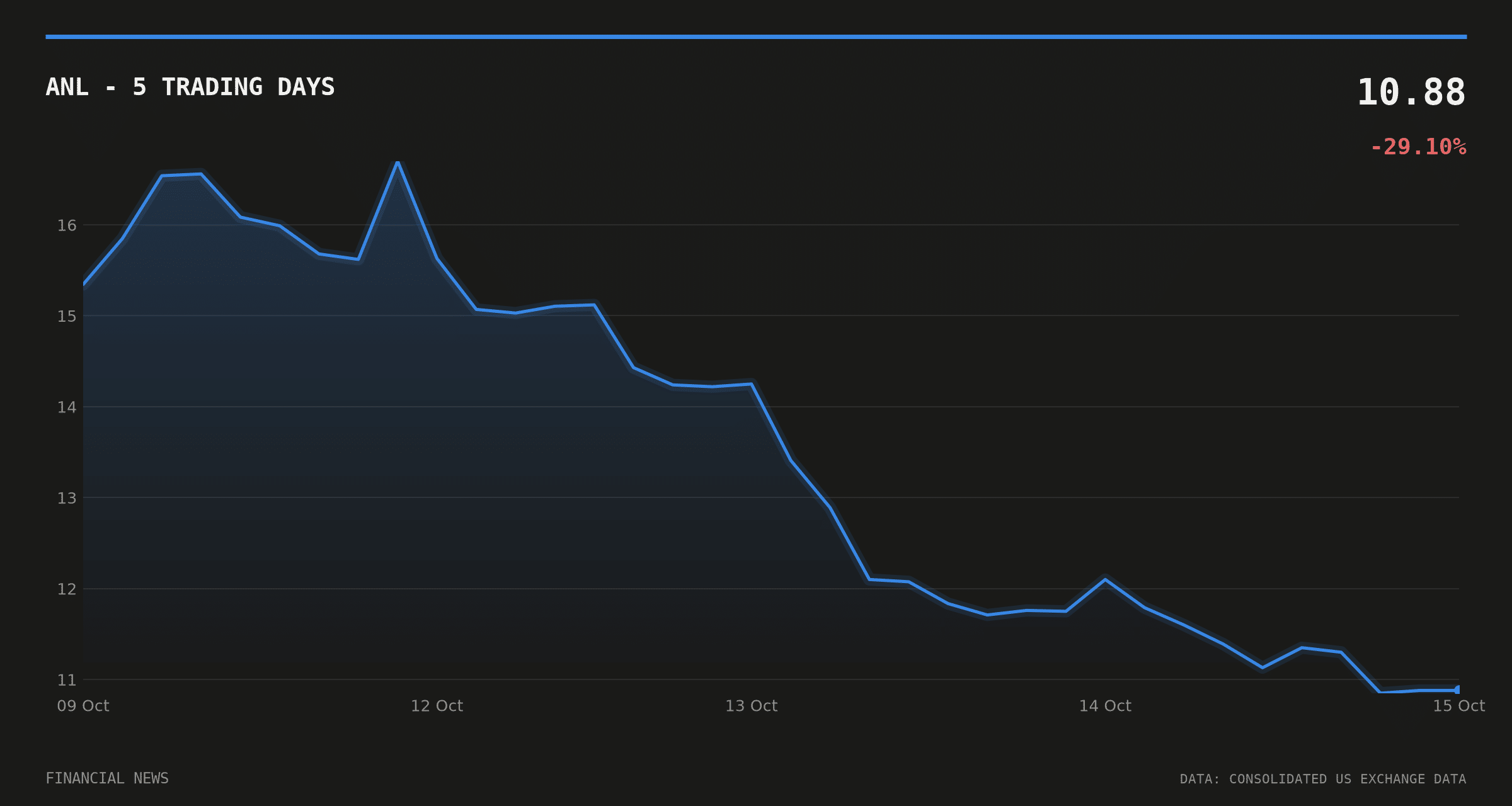
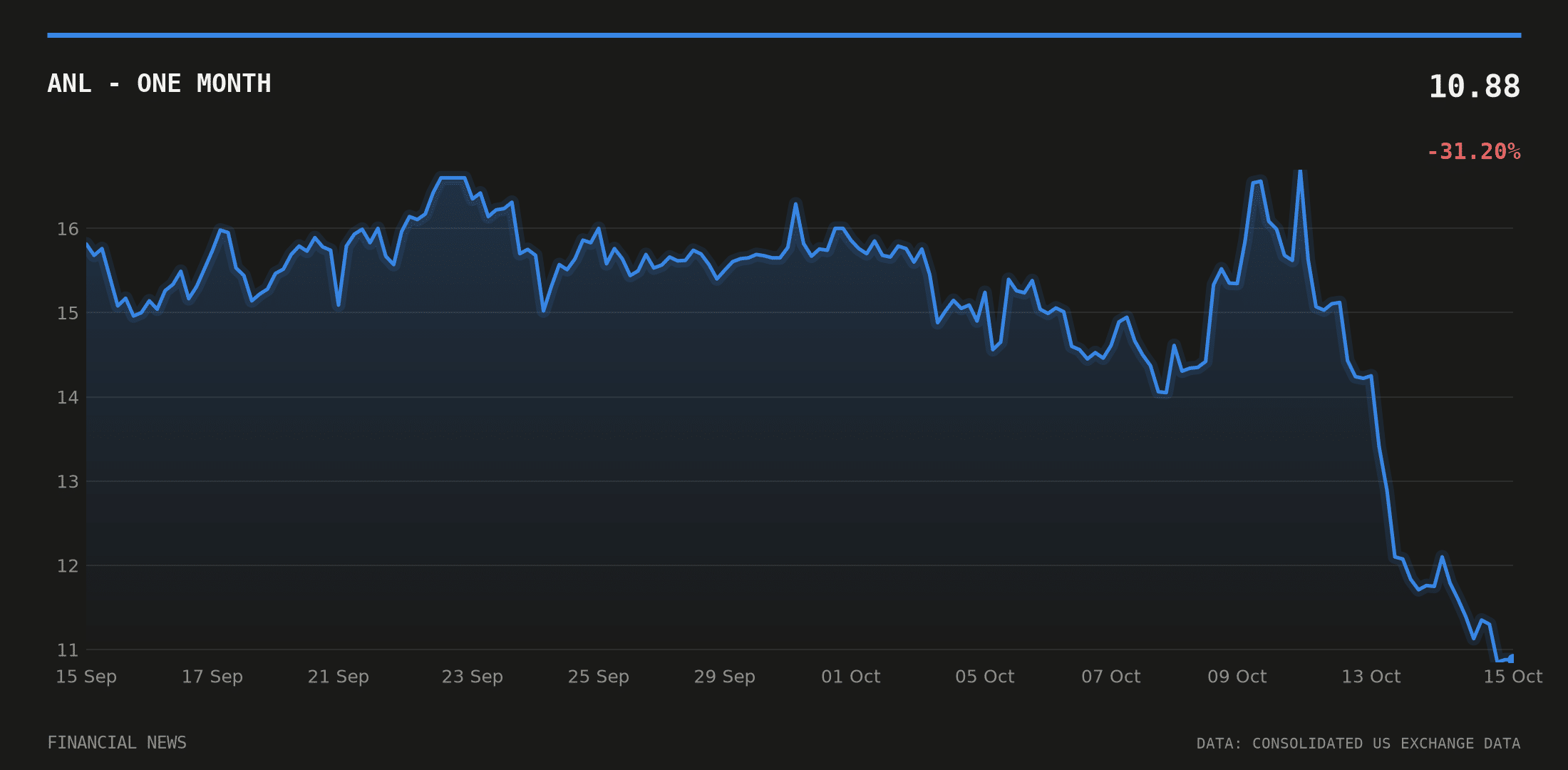
ANL closed at $11.61 as of the release, up just 0.09% on the day. Over the prior 20 trading sessions, the stock has fallen 25.96%, moving between a high of $16.70 and a low of $10.85, according to consolidated US exchange data. Volume on the day ran roughly in line with the 20-day average, at 1.05 times the norm.
Short-sale activity picked up in the run-up to the announcement. FINRA daily short-volume data put ANL’s short ratio at 0.675 on 13 October and 0.628 on 12 October, both well above the 0.088 reading recorded on 8 October. The ratio measures the share of reported volume attributable to short sales on a given day; a figure approaching or above 0.5 signals heavier-than-usual short-side participation, though FINRA’s data does not identify who is trading or why.
That positioning sits awkwardly against the clinical-collaboration news: shares barely moved on the day the deal was disclosed, even as the stock’s month-long decline continued to weigh on sentiment. No single factor in the public record explains the gap between the news and the share-price reaction.
Pipeline context
AN4035 is one of two RAS-pathway programmes Adlai Nortye has highlighted to investors. The company’s broader pipeline includes AN9025, an oral pan-RAS(ON) inhibitor, with initial Phase Ia data expected in the first half of 2027, according to its first-half 2026 results release. That readout gives investors a second near-term catalyst to track alongside the AN4035 Phase I trial now expanding with Lilly and Merck KGaA cetuximab supply in place.
The broader market backdrop remains steady rather than stressed: the 10-year US Treasury yield stood at 5.21% on 13 October, down marginally from 5.24% the prior session, while the 2-year yield held at 4.79%, according to Federal Reserve data. The yield curve’s 10-year/2-year spread narrowed slightly to 0.37 percentage points from 0.42, a shift that has drawn little direct comment from biotech-sector investors but forms part of the backdrop against which small-cap clinical-stage names like Adlai Nortye continue to trade.
Attention now turns to recruitment progress at the US, Australian and Chinese trial sites, and to whether Adlai Nortye discloses combination-arm data from the Phase I study before the AN9025 readout expected in the first half of 2027.
This article is for information only and is not investment advice or a recommendation to buy or sell any asset. Markets move quickly; figures are correct as sourced at the time of writing. Always do your own research before making financial decisions.
