

Verizon (NYSE: VZ) and Ericsson (NASDAQ: ERIC) said on 15 October they had completed what they called the world’s first outdoor 6G field call, using pre-standard equipment in the 7 GHz band.
The test ran on a live Verizon commercial network site in Concord, California, using a 400 MHz carrier to measure coverage, throughput and latency, according to the syndicated company statement.
What the outdoor 6G field call actually proved
The companies said the Ericsson 6G proof-of-concept kit was fully deployed at the site and that test validation moved 6G “from lab integration into a real-world environment,” according to the joint release. The trial examined both outdoor performance and outside-to-indoor signal penetration.
Hannes Ekström, Ericsson’s head of customer unit Verizon, said the result was “another validation of Verizon’s leadership on the path to 6G,” per the statement carried by StockTitan. The same claim, with identical technical detail, was republished by Benzinga.
What none of the coverage can establish is the “world’s first” label itself. The 3GPP standards body has not finalised a 6G specification, so there is no independent arbiter to certify a global first in a standard that does not yet exist. The companies’ own materials describe the exercise as a pre-standard proof-of-concept, not a commercial 6G service launch.
Ericsson shares move, but the volume doesn’t match the story
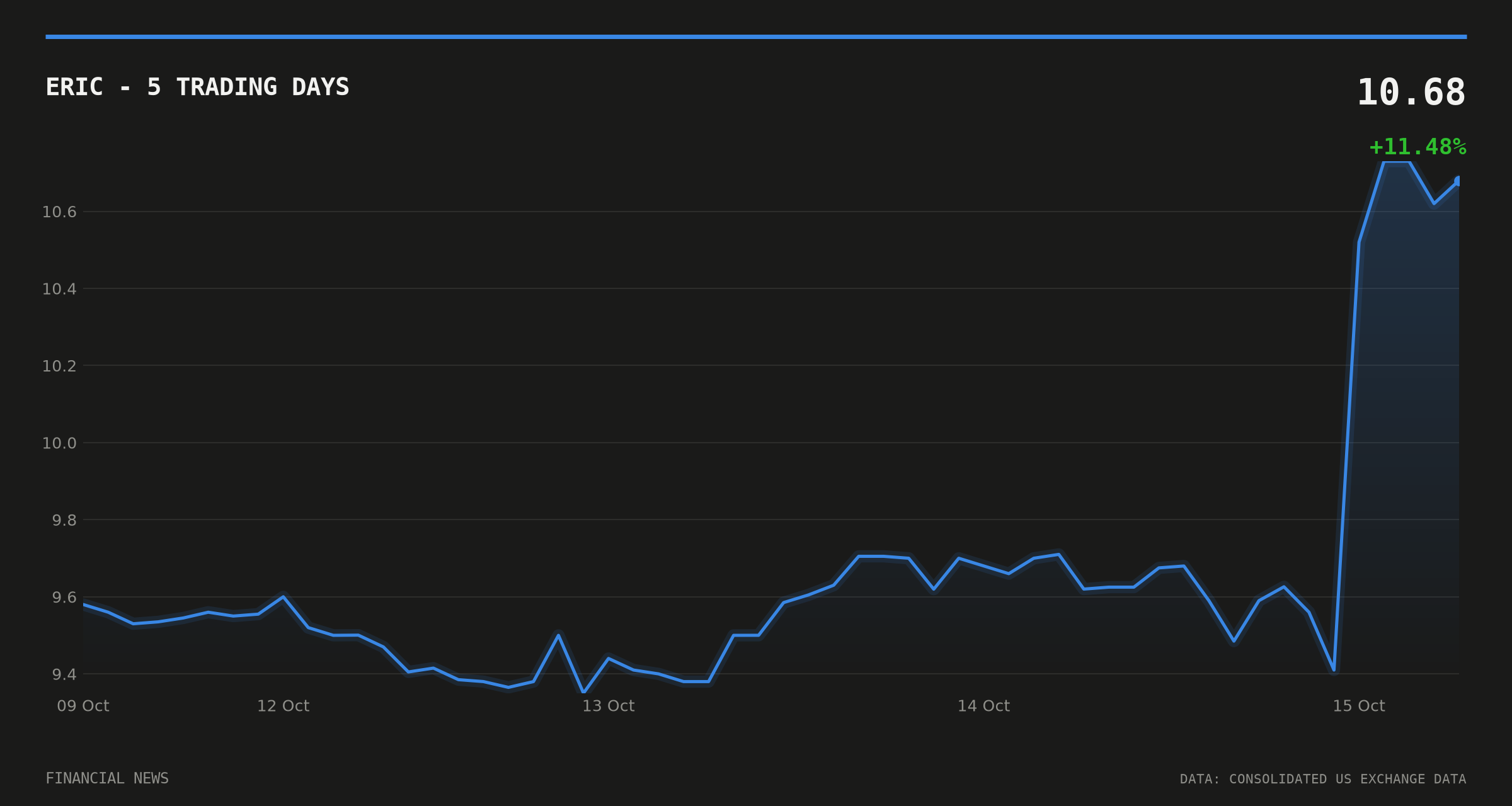
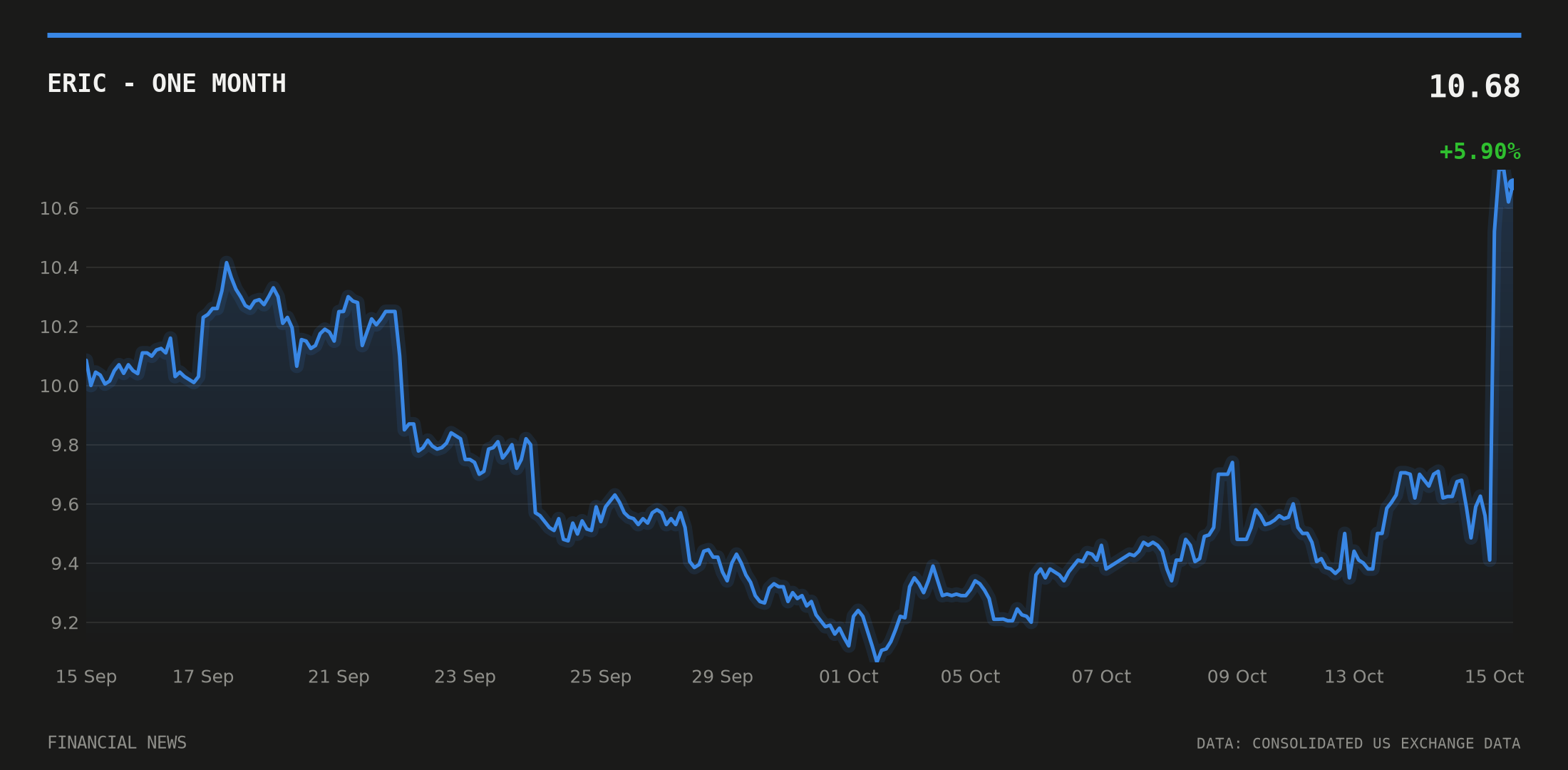
Ericsson’s US-listed shares were quoted 10.95% higher on the day, last changing hands at $10.68, having climbed 11.83% over the prior 20 trading days, according to consolidated US exchange data. That put the stock near the top of its recent range, with a 20-day high of $10.73 against a low of $9.065.
Trading volume, however, ran at just 0.74 times the 20-day average — below normal, not above it. That is an unusual pattern for a stock supposedly reacting to a single piece of news: genuine news-driven rallies typically show volume spikes well above trend, not below it.
FINRA short-sale data tells a similarly flat story. Ericsson’s daily short-sale ratio stood at 0.702 on 14 October, sitting squarely within its range of 0.459 to 0.858 over the first two weeks of October. There is no sign of a short squeeze or a sudden shift in positioning around the announcement.
Part of a broader 6G push
Ericsson’s role sits inside a wider effort. The Swedish vendor is a founding member of Verizon’s 6G Innovation Forum, alongside Samsung, Nokia, Meta and Qualcomm, a group formed to trial 6G use cases and candidate spectrum bands, according to Verizon’s newsroom. Verizon has separately added nine technology members to that forum, including AWS, Nvidia, Intel and Cisco, while showcasing integrated sensing and communication field trials as part of the same programme.
None of that activity carries a revenue line yet. 6G remains years from commercial deployment, and Thursday’s milestone — however it is badged — is a laboratory result moved outdoors, not a product. For AT&T (NYSE: T) and T-Mobile US (NASDAQ: TMUS), both watching the same standards process from the sidelines, the Concord test is one data point in a multi-year race that has not yet produced a single paying 6G customer anywhere.
Markets watching Ericsson’s next move will want to see whether the 10.95% advance holds once attention on the announcement fades, or whether it proves to be noise unconnected to a pre-standard trial that, by the companies’ own account, is not yet a commercial service.
This article is for information only and is not investment advice or a recommendation to buy or sell any asset. Markets move quickly; figures are correct as sourced at the time of writing. Always do your own research before making financial decisions.
