
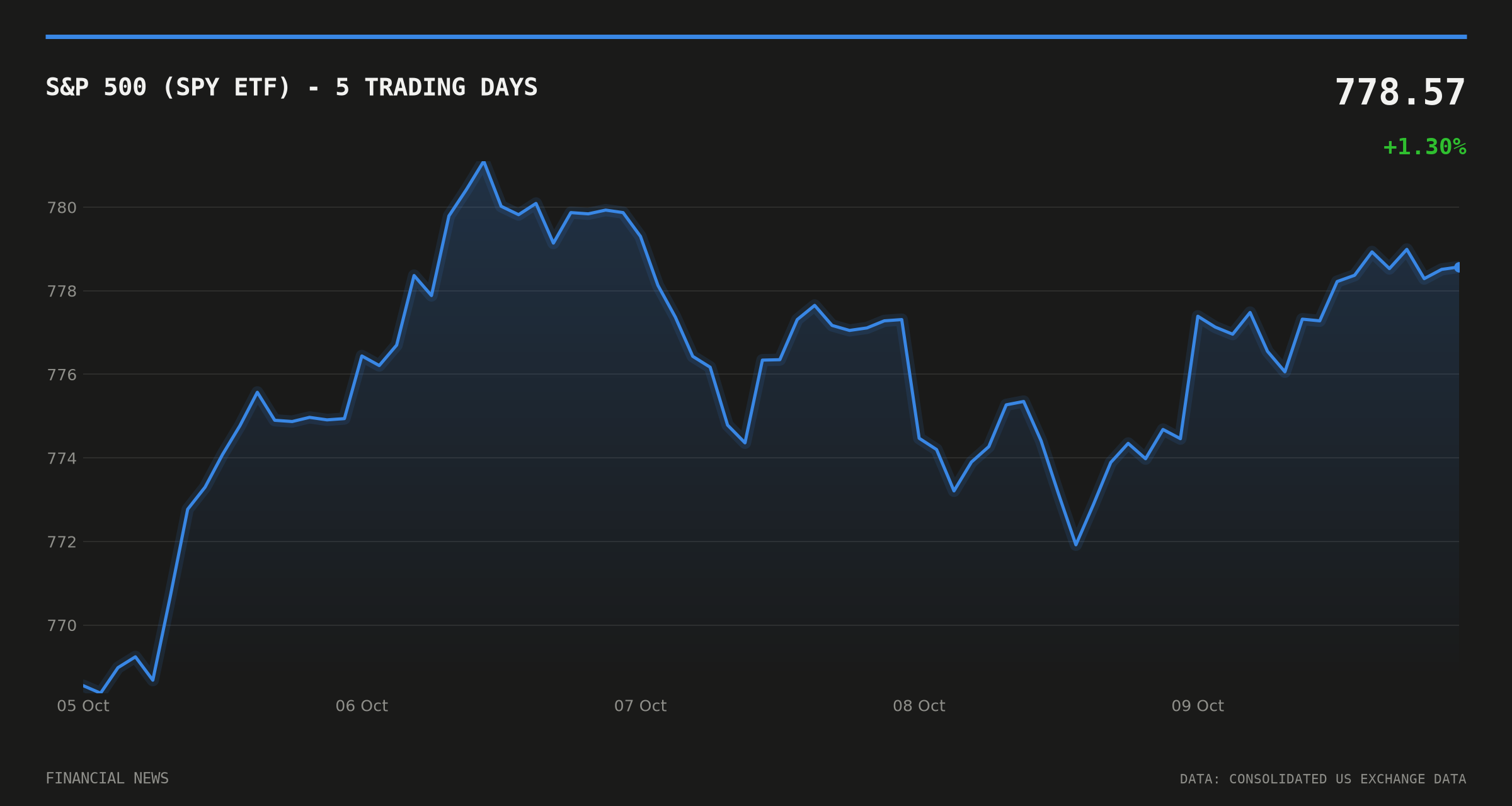

The S&P 500 (NYSEARCA: SPY) closed the week to 10 October 2026 up 1.3%, at 778.57, but the index-level calm masked one of the sharpest sector splits of the year. Telecom towers, utilities and a handful of defensive names surged by double digits while the chip supply chain that has driven markets for most of 2026 went into reverse.
The gap between the week’s best and worst performers ran to more than 33 percentage points. Crown Castle (NYSE: CCI) gained 19.97% while Arm Holdings (NASDAQ: ARM) fell 13.17% – both moves large enough on their own to dominate a quieter week.
S&P 500 Weekly Gains Lead a Mixed Scoreboard
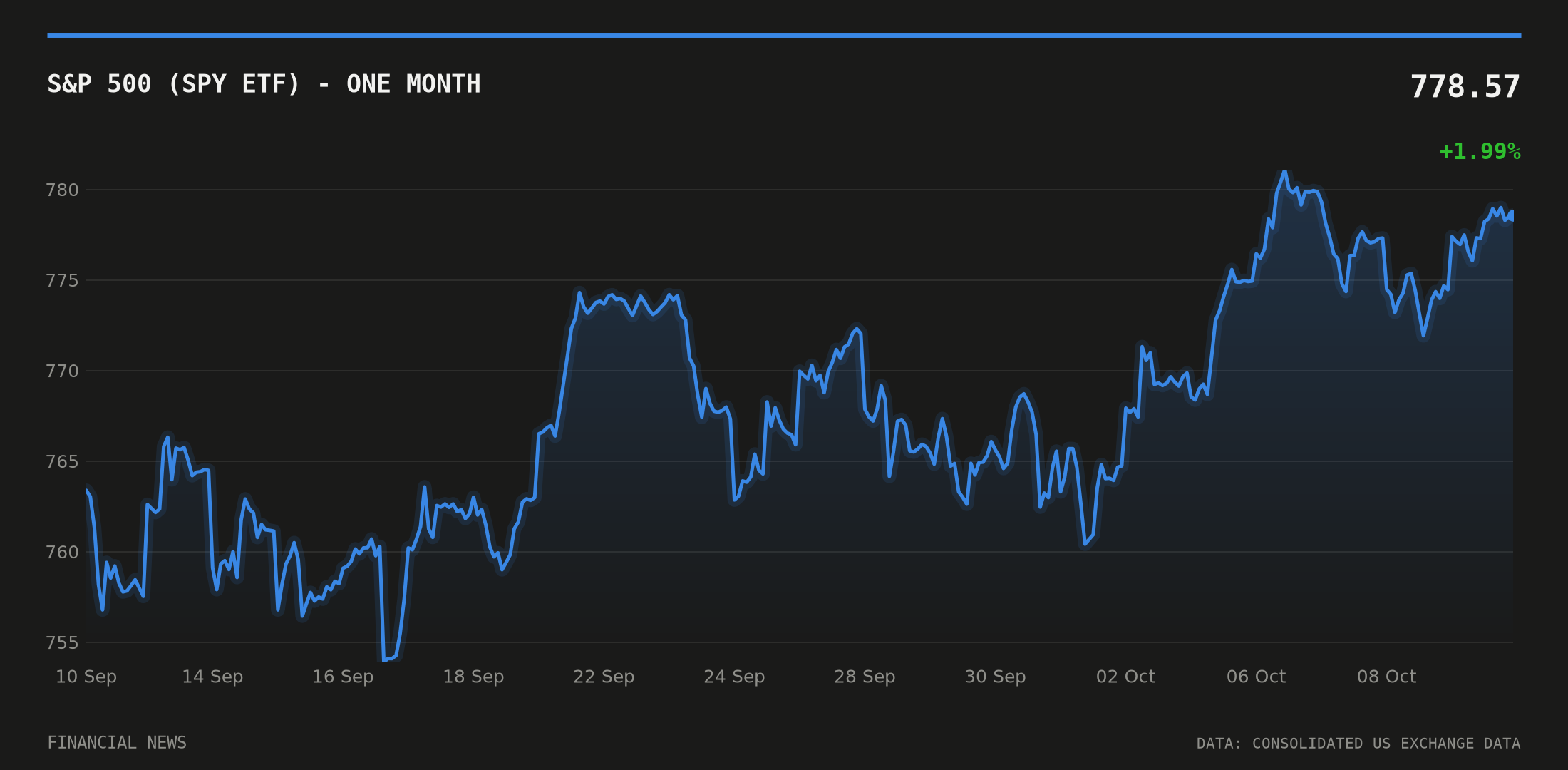
The headline S&P 500 weekly gains came alongside more muted moves elsewhere. The Nasdaq 100 (NASDAQ: QQQ) added just 0.35% to close at 751.38, dragged by the chip-sector losses, while the Dow (NYSE: DIA) rose 1.05% to 516.21.
That pattern – broad indices firm, mega-cap tech lagging – has become familiar this autumn, as this outlet noted in last week’s wrap, when the chip supply chain was still the market’s engine. This week it became the drag.
Towers, Vaccines and Power Lead the Winners
Crown Castle’s 19.97% rise to $79.71 topped the leaderboard, with fellow tower operator SBA Communications (NASDAQ: SBAC) close behind at 16.16%, ending the week at $182.65. Both stocks move on long-duration lease income, a profile that tends to benefit when Treasury yields soften, as they did this week.
Moderna (NASDAQ: MRNA) jumped 19.09% to $224.94, the sharpest move in the healthcare space this week. Corteva (NYSE: CTVA) added 15.82% to close at $13.84, extending a rally this outlet covered in detail after an analyst upgrade following its spin-off. Constellation Energy (NASDAQ: CEG) rose 14.64% to $298.12, part of a broader run in power generators tied to data-centre demand that has also lifted nuclear-adjacent names such as Vistra, the subject of reported federal loan talks earlier this year.
Chip Supply Chain Reverses Hard
The week’s losers came almost entirely from semiconductors and the hardware that depends on them. Arm fell 13.17% to $266.14, its steepest weekly drop in months. Mosaic (NYSE: MOS) dropped 10.35% to $18.83, while Teradyne (NASDAQ: TER) slid 10.08% to $403.06 – a reversal for a stock this outlet flagged after its undisclosed Bright Machines investment.
Seagate Technology (NASDAQ: STX) fell 9.79% to $780.24 and Intel (NASDAQ: INTC) dropped 9.75% to $104.47, giving back ground after the stock had recovered quickly from TSMC Terafab talks just weeks earlier. Taken together, the five biggest losers of the week all sit somewhere in the chip production or testing chain, from materials through equipment to storage.
Yields Ease, Oil Holds Steady
The macro backdrop helped explain some of the rotation. The 10-year Treasury yield eased to 5.22% on 8 October, down from 5.28%, according to data from the Federal Reserve Bank of St. Louis. The 2-year yield slipped more modestly, to 4.75% from 4.77%, narrowing the 10-year/2-year spread to 0.44 percentage points from 0.47.
Lower long-end yields tend to favour exactly the kind of duration-sensitive, income-generating equities that led this week’s advance – towers, utilities and power generators among them. WTI crude barely moved, at $96.24 a barrel on 6 October against $96.13 previously, leaving energy costs out of the story for once.
The Number of the Week
The number of the week is 33 – the percentage-point gap between Crown Castle’s 19.97% gain and Arm’s 13.17% loss, inside a headline index move of just 1.3%. It is a reminder that a calm S&P 500 weekly gains print can sit on top of a market tearing itself in two directions at once, as capital rotated out of chip-sector exposure and into assets that benefit when yields fall.
This article is for information only and is not investment advice or a recommendation to buy or sell any asset. Markets move quickly; figures are correct as sourced at the time of writing. Always do your own research before making financial decisions.
