


The S&P 500 (SPY ETF) edged up 0.26% over the week to close at 769.86, but the headline number hid the real story: a hardware-versus-software split that tore through single stocks far more violently than it moved the index.
The Nasdaq 100 (QQQ ETF) climbed 1.68% to 749.55, lifted by a run of optical-networking and chip-testing names posting weekly gains above 16%. The Dow (DIA ETF) slipped 0.77% to 511.70, dragged by its heavier weighting in consumer and payments names that found no such support.
The scoreboard
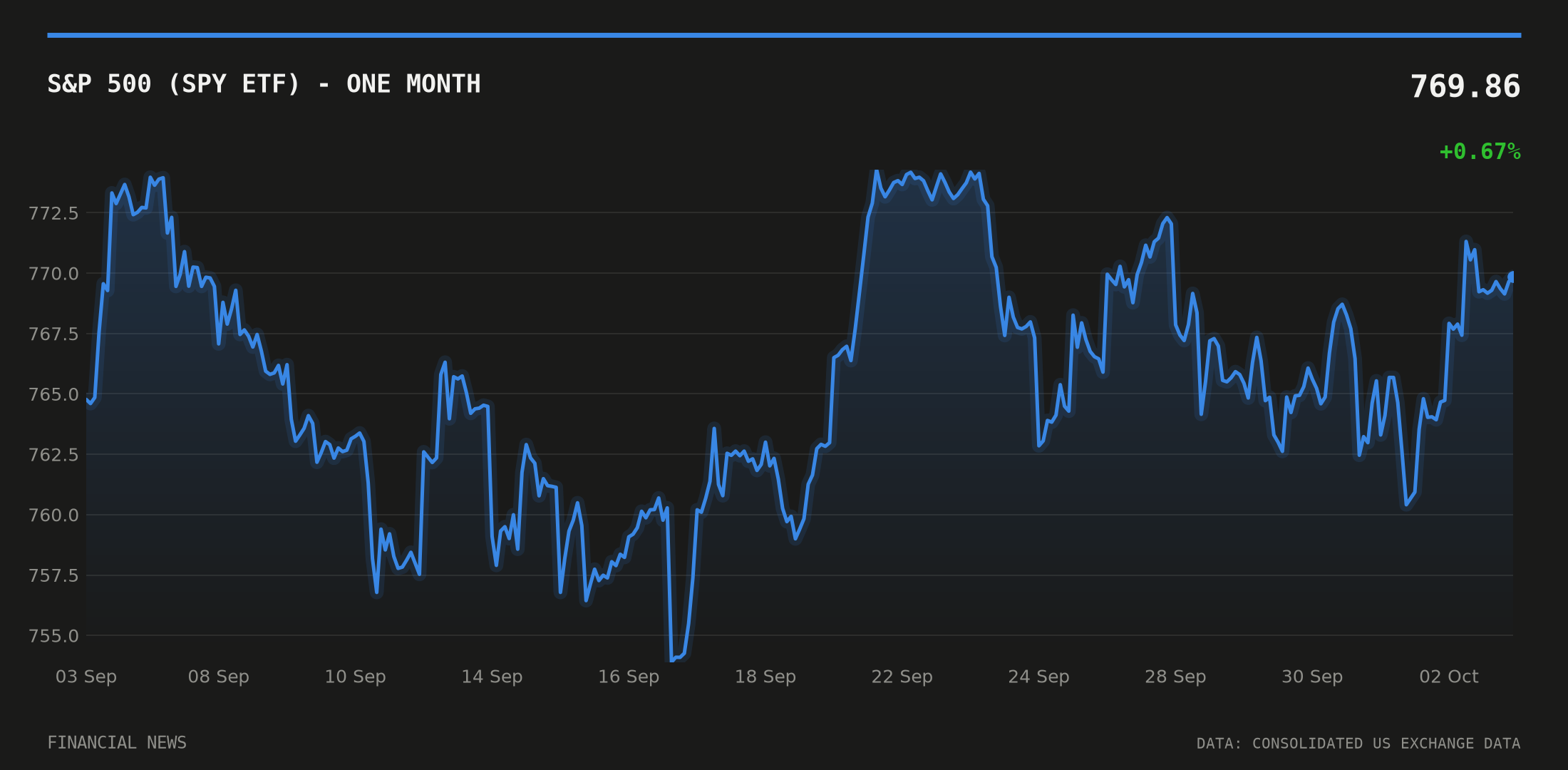
Three benchmarks, three directions. The broad market barely moved, the growth-heavy Nasdaq 100 pushed higher, and the Dow lost ground. That divergence is the cleanest signal of the week: investors rotated hard into semiconductor supply-chain exposure and rotated just as hard out of software and consumer-facing names, leaving the blended index looking calmer than the underlying moves actually were.
This follows a week in which chipmakers flew while software names sank, and the pattern held into this period rather than reversing.
Winners: the chip and travel trade
Lumentum Holdings (NASDAQ: LITE) led the board, up 18.24% to 1,087.72, with Coherent Corp (NASDAQ: COHR) close behind at 17.69% to 337.79. Both make optical components used in data-centre networking, putting them squarely in the AI infrastructure buildout that has driven much of this year’s capital spending story.
Teradyne (NASDAQ: TER) rose 16.73% to 450.56 and Synopsys (NASDAQ: SNPS) gained 16.14% to 489.40, extending the same theme into chip-testing equipment and design software respectively. Carnival Corp (NYSE: CCL) was the outlier in the top five, up 16.97% to 25.78, a reminder that travel and leisure names can still move sharply on demand signals unrelated to the AI trade.
The breadth of the move across equipment, testing and design layers of the chip supply chain is notable. It follows a separate run of hardware-linked corporate news this week, including Nvidia’s $150bn lift to its buyback authorisation and AMD’s $8.2bn purchase of Fei-Fei Li’s World Labs, both of which kept the sector in focus through the week.
Losers: software and payments under pressure
Fair Isaac Corp (NYSE: FICO) fell 23.63% to 661.35, the sharpest decline among large-cap names this week. Applovin (NASDAQ: APP) dropped 15.02% to 267.70, and Alnylam Pharmaceuticals (NASDAQ: ALNY) lost 13.50% to 219.71. Global Payments (NYSE: GPN) rounded out the list, down 9.65% to 78.38.
The losers’ list spans credit scoring, ad-tech, biotech and payments processing, four sectors with little in common beyond having sat on the wrong side of this week’s rotation out of software and consumer-facing financial names and into hardware.
The insider ledger
No large disclosed insider sales crossed the threshold for this week’s ledger. That is itself worth noting against a backdrop of double-digit weekly swings in names such as FICO and APP: executives at the week’s most volatile stocks were not filing disposals of size into the move, at least not by the measure tracked here.
The macro shift
Treasury yields eased across the curve. The 10-year yield slipped to 5.24% from 5.29%, while the 2-year fell to 4.78% from 4.88%, according to FRED data from the Federal Reserve Bank of St. Louis. The 10y-2y spread held almost flat at 0.45, down marginally from 0.46, per separate FRED figures, leaving the curve’s shape largely unchanged even as both legs moved lower in tandem.
Oil fell more sharply. WTI crude spot dropped to $96.16 a barrel from $99.37, according to FRED’s crude price series. A roughly 3% weekly decline in crude alongside falling yields points to a market pricing softer demand expectations without yet pricing in acute growth concerns, a combination that has sat behind several of this year’s rotations between cyclical and defensive positioning.
The number of the week
Set the index moves against the single-stock swings and the number that matters is the gap between them: a 0.26% weekly move in the S&P 500 sitting alongside an 18.24% weekly gain in Lumentum and a 23.63% weekly loss in Fair Isaac. The index stood still. The stocks underneath it did not.
This article is for information only and is not investment advice or a recommendation to buy or sell any asset. Markets move quickly; figures are correct as sourced at the time of writing. Always do your own research before making financial decisions.
