
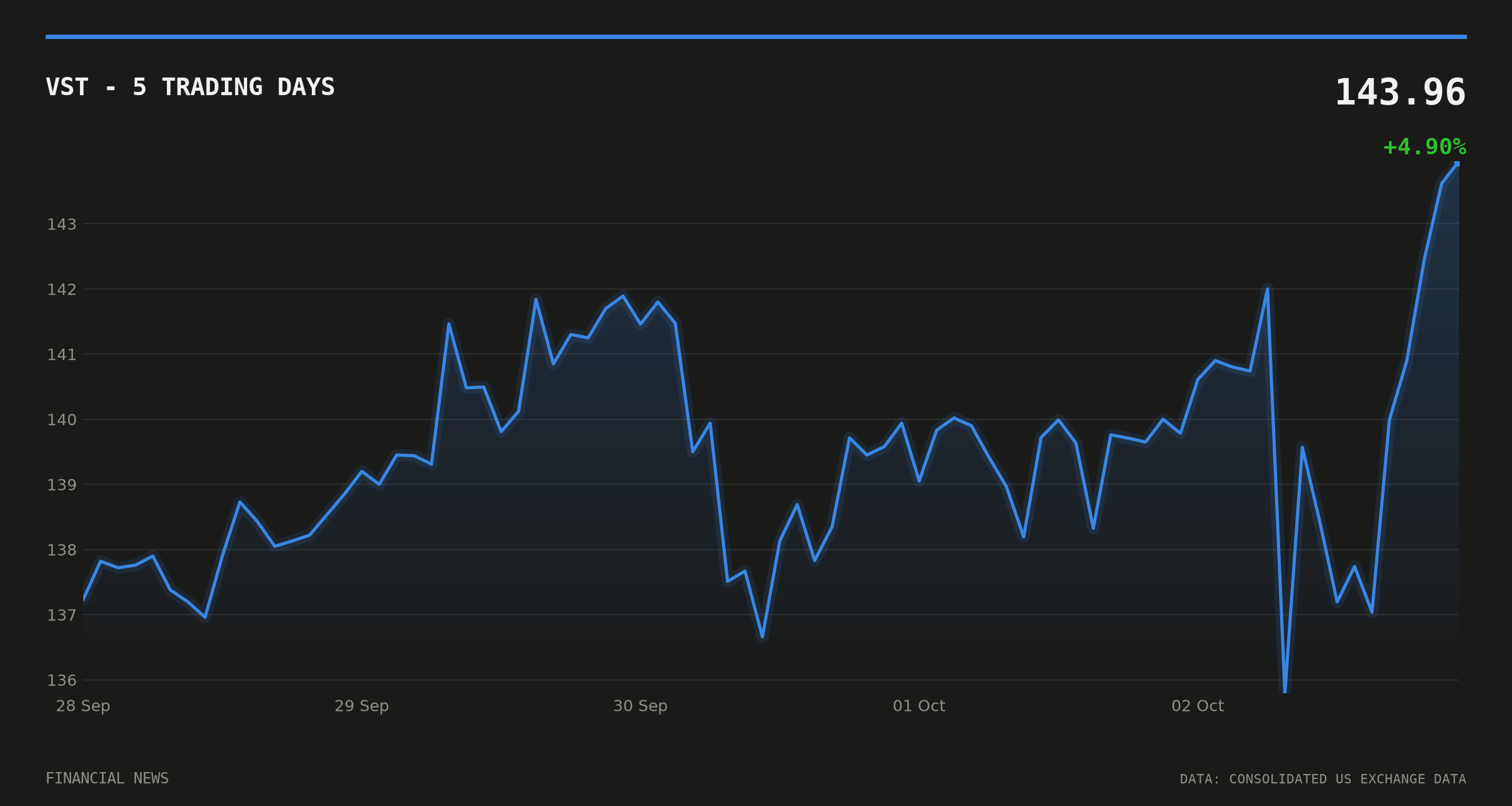

The US government plans to lend Vistra Corp. (VST) roughly $4bn to upgrade three of its nuclear power plants, Bloomberg reported on 2 October 2026, citing people familiar with the matter.
Reuters, citing its own source, put the figure higher: $4.2bn. Vistra shares closed up 4.93% at $143.9605 on 2 October, on volume nearly three times their 20-day average.
Wires disagree on the size of the Vistra nuclear loan
Every account of the Trump administration’s plan traces back to unnamed sources. Bloomberg’s original report described a package near $4bn; Benzinga’s write-up of that story carried the same figure in its headline. Reuters, reporting separately, said its source put the number at $4.2bn.
Neither the Department of Energy nor Vistra has issued a statement confirming the loan, its size or its terms. No 8-K or related disclosure appears in Vistra’s filings with the SEC as of the reports. Coverage also varies on scope: some accounts describe upgrades at two Ohio plants and one in Pennsylvania, others simply “three nuclear plants” without naming all three. Until Washington or the company confirms the package, the reporting stands as sourced to people familiar with the matter rather than an announced deal.
Shares jump on a report, not a filing
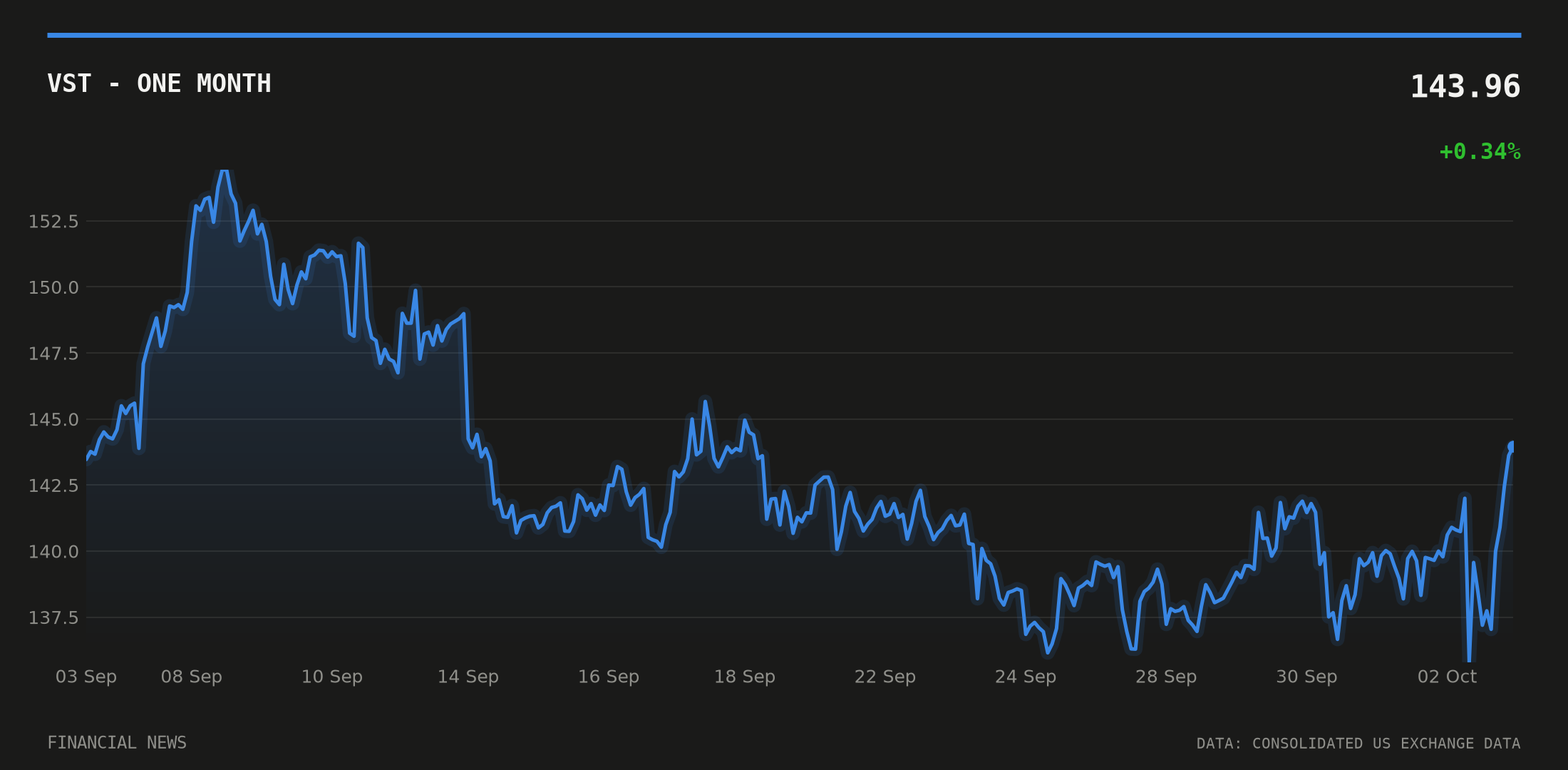
The market moved regardless of the uncertainty over the exact figure. VST’s 4.93% gain came on volume 2.98 times its 20-day average, pushing the stock near its 20-day high of $145.665. Daily short-sale ratios tracked by FINRA stayed within a narrow 0.40-0.56 band through the move, showing nothing resembling a short squeeze behind the rally – the gain looks like fresh buying on the headline rather than short-covering.
Federal financing of this kind would land against a backdrop of elevated borrowing costs. The 10-year Treasury yield stood at 5.24% on 1 October, with the 2-year at 4.78%, keeping the 2s10s spread at a slim 0.45 points. A government loan at concessional terms would cut Vistra’s cost of capital for nuclear capex well below what it could secure in the open market at those levels.
Demand from data centres underpins the case
The reported financing fits a pattern already visible in Vistra’s own disclosures. Its most recent 10-Q shows a 20-year power purchase agreement signed with Meta in January 2026 for 2,609 MW of carbon-free capacity, tied in part to output from its PJM nuclear fleet. Electricity demand in the US has accelerated after decades of flat growth, driven largely by AI data centres and electrification, the backdrop cited by Reuters for why federal nuclear financing is being pursued now.
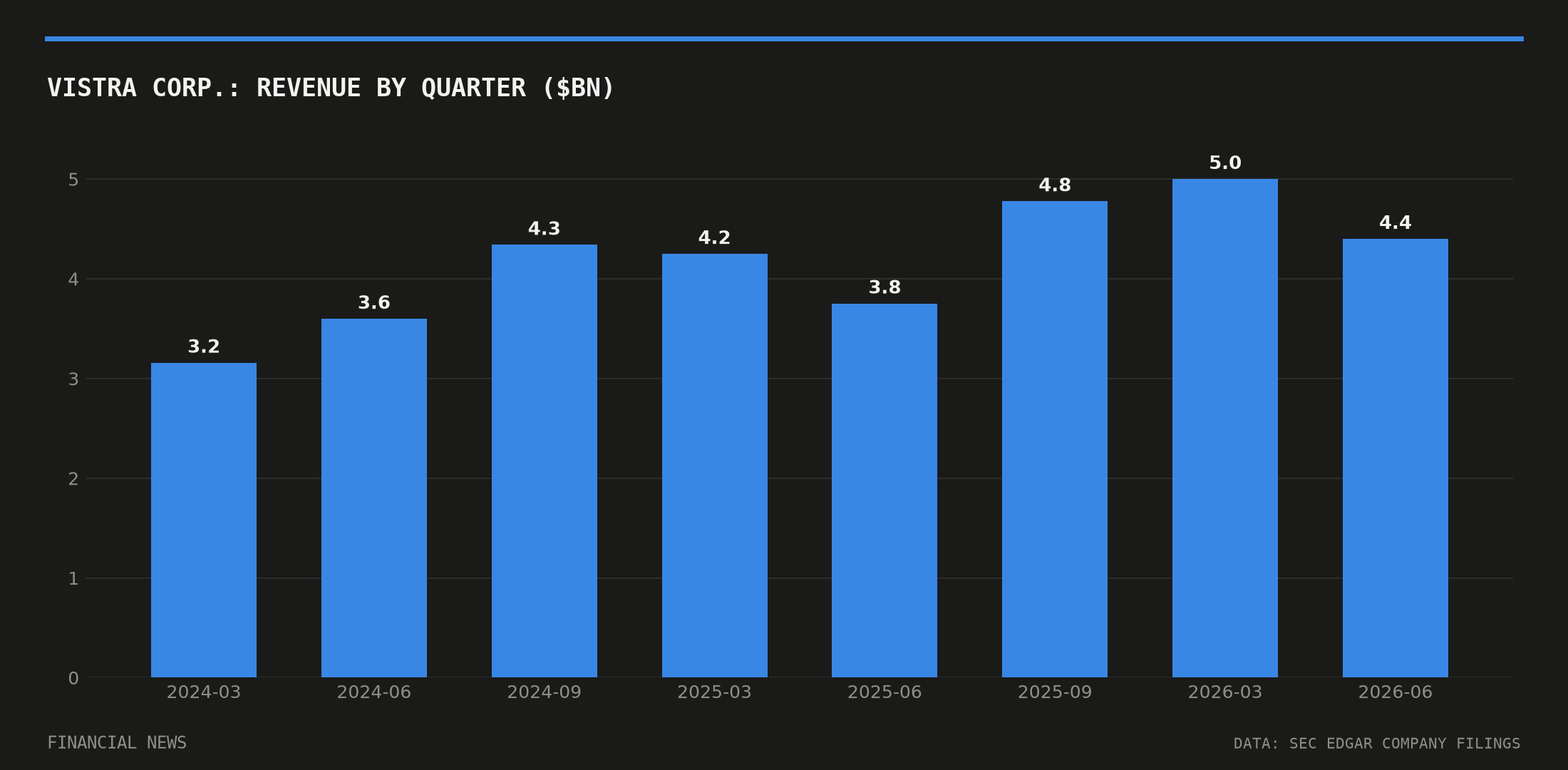
Vistra’s underlying numbers have been volatile quarter to quarter but broadly improving. The company reported net income of $305m on revenue of $4,401m in the quarter to 30 June 2026, following $1,029m of net income on $5,001m of revenue in the first quarter. That compares with a $268m loss in the first quarter of 2025, when the company’s nuclear and power generation units were still working through weaker pricing.
What to watch
Investors are watching for confirmation from either the Department of Energy or Vistra itself, which would settle the gap between the $4bn and $4.2bn figures circulating in the market. A formal announcement would also clarify which plants qualify and under what repayment terms, details that remain unconfirmed in the reporting so far. Until then, the stock’s move reflects a single-sourced report rather than a disclosed federal commitment.
This article is for information only and is not investment advice or a recommendation to buy or sell any asset. Markets move quickly; figures are correct as sourced at the time of writing. Always do your own research before making financial decisions.
