
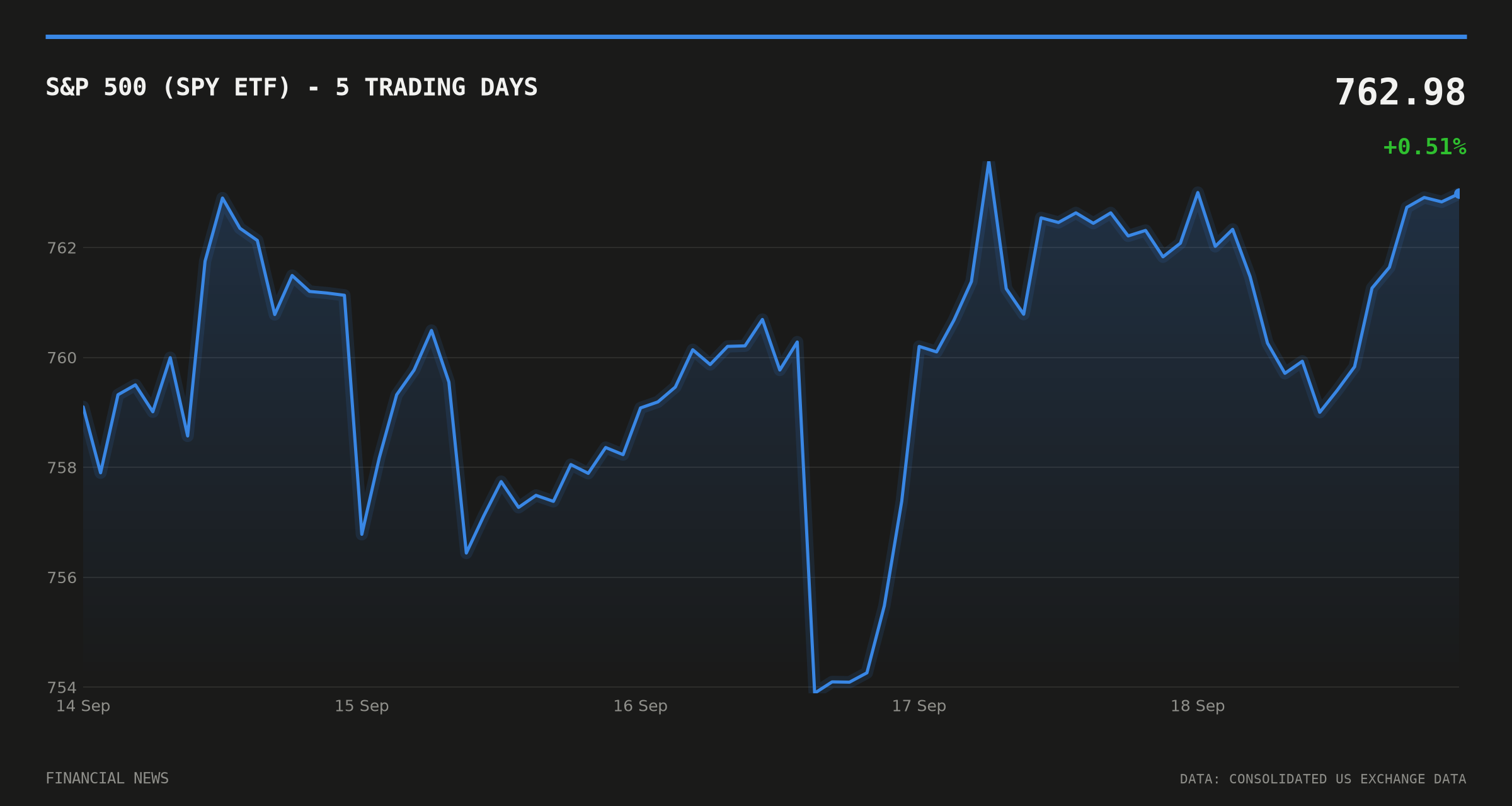

US equities split down the middle this week, and the divergence was the story. The Nasdaq 100 (QQQ ETF) jumped 2.77% while the Dow (DIA ETF) fell 1.68%, leaving the broader S&P 500 (SPY ETF) to eke out a 0.51% gain, closing at 762.98.
The number that defined the week was the 4.45-percentage-point spread between the Nasdaq 100’s 2.77% gain and the Dow’s 1.68% decline. That gap captures a market rewarding chipmakers and technology names while punishing telecoms, energy and industrials in the same five sessions.
The Weekly Close scoreboard
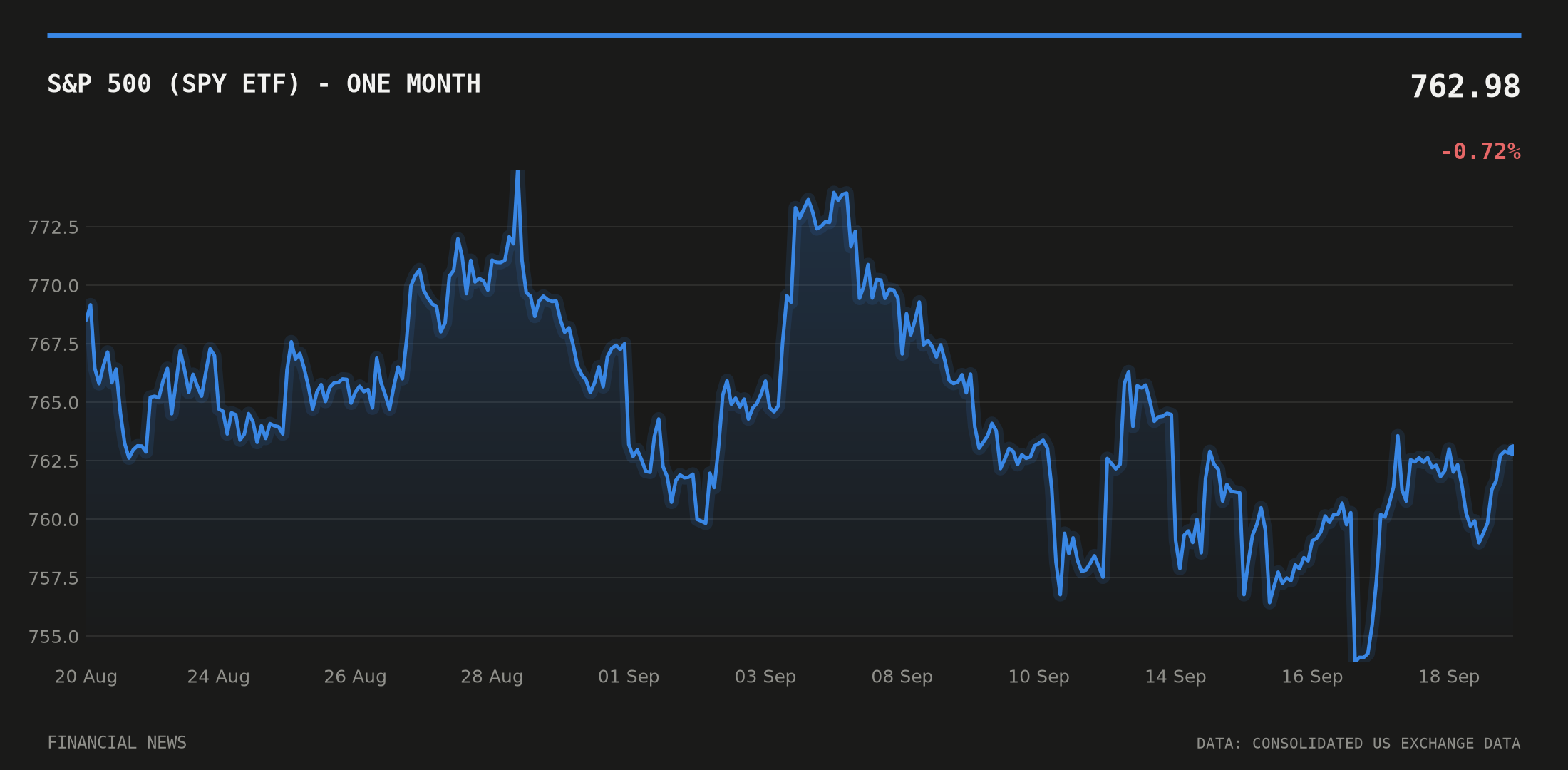
The S&P 500 added 0.51% for the week to settle at 762.98, a modest headline number that masked sharp rotation underneath. The Nasdaq 100 outran the broader market by more than five times, closing at 722.05 after a 2.77% advance. The Dow told the opposite story, dropping 1.68% to 516.15 as legacy industrials and telecoms weighed on the index. For a market that has spent much of the year moving in lockstep, this week’s Weekly Close split is a reminder that leadership can rotate abruptly.
Winners: chips and a bitcoin proxy lead the pack
Strategy Inc (MSTR) topped the leaderboard with a 17.65% weekly gain to 153.15, the software firm’s bitcoin treasury strategy continuing to amplify swings in the underlying cryptocurrency. Revvity (RVTY) rose 16.17% to 144.86, and Sandisk (SNDK) climbed 15.49% to 1,792.01, a move that comes days after this site reported Sandisk’s entry into the S&P 100 as Nike exits the index.
Generac (GNRC) gained 13.79% to 207.49, and Advanced Micro Devices (AMD) rose 13.76% to 556.80, extending a run of chipmaker strength that has also touched SK Hynix and Intel’s reported talks over a US memory plant and HPE’s memory-constrained AI backlog. The semiconductor complex has been the market’s most consistent theme this quarter, and this week’s gains in AMD and Sandisk fit that pattern.
Losers: telecoms and energy weigh on the Dow
J B Hunt Transport (JBHT) led the fallers, down 14.61% to 231.01. Charter Communications (CHTR) dropped 11.71% to 129.20, and Comcast (CMCSA) fell 10.03% to 22.78, a heavy week for cable and broadband names. Expand Energy (EXE) slipped 8.98% to 87.38 and SLB (SLB) fell 8.87% to 51.16, even as crude oil climbed over the same period – a divergence between spot prices and oilfield-services equities that traders will be watching into next week. The energy-sector weakness echoes this site’s recent coverage of EOG Resources’ share slide and Exxon’s reported Venezuela dealings.
The macro shift: yields ease, oil climbs
Treasury yields drifted lower across the curve this week. The 10-year US Treasury yield eased to 4.94% on 17 September, down from 5.01%, according to FRED data from the Federal Reserve Bank of St. Louis. The 2-year yield fell to 4.67% from 4.74% over the same period, per FRED, while the 10y-2y spread narrowed slightly to 0.25 percentage points from 0.27, according to Federal Reserve data. A flattening curve alongside falling absolute yields typically signals the bond market pricing in a slower growth path, though neither move this week was dramatic enough to force a change in positioning.
Crude bucked the softer-yield trend. WTI spot rose to $107.02 a barrel as of 15 September, up from $102.42, according to FRED. That five-dollar jump sits awkwardly against the week’s losses in oilfield-services names such as SLB, underlining how equity moves in the energy sector can decouple from the commodity itself over short windows.
Elsewhere on the tape
Corporate news this week ranged well beyond the index moves. Larry Ellison cancelled a planned $7.5bn Oracle share sale, a reversal that this site also covered from the market-reaction side in a follow-up piece on Oracle’s stock slide. Medtronic moved forward with a plan to split off its MiniMed stake via an exchange offer, and Sysco launched a $1bn share sale to help fund its acquisition of Jetro, as reported here.
Berkshire Hathaway confirmed a generational leadership change, with Warren Buffett stepping down as chairman and his son Howard taking over. Axon disclosed plans for a $1bn zero-coupon convertible notes offering, detailed in this site’s earlier report, and Amazon paused operations with cargo carrier 21 Air following a Miami crash, as covered separately.
The number of the week
Set against a week of scattered corporate headlines, one figure stands above the rest: the 4.45-percentage-point spread between the Nasdaq 100’s gain and the Dow’s decline. It is the clearest evidence yet that this market’s rotation between technology leadership and old-economy laggards has not run its course. With Treasury yields easing and crude oil climbing in the same window, the coming week’s data releases will test whether that divergence widens further or finally begins to close.
This article is for information only and is not investment advice or a recommendation to buy or sell any asset. Markets move quickly; figures are correct as sourced at the time of writing. Always do your own research before making financial decisions.
