

Axon Enterprise (Nasdaq: AXON) said on 15 September 2026 that it intends to offer $1.0bn of convertible senior notes carrying a 0% coupon, due 2031, in a public offering registered with US regulators.
The notes carry no interest at all, a marked change from the 6.125% and 6.250% senior notes Axon priced just 18 months earlier, according to the company’s announcement.
Zero-coupon structure replaces cash-pay debt
Axon’s exhibit attached to its own filing sets out the terms: $1.0bn aggregate principal, a public offering under the Securities Act of 1933 rather than a private placement, and a 2031 maturity, according to the filing with the Securities and Exchange Commission.
That marks a shift in Axon’s approach to debt markets. In March 2025 the company priced an upsized $1.0bn of 6.125% senior notes due 2030 alongside $750m of 6.250% notes due 2033, both cash-pay instruments carrying coupons more than six percentage points above the new deal, according to a separate 8-K exhibit filed in March 2025.
Axon has used convertible structures before, at smaller scale. In December 2022 the company placed $690m of 0.50% convertible notes due 2027 in a private Rule 144A deal, according to law firm Davis Polk, which advised on that transaction. Axon has been unwinding that earlier issue this year: it redeemed $840,000 of principal and settled conversions on $80.27m of principal in February 2026, delivering roughly $80.3m in cash and 211,870 shares to noteholders, according to an 8-K covering that settlement.
Credit facility upsize tied to the deal closing
The same disclosure that announced the convertible offering also revealed an amendment to Axon’s revolving credit agreement with JPMorgan as administrative agent. The amendment lifts the facility from $300m to $500m, with an option to increase it by a further $150m, but the increase only takes effect once the convertible notes offering closes, according to the 8-K’s Item 1.01 disclosure.
Tying the credit-line expansion to the notes deal closing links the two pieces of the balance sheet together: Axon cannot draw on the larger facility unless the convertible raise goes through as planned.
Shares near 20-day low as deal lands
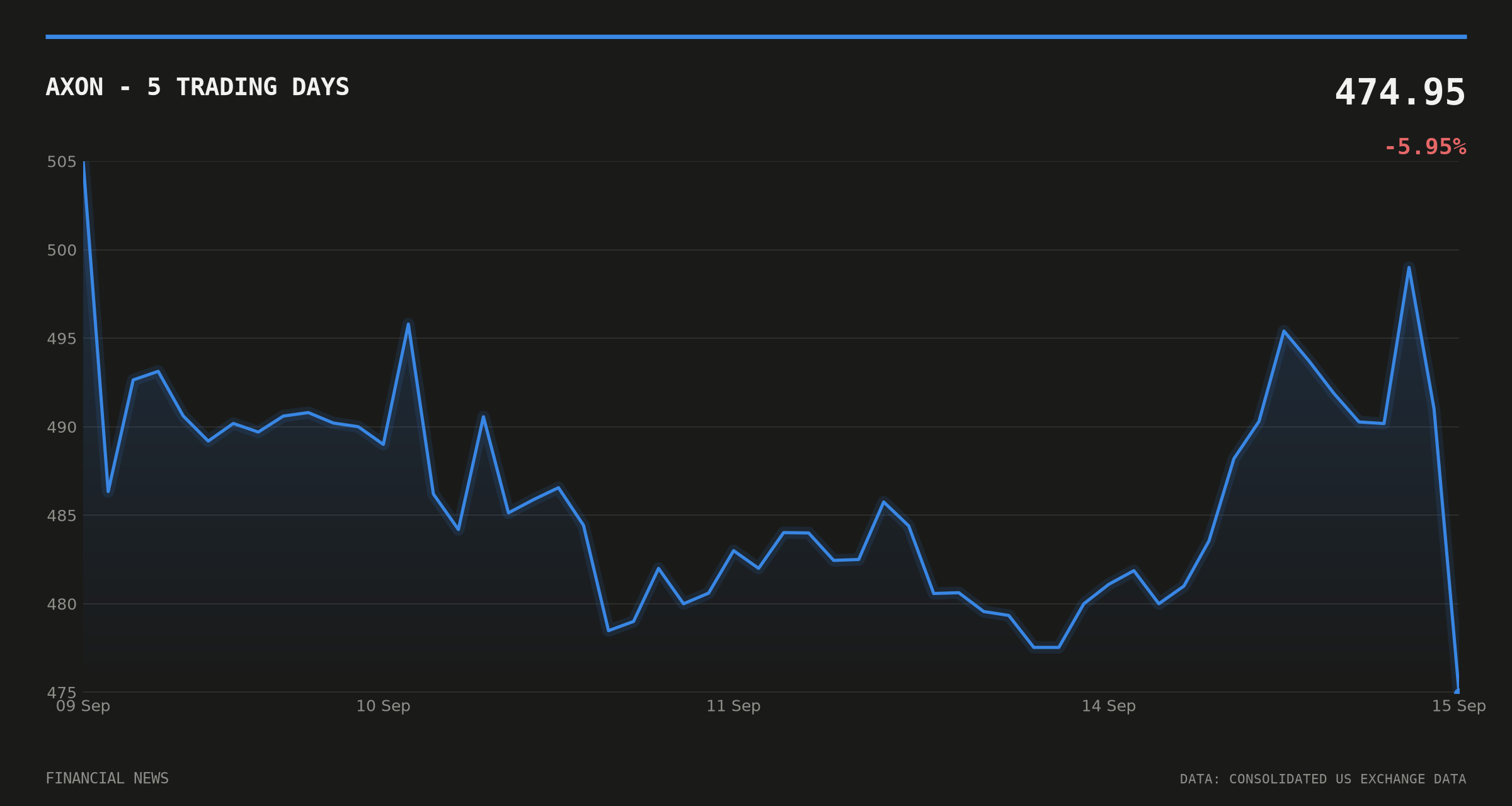
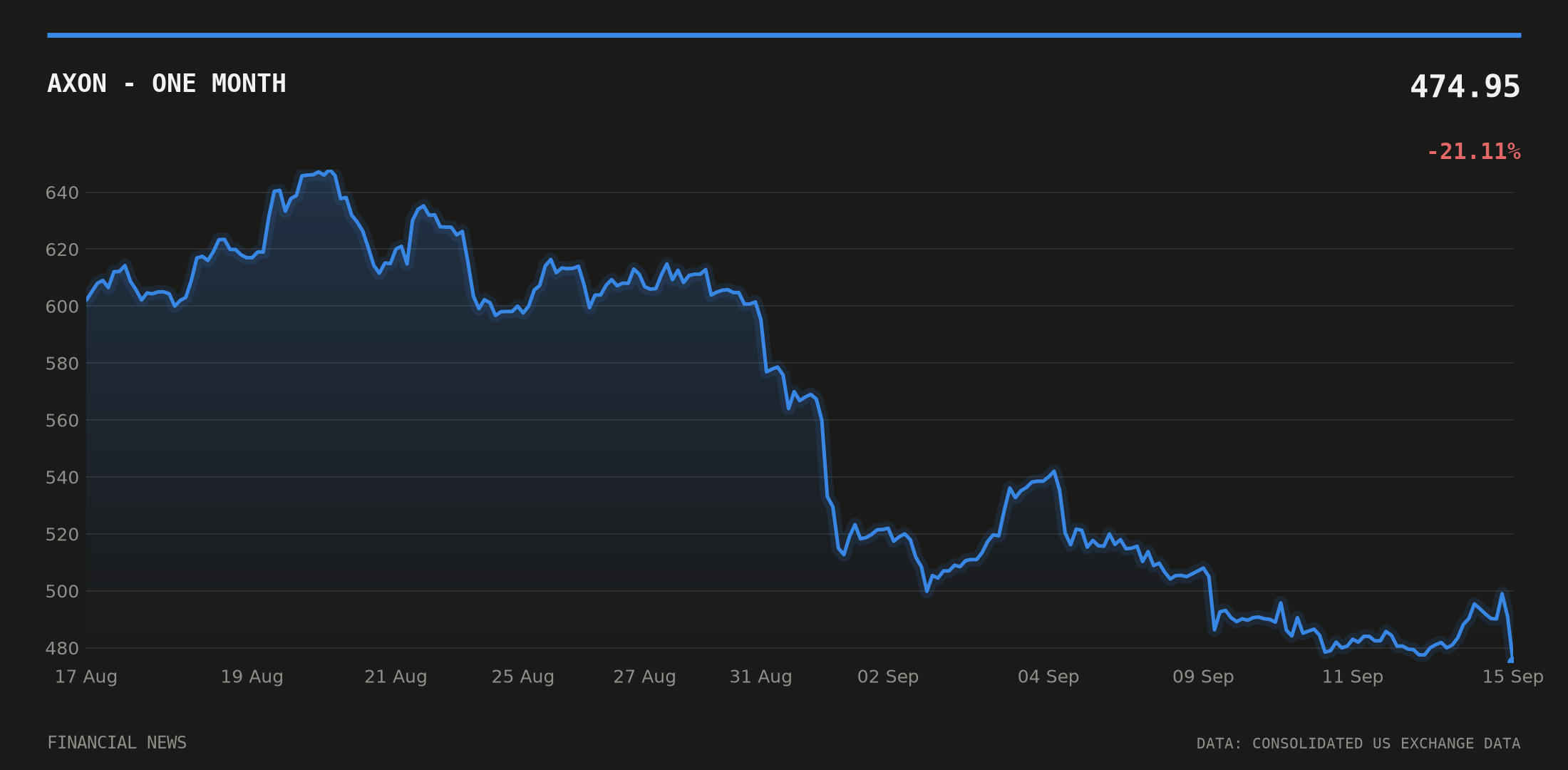
The announcement landed as Axon shares traded near $475.29 as of 11:00 UTC on 15 September, down 4.06% on the day and roughly 20.8% below the 20-day high of $616.38, according to stock market data. Trading volume sat close to the 20-day average.
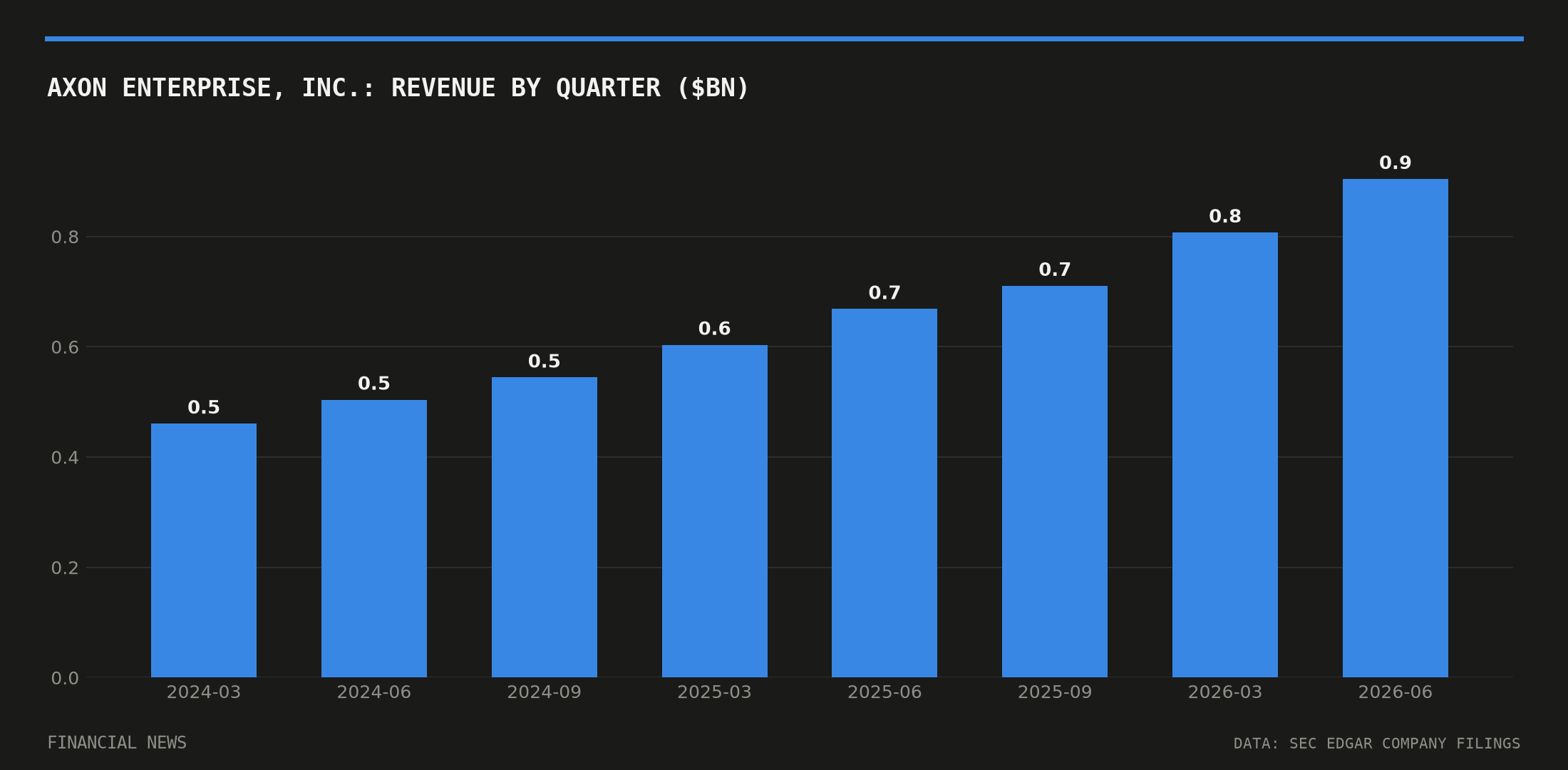
Axon’s revenue has kept climbing through that share-price slide. Quarterly revenue rose from $460.7m in the first quarter of 2024 to $904.4m in the second quarter of 2026, according to the company’s quarterly filings with the SEC. Net income has been less consistent: Axon posted a net loss of $2.19m, or 3 cents a share, in the third quarter of 2025 despite the revenue growth, before rebounding to net income of $169.3m in the first quarter of 2026.
Analyst sentiment on Axon has swung sharply in recent weeks. Argus raised its price target to $600 from $460 on 3 September, and a separate ‘Top Pick’ rating with an $825 target was reaffirmed on 10 September, according to CNN’s markets tracker. Simply Wall St’s fair-value model, meanwhile, has been revised down from roughly $521 to roughly $420 as analysts pared back revenue expectations.
Financing against a firmer-rate backdrop
The 10-year US Treasury yield stood at 4.96% and the 2-year at 4.63% on 11 September, with the 10-year/2-year spread at 0.32 points, according to data from the Federal Reserve Bank of St Louis. Against that backdrop, a zero-coupon structure offers Axon financing well below prevailing market rates, provided investors are willing to accept the conversion terms in place of a cash yield.
Pricing and final terms of the offering, including the conversion price, remain subject to market conditions, Axon said in its announcement, as first reported by Benzinga and confirmed separately by Seeking Alpha. Investors will get clarity on those terms, and on how the credit-facility upsize interacts with the raise, once the deal prices.
This article is for information only and is not investment advice or a recommendation to buy or sell any asset. Markets move quickly; figures are correct as sourced at the time of writing. Always do your own research before making financial decisions.
