Tencent Music Entertainment Group (NYSE: TME) reported third-quarter revenue of RMB8.94bn on 17 November 2026, up 5.6% from RMB8.46bn a year earlier.
Profit attributable to equity holders held at RMB2.15bn, unchanged from the same period in 2025, even as the top line grew, according to the company’s Form 6-K filing with the SEC.
Tencent Music Q3 revenue beats profit growth
Non-IFRS diluted earnings per American depositary share came in at RMB1.55, against RMB1.54 a year earlier, the filing shows.
Non-IFRS net profit attributable to equity holders rose 1.7% to RMB2.45bn from RMB2.41bn, a narrower gain than the revenue growth implies, the filing states.
The IFRS and adjusted profit lines diverging from revenue growth echoes the framing in MarketScreener’s report, which described the quarter as “unchanged from a year ago” on attributable profit despite the sales increase.
Shares whipsaw on the miss
The headline revenue figure still fell short of Wall Street estimates, according to TradingView’s syndication of Seeking Alpha coverage, even as adjusted earnings and operating income beat consensus.
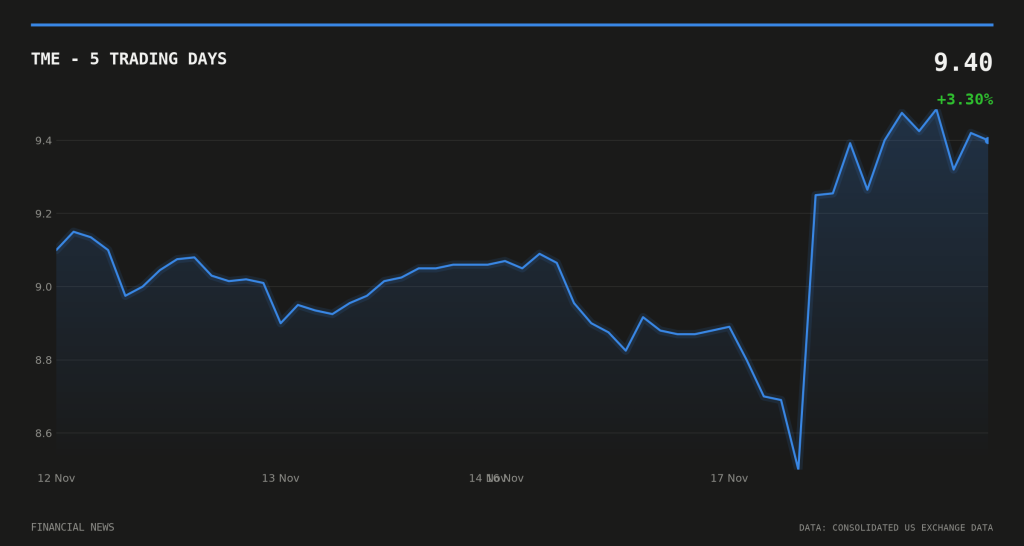
TME shares fell roughly 3.5% in premarket trading on the revenue miss before recovering to close up 6.36% at $9.445, GuruFocus reported. By the close of trading on 17 November, the stock stood at $9.40, up 1.46% on the day and 10.72% over the prior 20 sessions, with volume running more than twice the 20-day average.
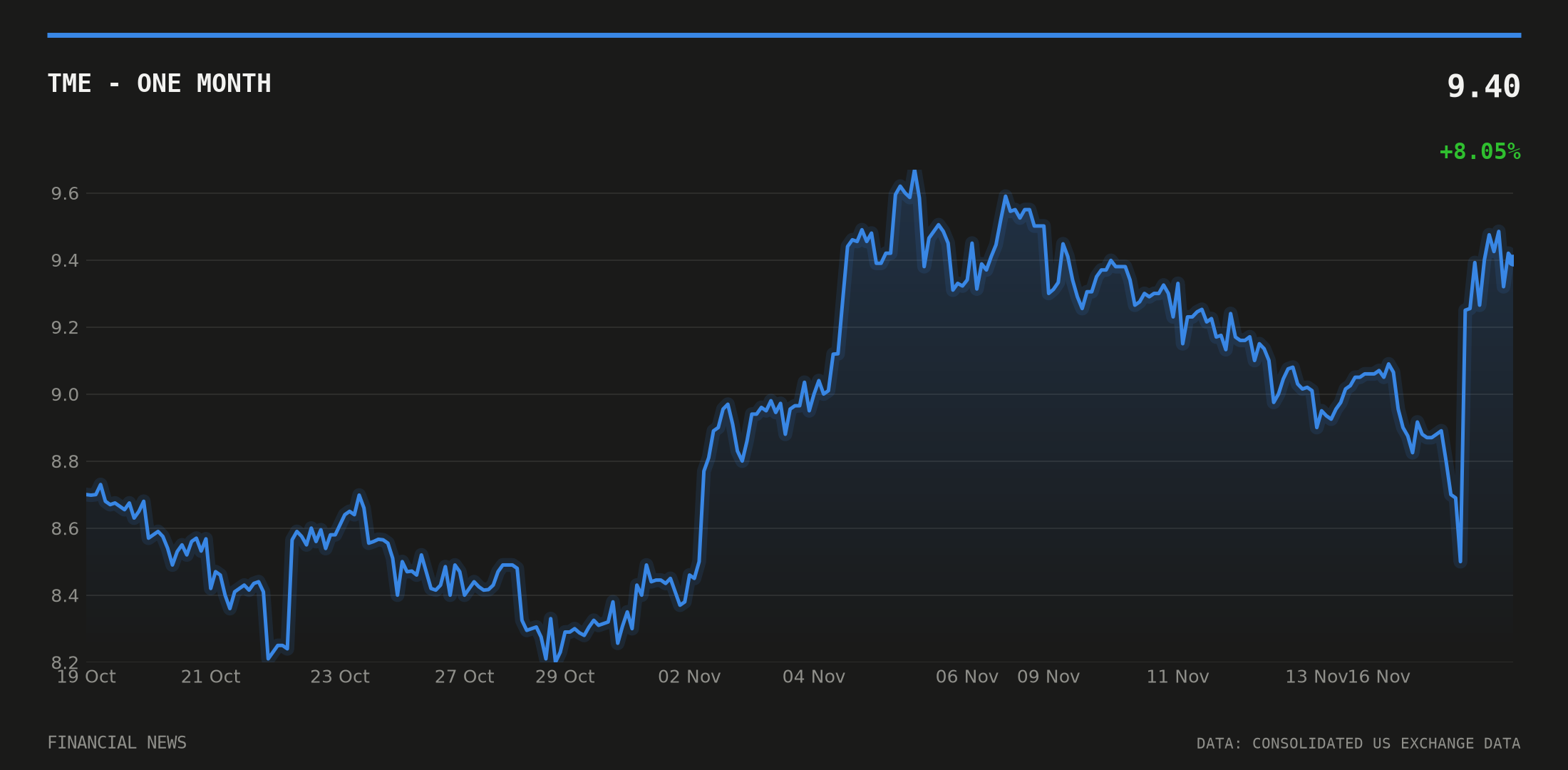
The stock had traded between $8.20 and $9.67 over the preceding month, putting Monday’s close near the upper end of that range.
Where the pressure sits
Chief financial officer Shirley Hu described the quarter as steady on the earnings call, pointing to adjusted EBITDA of RMB3bn, up 3% year-on-year, and non-IFRS net profit attributable to equity holders up 2%, according to a transcript published by The Motley Fool.
Social entertainment services revenue, the weakest line in the results, fell 15.7% year-on-year to RMB1.3bn, the transcript shows, a drag offset by gains in music subscriptions and intellectual-property-related services.
That split underlines the shape of TME’s business this year: subscription and IP revenue carrying growth while the older social entertainment segment continues to shrink. Investors appear to have weighed that mix more heavily than the top-line miss on the day, judging by the scale of the intraday reversal in the shares.
Filings and positioning
Separately, director Mak Yau Kee Adrian filed a Form 4 with the SEC on 16 November, a routine ownership disclosure unrelated to the earnings release itself.
Short-sale activity in TME has climbed through the run-up to results. FINRA data put the daily short-sale ratio at 0.271 on 5 November, rising in stages to 0.77 by 16 November before easing to 0.53 on 17 November, the day the figures were published, according to FINRA’s daily short sale volume data. The climb and subsequent pullback track the swing in sentiment seen in the share price itself, though the ratio stopped short of the peaks reached in mid-November.
The results land against a steadier US rates backdrop than TME has faced in recent quarters. The 10-year Treasury yield stood at 5.12% on 16 November, down slightly from 5.15% a day earlier, while the 2-year yield eased to 4.83% from 4.88%, according to Federal Reserve data. The 10-year/2-year spread widened marginally to 0.30 percentage points. US unemployment eased to 4.1% in October from 4.2%, and consumer prices rose modestly month-on-month, per the same Federal Reserve series — a backdrop that has left risk appetite for China-exposed ADRs broadly intact heading into the print.
TME’s next scheduled disclosure will be its fourth-quarter results, which will show whether the social entertainment decline has stabilised or continues to offset gains elsewhere in the business.
This article is for information only and is not investment advice or a recommendation to buy or sell any asset. Markets move quickly; figures are correct as sourced at the time of writing. Always do your own research before making financial decisions.