
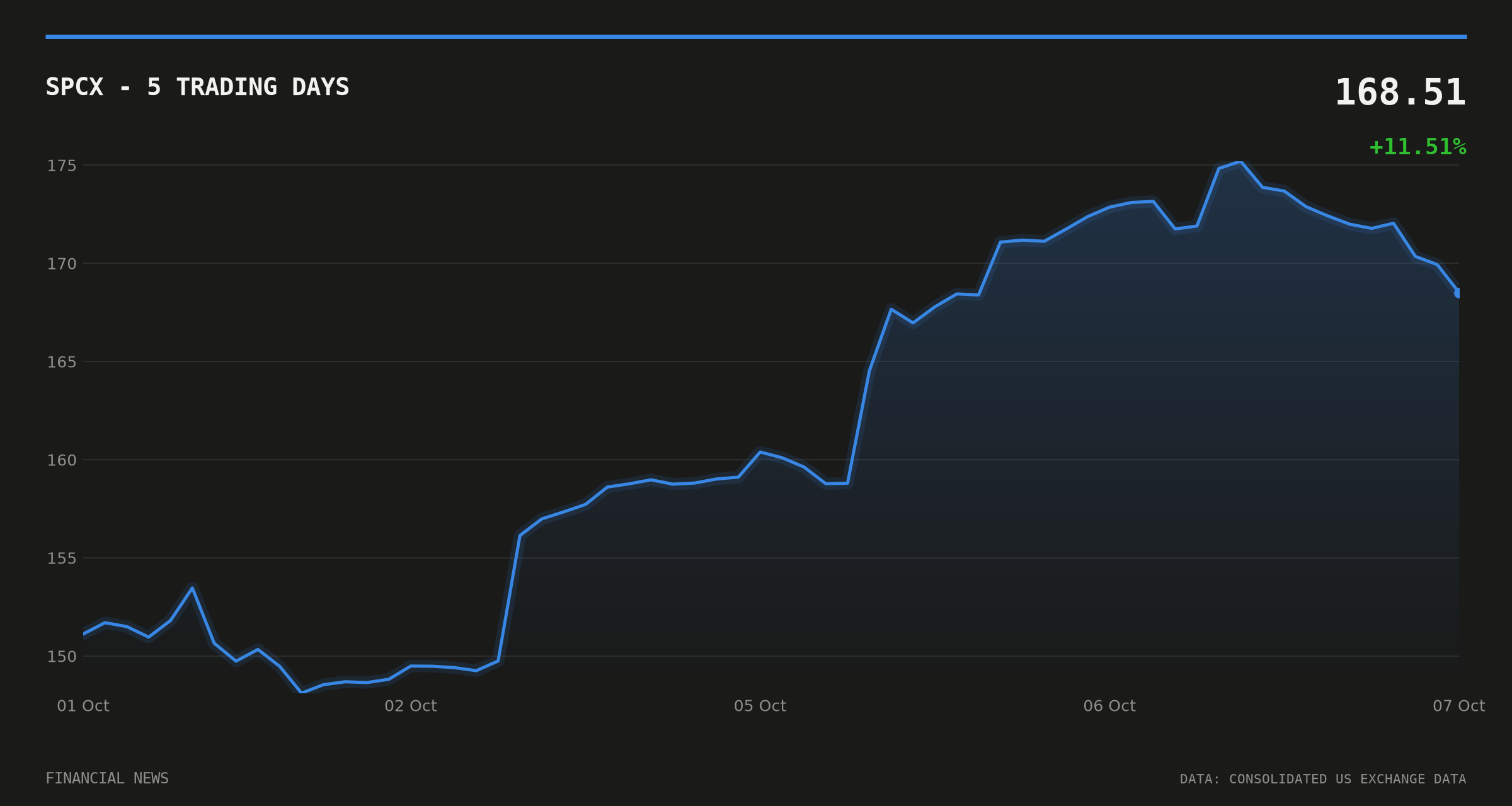

SpaceX (NASDAQ: SPCX) shares fell after hours on 6 October 2026 following a report of a $40bn Nvidia chip deal to fund the company’s AI data-centre buildout.
The financing, led by Apollo Global Management (NYSE: APO), would split into roughly $10bn of bank loans and $30bn of investment-grade debt, the Financial Times reported, as first reported by Reuters.
Why the SpaceX Nvidia chip deal remains unconfirmed
SpaceX, Apollo and Nvidia (NASDAQ: NVDA) did not respond to requests for comment, and the bond manager Pimco – named as among a small group of lenders in talks to provide financing – declined to comment, according to a Reuters wire picked up by Business Recorder. The arrangement traces to a single FT report that other outlets have since re-wired without independent confirmation from any of the four parties.
Apollo is expected to lead placement of the debt with a broad range of investors should the deal proceed, with the FT’s sourcing pointing to a close in 2027.
Shares barely flinch
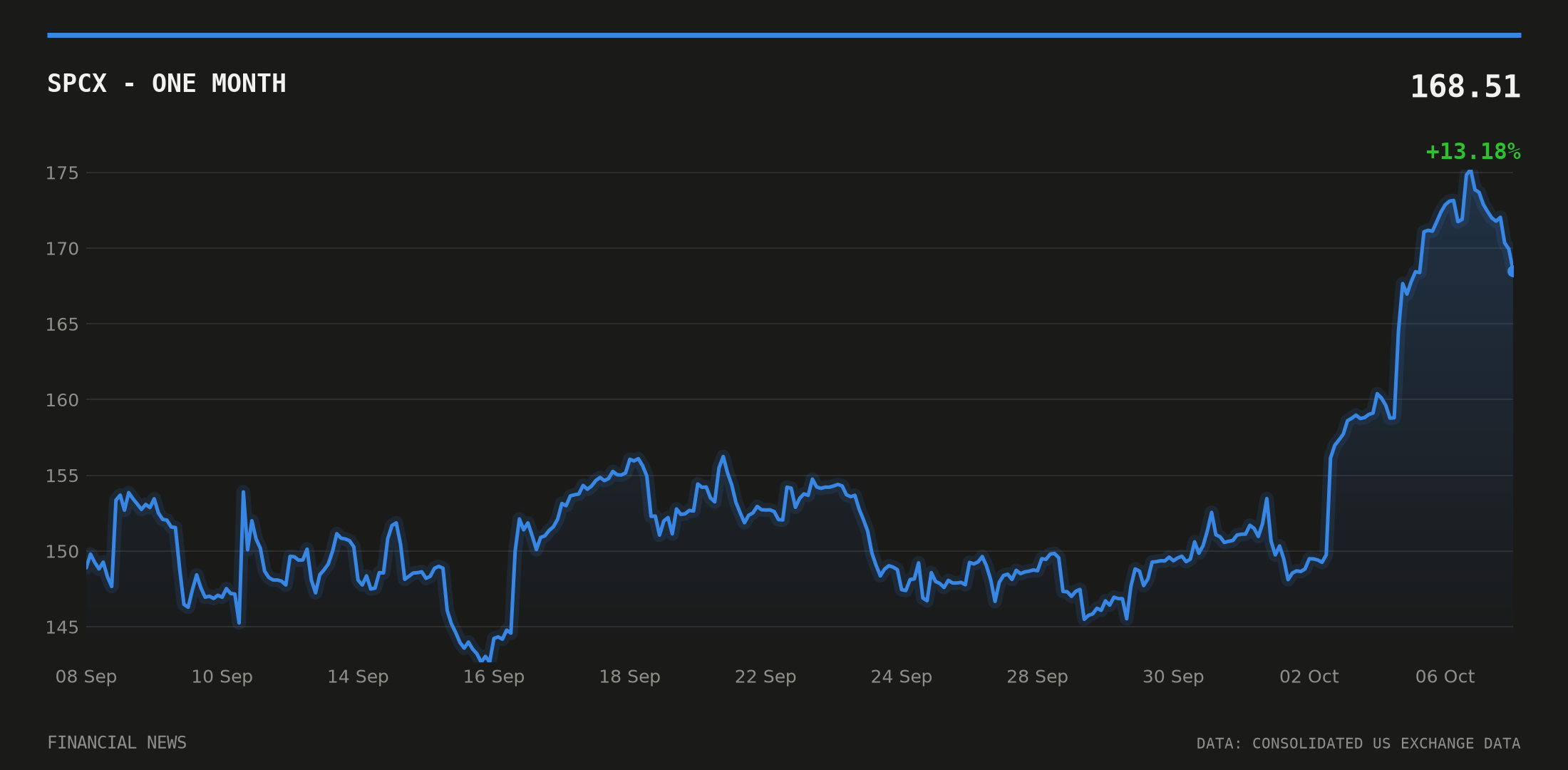
SPCX closed regular trading 0.49% lower at $171.92, then slipped a further 1.15% to $169.94 in after-hours dealing once the report broke, according to Benzinga. Nvidia shares, by contrast, rose about 0.5% in extended trading on the same news, Reuters reported via Investing.com.
The muted reaction fits a pattern: Apollo’s role in financing Nvidia’s AI supply chain was already public. In August, Nvidia named Apollo alongside BlackRock, Blackstone, Brookfield, Goldman Sachs (NYSE: GS) and KKR as partners in a platform to mobilise more than $500bn of third-party capital for AI compute infrastructure, Nvidia said at the time.
Musk’s Nvidia-only strategy
Elon Musk has said SpaceX’s data centres will run “exclusive to Nvidia” hardware, Yahoo Finance reported, a stance that makes the reported SpaceX Nvidia chip deal a logical next step rather than a surprise pivot. Musk has also said the company’s xAI unit could more than double the Nvidia chip count at its Colossus 2 cluster by the end of the year.
Investors weighing the financing have SpaceX’s underlying balance sheet to go on. The company reported a net loss of $541m for the quarter ended 30 June 2026, narrowing from a $1.008bn loss in the comparable period a year earlier, according to its 10-Q filed with the SEC. Diluted losses per share fell to 9 cents from 34 cents over the same span.
A listed stock born of a record IPO
SpaceX only has a traded ticker to move because of its listing on 12 June 2026, when it priced 555,555,555 Class A shares at $135 each, raising roughly $75bn at a valuation near $1.75trn, according to SpaceX’s own investor relations materials. That history explains why a financing report about chip purchases – the kind of detail that would once have stayed private – can now swing a public stock price overnight.
The borrowing plan also lands against a firmer rates backdrop. The 10-year US Treasury yield stood at 5.31% on 5 October 2026, up from 5.28% the previous session, according to Federal Reserve Bank of St Louis data – a cost-of-capital marker that bond investors will watch closely if the proposed $30bn investment-grade tranche comes to market.
Morgan Stanley has estimated that AI infrastructure build-outs will require $1.5trn in external financing by 2028, Reuters reported via Investing.com, framing SpaceX’s reported $40bn ask as one slice of a far larger debt-funded wave across the sector. CNBC’s Jim Cramer has separately floated the idea that SpaceX could eventually earn $3bn to $4bn a month renting out AI compute capacity even as it borrows to buy the hardware, Benzinga reported – a figure that has not appeared in any SpaceX filing.
For now, the SpaceX Nvidia chip deal sits where the Financial Times left it: a scoop that every principal involved has declined to confirm or deny, with a 2027 close date as the next marker investors have to watch for.
This article is for information only and is not investment advice or a recommendation to buy or sell any asset. Markets move quickly; figures are correct as sourced at the time of writing. Always do your own research before making financial decisions.
