

Self-Service Customer Portal and Automated Updates Eliminate ‘Where’s My Mount?’ Calls, Freeing yan Mercer counted the cost before he built MountChief. In a shop managing 200 active projects, each “where’s my mount?” call runs 5 to 15 minutes. And they never stop coming.
The calls arrive by phone, text, email and unannounced weekend visit. A hunter drops off a whitetail cape in November and hears nothing for months. They wonder whether work has started or whether the project sits half-finished on a shelf. Some worry their animal still lies in a freezer somewhere. So they call. Then they call again. The mention at hunting camp travels fast, and the shop’s reputation starts to move with it.
For the taxidermist answering those calls, the arithmetic is brutal. Five to fifteen minutes per inquiry, across a board of 200 active projects, adds up fast. Hours of the working day go before a single mount gets touched. The backlog grows. Wait times stretch. More calls follow. Meanwhile, the actual work drifts to the end of the day.
MountChief breaks that cycle at the point where it starts. Every specimen coming through the door receives a QR code at intake. Each stage of the process gets photo documentation and a timestamp. Every transition triggers an automatic notification to the customer. As a result, the phone stops ringing — not because the shop got better at answering calls, but because customers already know the answer before they reach for it.
The difference shows clearly in a single example. A hunter who dropped off a whitetail cape in November can open the MountChief portal in February. There they check current status, intake photos, tanning start date and upcoming form fitting schedule. By then, the shop owner has not responded to a single message. The customer has everything they need. That taxidermist has kept working.
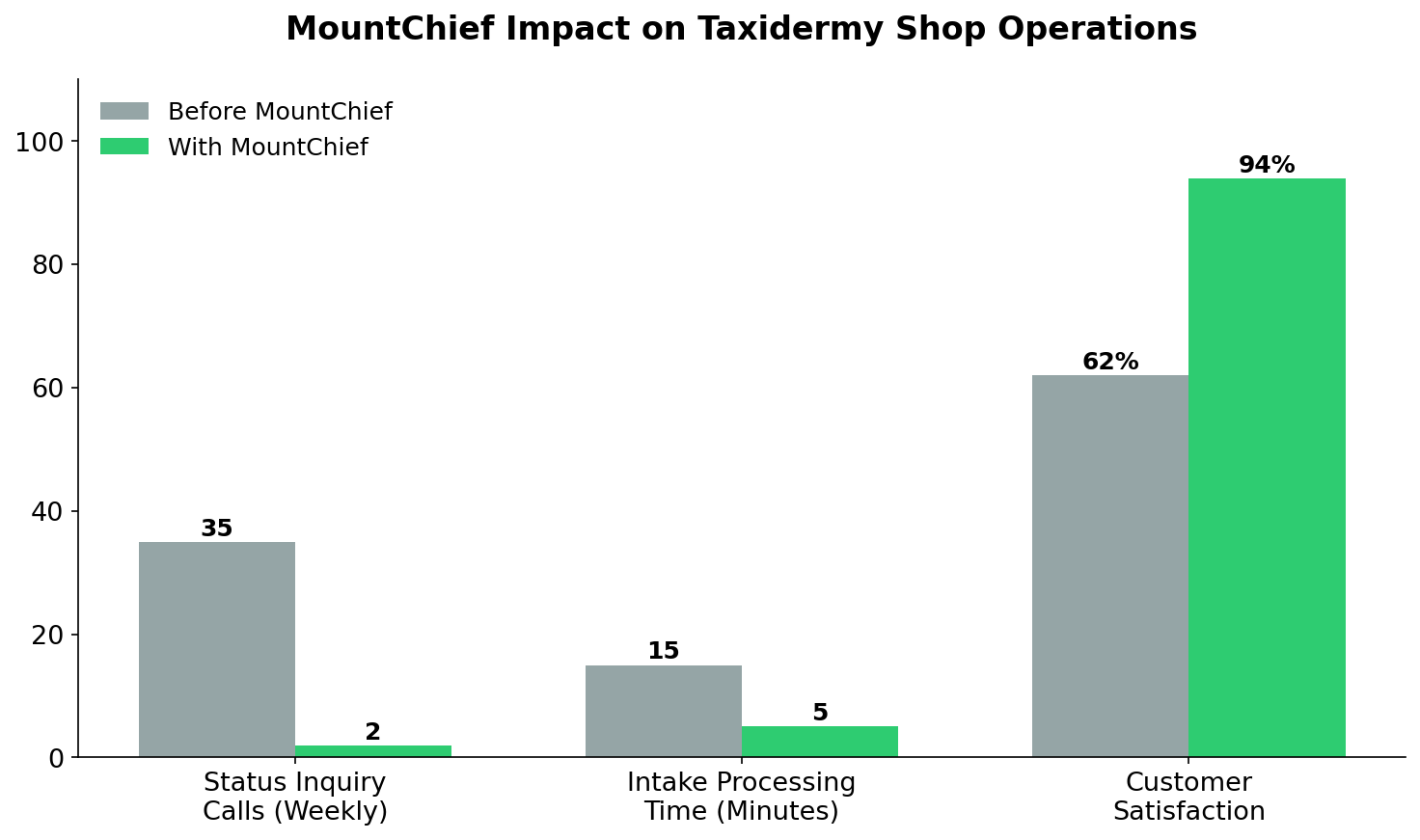
In turn, early adopters report that intake processing runs three times faster than paper forms. Status inquiry calls have dropped to near zero. Customer satisfaction has reached levels previously unusual in a trade where 12-month turnarounds remain common. All three figures come from operator self-reporting rather than independent review. Yet the mechanism behind them — removing the need for manual updates entirely — holds up logically.
Mercer did not frame the problem as a technology gap. He framed it as a craft problem. “Taxidermists are among the most talented artists you will ever meet,” he said. “They transform a raw cape and form into lifelike art that stops people in their tracks. Yet many run the business side like it is still 1995, relying on whiteboards, paper logs, and memory. MountChief leaves their craft untouched. It simply removes the administrative burden so they can focus on the work that matters.”
Together, the platform handles the full project lifecycle. Digital intake captures species details, customer preferences, pose options and reference photos. Every member of staff can access and track that record from the start. Job scheduling manages dozens or hundreds of simultaneous projects with priority flags and deadline monitoring. Photo documentation at every stage builds a visual record. That protects both the shop and the client if questions arise later. Automated progress updates send professional, timestamped notifications at each milestone. Photos attach where relevant, and the taxidermist never lifts a finger.
MountChief serves full-service studios, bird and fish specialists, European skull mount operations and high-volume commercial shops. In that respect, it follows the same pattern as platforms built for farriers, reptile hatcheries, septic operators and barn managers. All represent skilled trades that outgrew the whiteboards and paper systems they inherited, but never had software built around them. In each case, the tools that existed before either came from a neighbouring industry. Or required so much adaptation they barely worked.
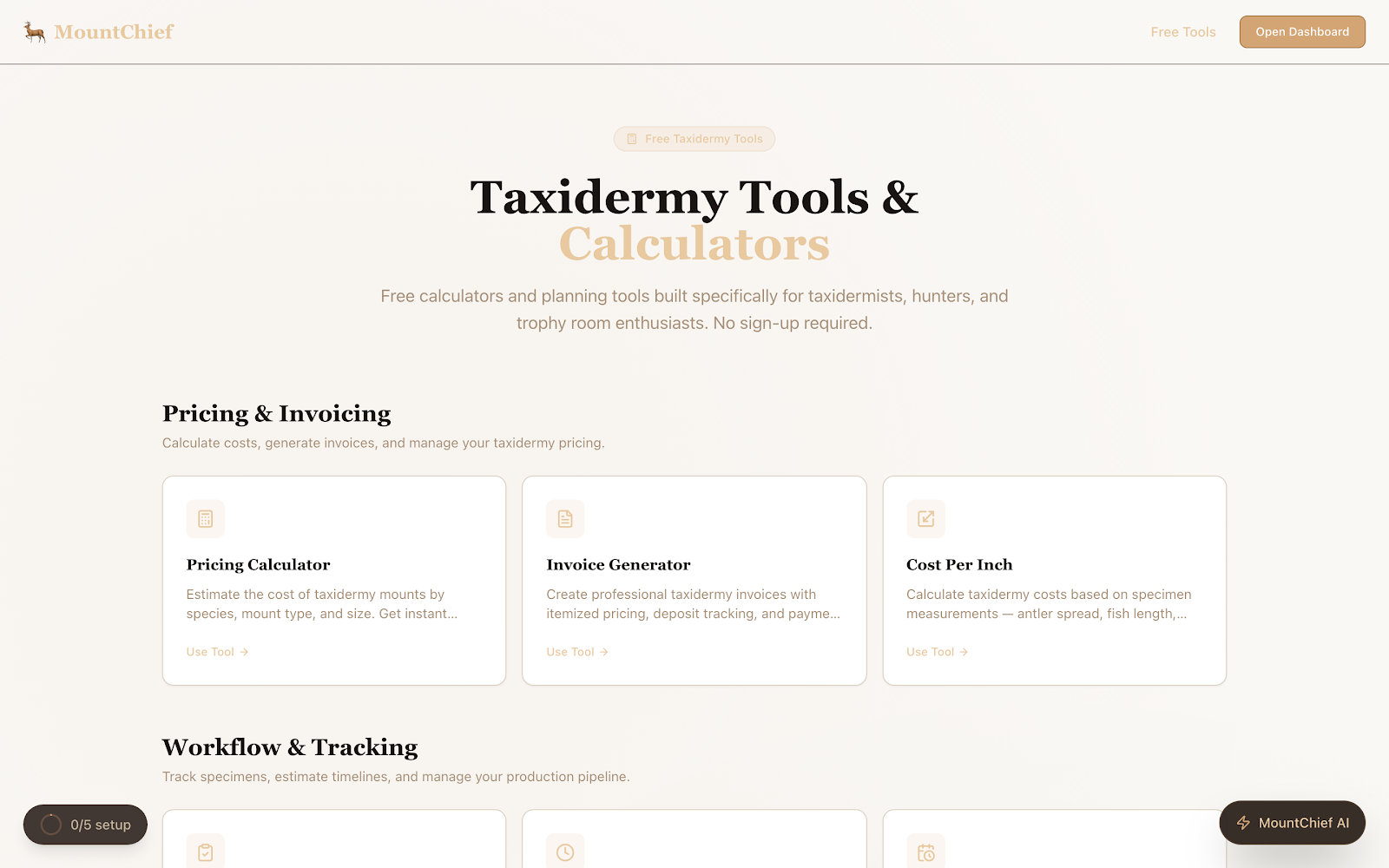
Free tools sit alongside the platform without needing an account. They include pricing calculators, turnaround time estimators and intake form builders. On top of that, a materials section covers tanning agents, forms, adhesives and finishing products in practical detail. Industry guides address pricing strategy and workflow planning for shops at every scale.
Somewhere in America right now, a hunter is picking up the phone to ask where their mount is. In a shop running MountChief, that call does not reach anyone. The answer is already on the customer’s screen.
