Delta Air Lines (DAL) delayed hundreds of flights across the US on 22 November 2026 after an automated system used to calculate aircraft weight and balance failed at its Atlanta hub.
By midday, 48% of Delta’s schedule was running late, according to FlightAware data cited in a wire report carried by Yahoo News. The tally kept climbing: by early afternoon FlightAware counted 1,245 delayed Delta flights out of 3,743 delays nationwide, ms.now reported.
Delta flight delays trace to a single Atlanta system
The fault sat with Delta’s Automated Load Instruction System, known internally as ALIS, which handles weight-and-balance calculations from the carrier’s Atlanta Operations and Customer Center, CNN reported. Staff fell back on manual workarounds while engineers worked on a fix, a process airlines have historically found far slower than automated load calculations at scale.
An air traffic control radio transmission captured by aviation trade site ATC.com and relayed by Paddle Your Own Kanoo described a controller flagging a “systemwide outage” tied to ALIS and affecting multiple stations. Early Sunday morning, roughly 700 flights — about 20% of Delta’s schedule — were already delayed, ABC7 New York reported.
The Federal Aviation Administration said the disruption was specific to Delta and unrelated to any FAA air traffic control system, according to ms.now. That distinction mattered: Delta had only recently finished recovering from a separate nationwide disruption on 13 November tied to an FAA ground stop, and its own advisory page showed it was still restoring full operations from that earlier event.
Second network failure in nine days
Sunday’s ALIS failure marks the second time in little over a week that Delta’s network has buckled under a technology fault rather than weather or crew shortages. The earlier incident was an air-traffic-control-side outage; this one originated inside Delta’s own operations centre. Delta is not alone in facing weight-and-balance system failures: United Airlines suffered a comparable outage in 2025 that triggered more than 1,000 delays and dozens of cancellations, CNN noted.
The timing compounds the disruption. The outage struck days before Thanksgiving, one of the busiest stretches of the US travel calendar, with more than four million passengers expected to pass through Atlanta’s Hartsfield-Jackson hub between 19 November and 1 December, according to CNN. Any slippage in Delta’s Atlanta operations tends to ripple through its wider schedule given the airport’s role as its primary connecting hub.
Markets were shut when the outage hit
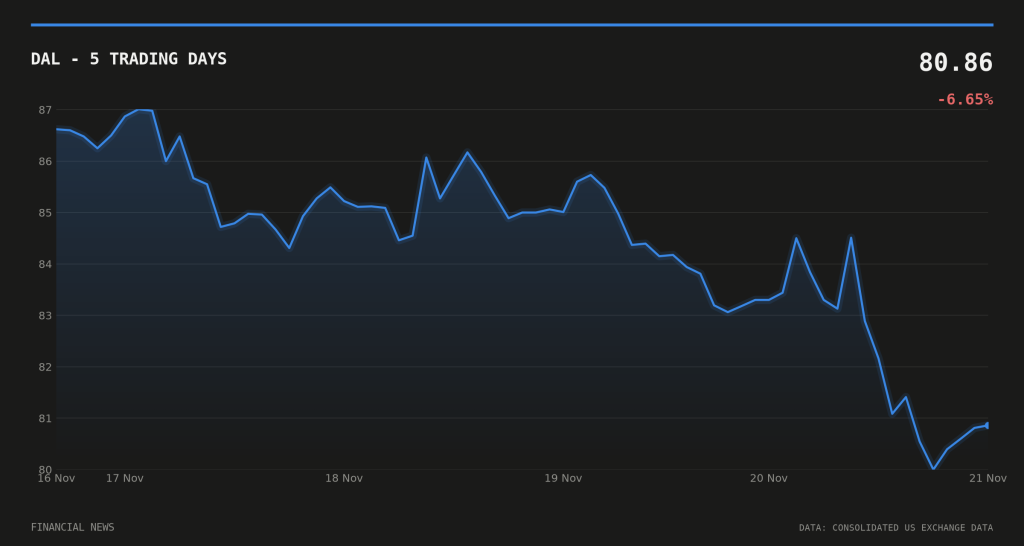
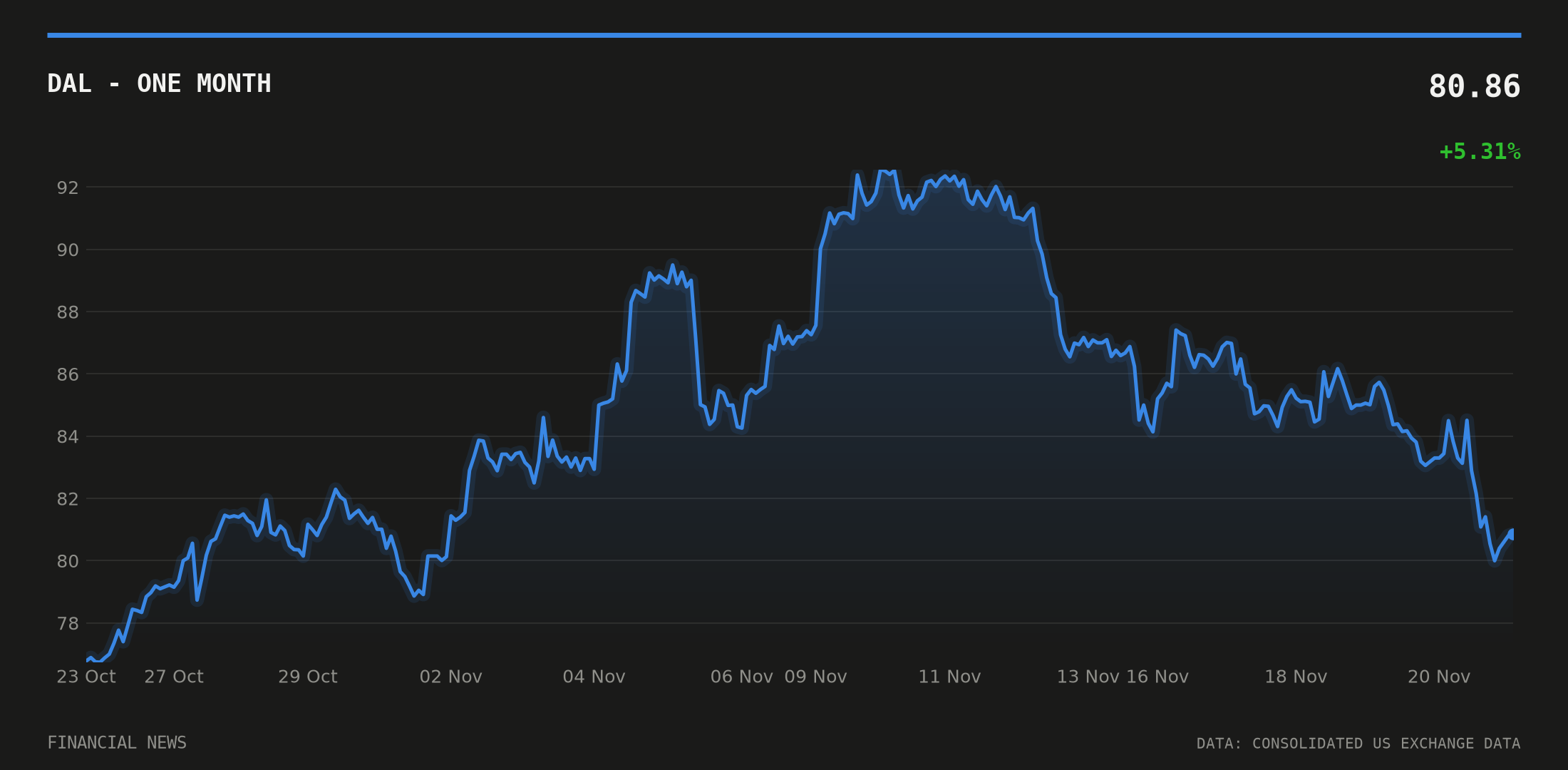
Because the failure began on a Sunday, US equity markets had no immediate chance to react. Delta shares last traded at $80.86 as of 21 November, down 0.71% over 20 days and sitting near the bottom of that range’s $80.00 low, according to consolidated exchange data. Trading volume in the preceding session ran 24% above the 20-day average.
Options and short-sale positioning had already been shifting before the outage. Delta’s FINRA short-sale volume ratio rose from 0.385 on 9 November to 0.514 on 20 November, the two trading sessions immediately ahead of the disruption, according to FINRA daily short sale data. Whether that shift reflects positioning tied to holiday-season operational risk or unrelated flow is not something the data alone can show.
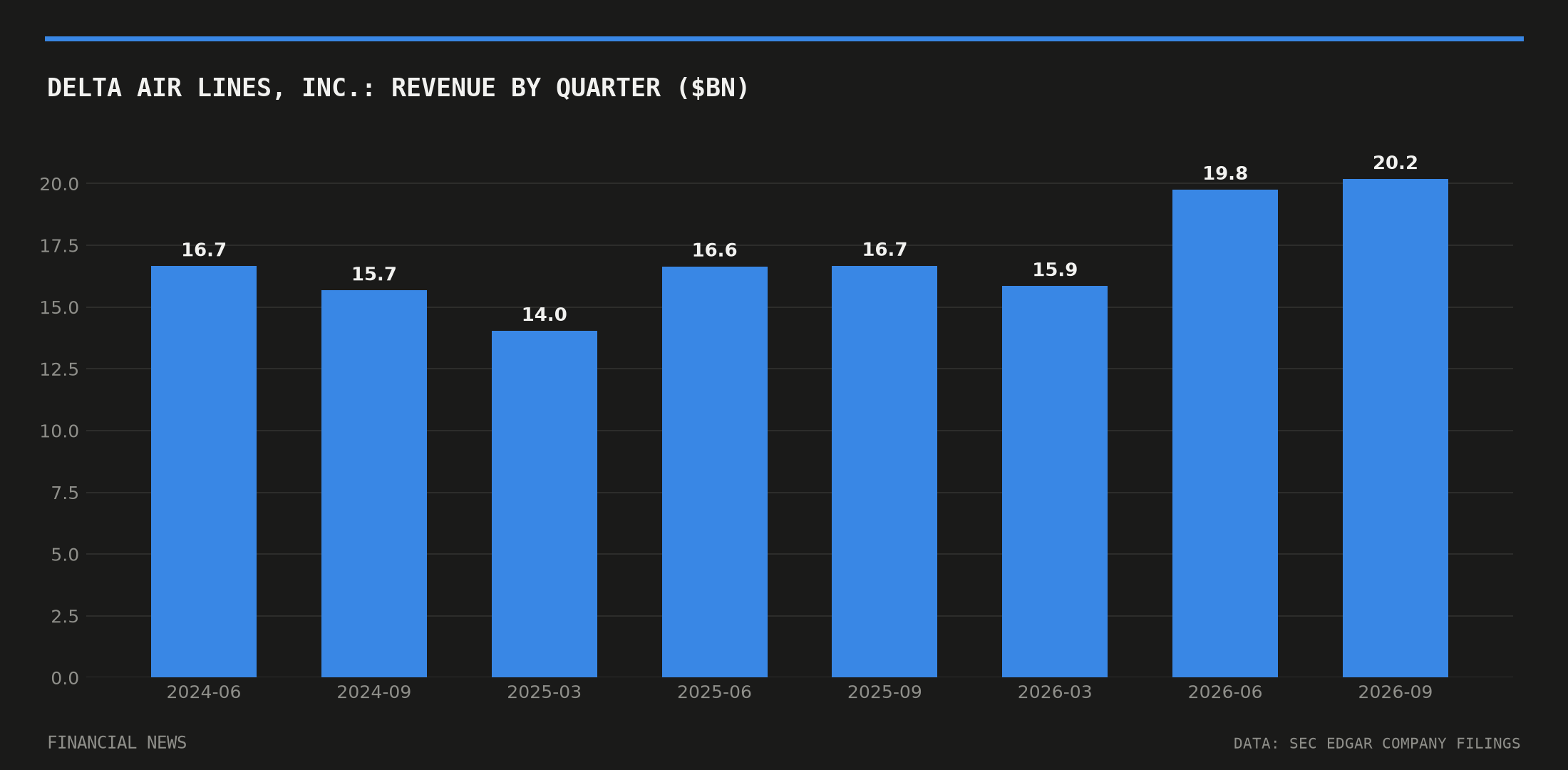
The outage also lands against a mixed earnings backdrop. Delta posted a rare quarterly net loss of $289m, or diluted earnings per share of -$0.44, in the first quarter of 2026, according to its 10-Q filed with the SEC. The carrier returned to profit in the following two quarters, reporting net income of $1.604bn in the second quarter and $756m in the third, per its most recent quarterly filing.
What happens next
Delta has not yet filed any disclosure quantifying the cost of Sunday’s delays, and none would typically be expected until the carrier’s next quarterly report. Passengers and crews face a tight window to clear the backlog before Thanksgiving traffic peaks at Atlanta and other hubs. Market participants will be watching Monday’s opening trade for the first read on how investors price a second network failure inside a fortnight, alongside any update from Delta on when ALIS returned to full function.
This article is for information only and is not investment advice or a recommendation to buy or sell any asset. Markets move quickly; figures are correct as sourced at the time of writing. Always do your own research before making financial decisions.