

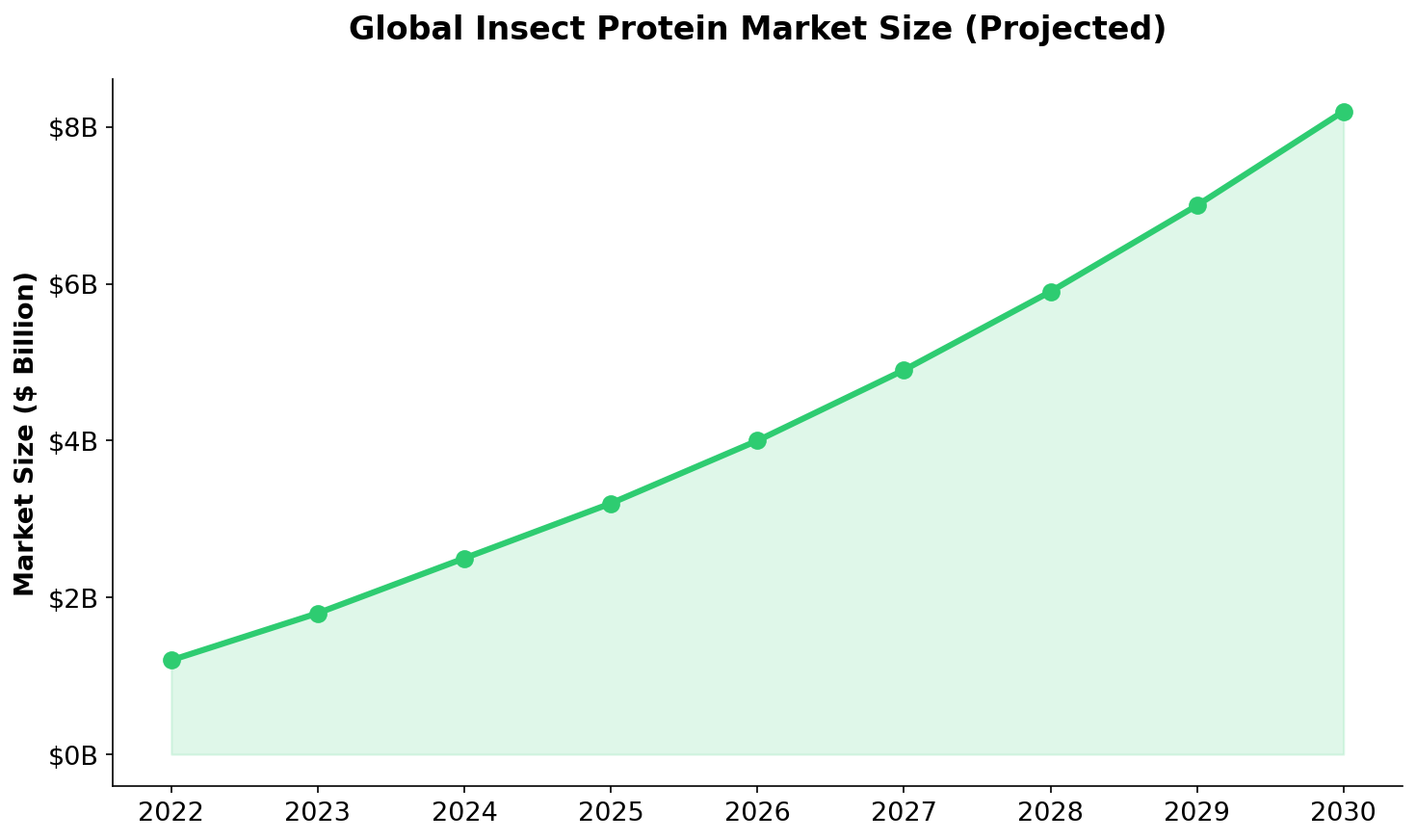
The global insect protein market could reach $8 billion by 2030. Most of the farms producing that protein still manage operations on spreadsheets and whiteboards. Priya Sharma built CricketOps in Los Angeles to close that gap.
Three insect species drive most of the commercial activity. Crickets go into protein flour for consumer food products. Black soldier fly larvae replace fishmeal in aquaculture feed, an application that has drawn serious investment from the fish farming industry as wild-catch fishmeal supplies tighten. Mealworms have become a key ingredient in premium pet foods, a category that commands significant retail margin. Each species runs on different environmental requirements, different growth cycles and different production economics — yet most farms managing all three still track operations the same way.
Environmental control is where manual management becomes most costly. Small shifts in temperature, humidity, CO₂ levels or airflow can materially affect insect growth rates, trigger disease development and alter feeding behaviour. In a facility running multiple rooms with different species or growth cohorts, those variables require continuous monitoring across every zone simultaneously. The whiteboard cannot do that.
CricketOps connects directly to IoT sensors installed across production facilities, measuring temperature, humidity, CO₂ and airflow in real time. The system compares readings against species-specific optimal ranges for each stage of development. When conditions drift outside those thresholds, it alerts operators immediately. Large farms managing dozens of zones receive independent environmental tracking for each area — the system does not average conditions across a facility but monitors and responds to each space on its own terms.
Cameras do the rest of the close observation. At regular intervals, computer vision analyses images of insect bins for indicators that manual walkthroughs would likely miss: unusual mortality patterns, stress signals, developmental irregularities and early signs of disease. In a facility where a single inspector might check hundreds of bins across a shift, automated visual monitoring changes what is observable. Problems that would previously surface only at harvest — when recovery is impossible — surface earlier.
Sharma framed the broader opportunity in sustainability terms. “This industry is producing high-quality protein with a fraction of the water, land, and emissions required by traditional livestock,” she said. “But many farms are still operating without the kind of software infrastructure that other agricultural sectors rely on. CricketOps was designed to bring modern operational intelligence to insect farming so the industry can scale efficiently.”
Yield prediction and batch traceability address the production planning problem. The forecasting tools estimate harvest timing and expected biomass by building predictive models from each farm’s own historical data — accounting for feed composition, population density, temperature, humidity and genetic strain, all of which cause growth rates to vary. Batch records capture environmental conditions, feed inputs, health monitoring results, treatments and processing information from egg to harvest. Food manufacturers, retailers and regulatory bodies increasingly require that level of documentation, and CricketOps generates it automatically rather than leaving it to manual record-keeping.
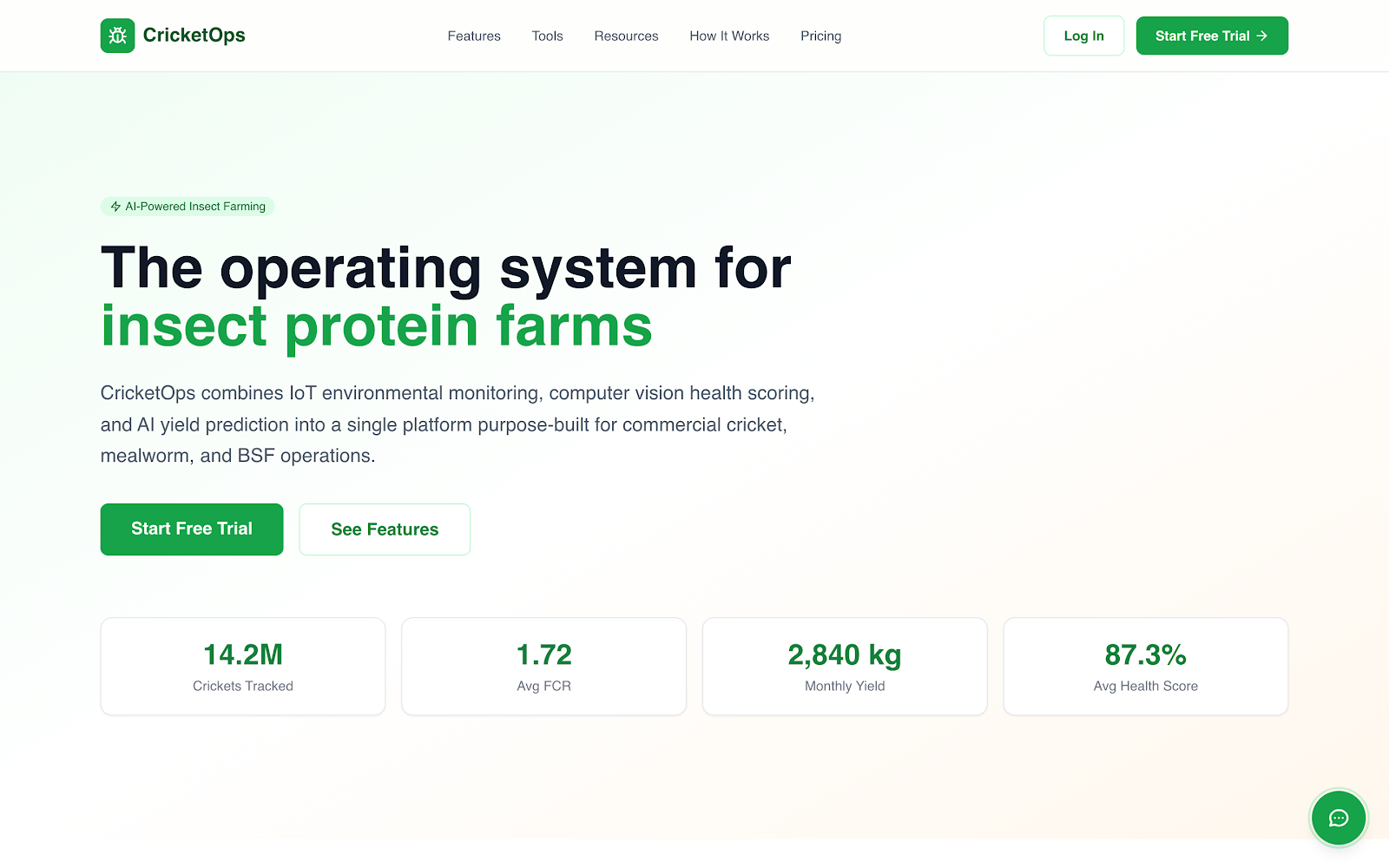
Feed conversion ratio sits at the centre of insect farm economics. FCR measures how much feed a farm needs to produce one kilogram of insect biomass — the lower the ratio, the more efficient the operation. CricketOps tracks FCR performance across batches and correlates results with feed formulations, particle size, moisture levels and feeding schedules. Over time, those correlations identify which feeding strategies improve efficiency and which drive unnecessary cost. For an industry where margins depend heavily on feed input costs, that data matters.
CricketOps serves commercial cricket farms, mealworm producers, black soldier fly operations, insect-based pet food manufacturers, alternative protein startups and research institutions studying insect production systems. The platform extends the vertical AI pattern already emerging across fragmented agricultural and trade industries — the same operational intelligence gap that SepticMind addresses for wastewater services and PollenOps addresses for commercial beekeeping appears here in a sector that is scaling faster than its management infrastructure.
A substrates reference library covers feed formulations, moisture management and nutritional profiles for commercially produced species. Free standalone tools — feed conversion calculators, environmental parameter planners and batch yield estimators — require no account to access.
The $8 billion projection arrives in 2030. Between now and then, the farms that build operational infrastructure early will carry the efficiency advantages that compound across every production cycle. Sharma’s argument is straightforward: the protein is already competitive. The operations need to catch up.
