

One to four days. That’s how long it typically takes a tree service company to deliver a quote after a homeowner calls. Lucas Brandt built StumpIQ in Los Angeles to compress that timeline to minutes.
The traditional process is laborious by necessity. A homeowner reports a tree. The company dispatches an estimator — sometimes a twenty-minute drive, sometimes over an hour — who assesses species, trunk size, lean angle, canopy spread, proximity to structures and power lines, equipment access, and complications like roots near foundations or branches crossing a neighbour’s property. Back at the office, the estimator prepares and sends the quote. By the time it arrives, the homeowner may have already hired someone faster.
StumpIQ’s photo quoting engine attacks that gap directly. Homeowners submit images of the tree in question. The AI analyses species, estimated trunk diameter, canopy spread, lean direction, proximity to structures and utility infrastructure, equipment access and overall site complexity, then generates a pricing estimate that the company reviews and sends — all within minutes. Training on thousands of real tree service jobs with documented outcomes, it builds a model that accounts for the variables that actually move price.
The 24-inch oak comparison illustrates how that training matters. A 24-inch oak standing in an open yard requires one approach. One leaning over a garage with power lines running through the canopy requires a fundamentally different one. The AI evaluates those distinctions rather than treating trunk diameter as the primary variable.
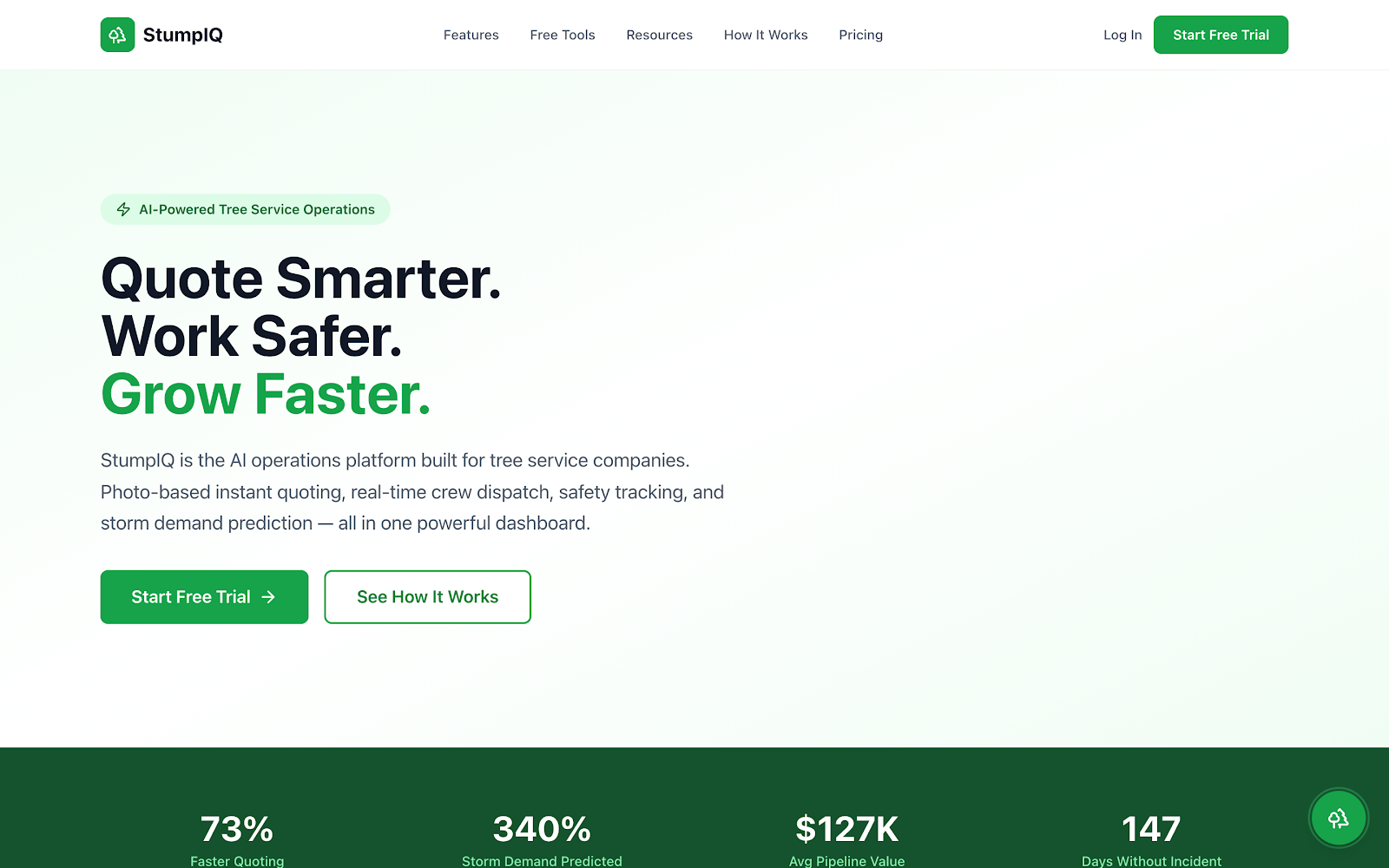
Brandt did not build the system to replace estimators. Complex jobs still need a physical inspection. Instead, the photo quoting engine functions as a triage tool — the system quotes immediately any job photos can assess accurately, and flags complicated cases for an on-site visit. The result is fewer estimator dispatches for smaller projects, and faster responses for customers across the board. General field service platforms such as Jobber and ServiceTitan handle scheduling and invoicing for trades businesses, but neither carries photo-based quoting or storm intelligence built specifically for arborist work.
Storm demand is where StumpIQ diverges furthest from anything else in the market. Severe weather events drive more incoming calls in 48 hours than many tree companies handle in an entire month. Most operators react to that surge — scrambling for crews, renting equipment, competing for the same subcontractors. StumpIQ’s prediction engine forecasts demand spikes up to seven days out, drawing on weather data, historical storm damage patterns, regional tree density, species distribution and each company’s own service history. Early notice lets operators pre-position crews, stage equipment and launch targeted advertising in affected areas before competitors know the storm is coming.
Brandt put the competitive advantage plainly. “After a big storm, every tree service company in town is scrambling,” he said. “They’re calling in off-duty crews, trying to rent extra equipment, and competing for the same subcontractors. The companies using StumpIQ already have their crews deployed before the first call comes in. That’s the difference between capturing the surge and watching it go to competitors.”
Beyond quoting and storm prediction, the platform covers day-to-day field operations. Crew dispatch tools include GPS tracking so business owners see crew locations, current jobs and availability in real time. A safety dashboard tracks certifications, equipment inspections, incident reports and OSHA compliance across every crew member. Tree inventory tools serve municipal clients and commercial property managers maintaining ongoing documentation and risk assessments across large sites.
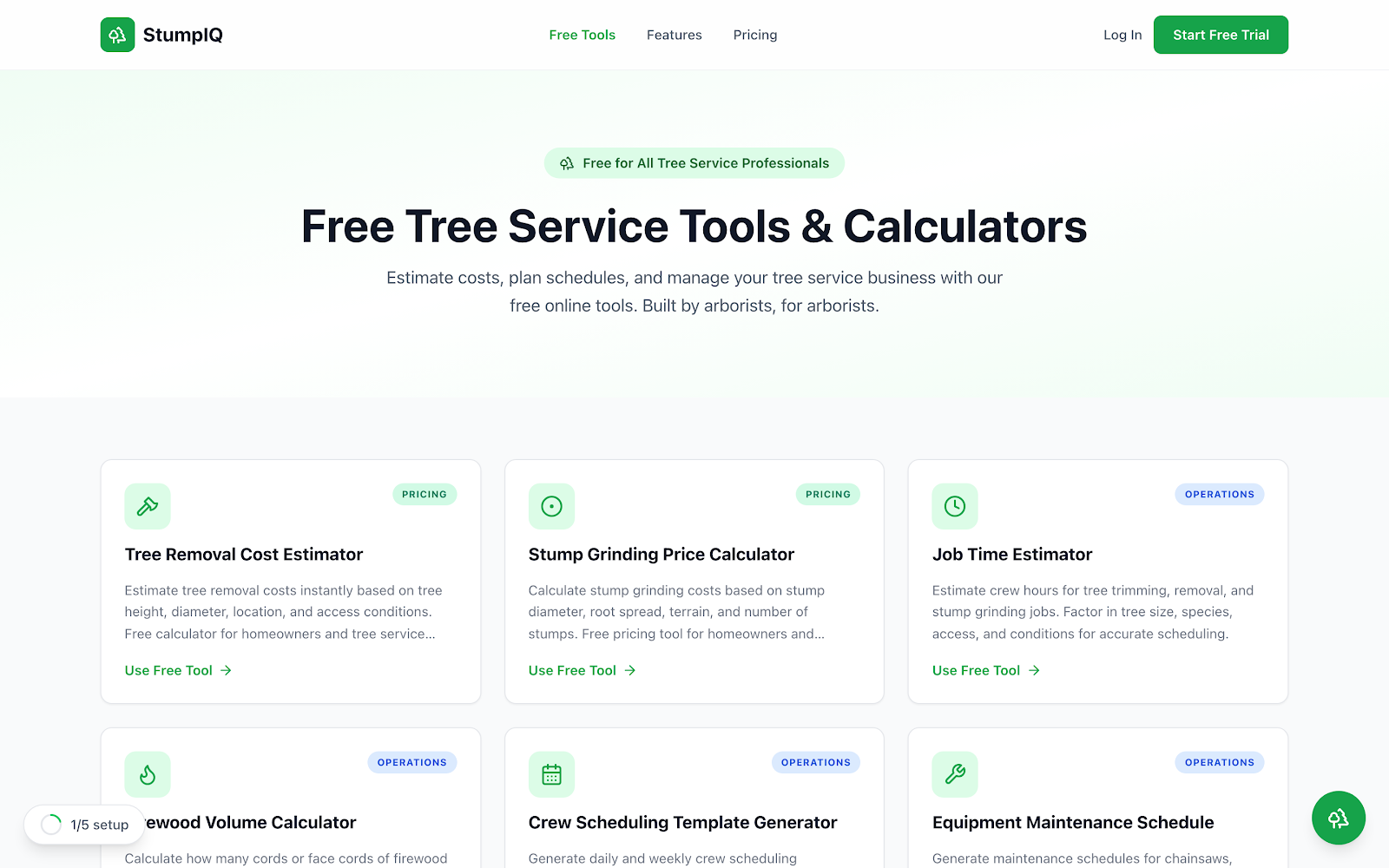
StumpIQ also maintains a species database covering removal difficulty ratings, root system characteristics, storm vulnerability scores and regional distribution data for major North American tree species. Free tools sit alongside the platform as standalone resources. They include removal cost estimators, stump grinding calculators, storm risk assessment tools and canopy evaluation guides.
The platform serves tree removal companies, trimming services, stump grinding businesses, arborist consulting firms and municipal forestry departments. Tree service remains a fragmented market where small operators with limited administrative infrastructure run most of the work. Most schedule from a notepad, quote from memory and learn about storm demand when the phones start ringing. StumpIQ’s argument is that companies which adopt operational intelligence earliest will capture a disproportionate share of the work that comes after every major storm.
Whether that prediction proves accurate depends partly on how quickly tree operators adopt AI-assisted quoting — and partly on how reliably the storm forecasting performs in the field. The seven-day horizon is ambitious. Brandt’s bet is that even an imperfect early warning beats no warning at all.
