

Accenture (NYSE: ACN) has acquired Sagacity, a London-based data and AI customer intelligence firm, the companies said on 13 October 2026. More than 140 Sagacity professionals join Accenture Song’s UK and Ireland business under the deal.
Terms were not disclosed, according to the announcement. Accenture said the deal strengthens its ability to deliver what it called AI-powered customer reinvention at scale.
A small deal, a big AI pitch
Sagacity was founded in 2005 by Anita Dougall, Malka Townshend and Harry Dougall. It is headquartered in London and works with clients across utilities, retail, banking and telecoms, sectors Accenture flagged for their large customer bases and complex journeys.
No Form 8-K was filed for the transaction on the SEC’s EDGAR system. The nearest contemporaneous Accenture filing covers a $300m floating-rate notes offering through Accenture Capital, unrelated to the Sagacity purchase. The absence of a dedicated disclosure is unsurprising: a sub-150-person acquisition sits well below the threshold that would register against a company of Accenture’s scale.
Context: a rounding error against quarterly revenue
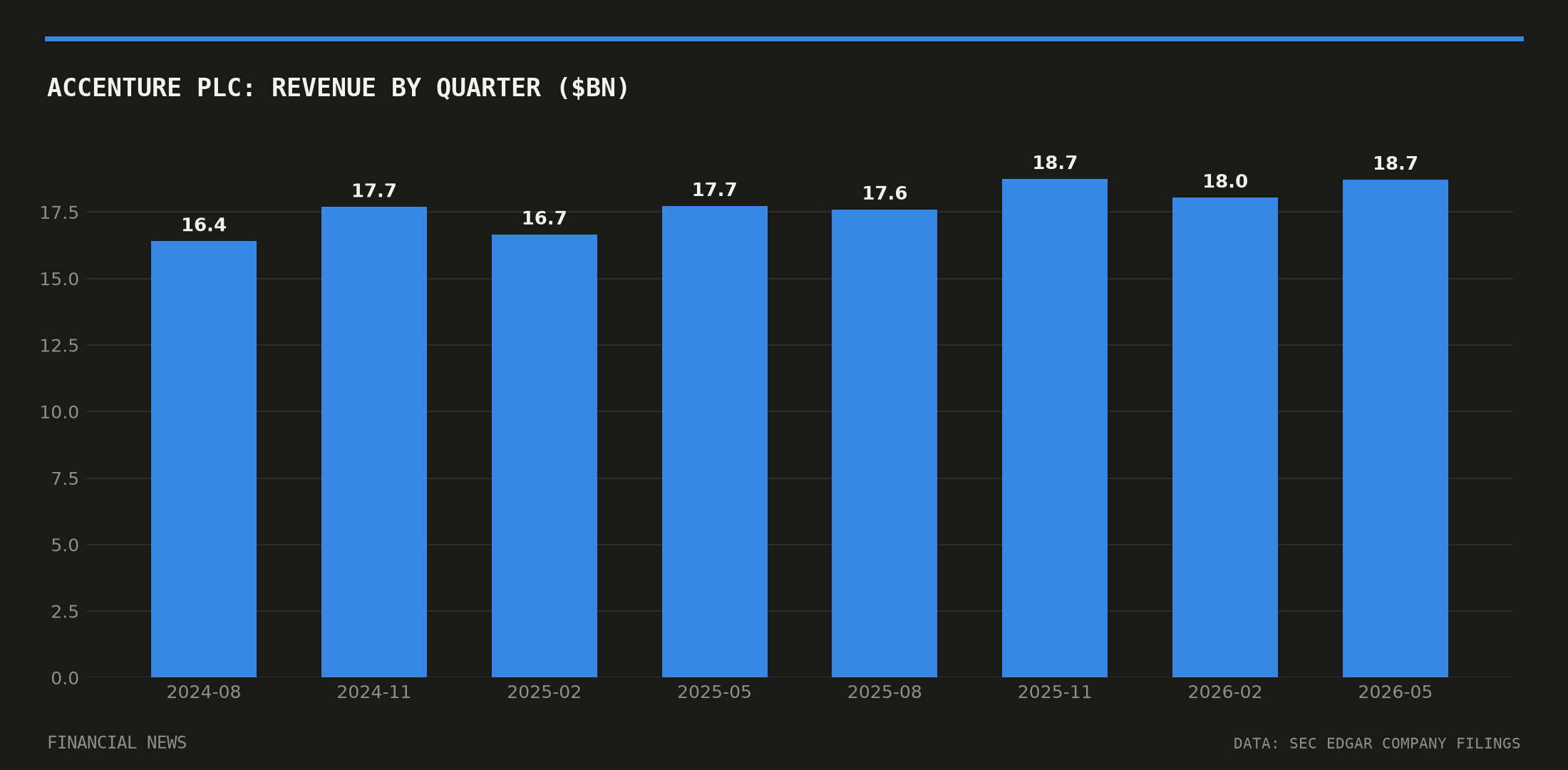
Accenture reported revenue of $18.72bn for its fiscal third quarter, the three months to 31 May 2026, with diluted earnings per share of $3.80. That marks a rise from $18.04bn in the preceding quarter, which ended 28 February 2026, and from $18.74bn in the quarter before that, which ended 30 November 2025. Diluted EPS across the same three quarters ran at $2.93, $3.54 and $3.80 respectively, a pattern that shows steady sequential growth through the fiscal year. Against a top line measured in the tens of billions each quarter, a deal the size of Sagacity barely registers on the balance sheet, even as it generates a full press release and syndicated coverage across multiple outlets.
That gap between financial materiality and public profile is now a recurring feature of Accenture’s acquisition strategy. The company has built a long run of bolt-on purchases designed to add specific capabilities rather than scale revenue in a single step; an earlier, unrelated deal for Sagacious Consultants, a Kansas-based Epic health-records consultancy, followed the same pattern of a narrowly scoped purchase announced with full corporate messaging. Sagacity fits that mould: a few hundred staff, a specific sector focus, and a positioning statement built around artificial intelligence rather than headcount or fee income.
Market reaction muted
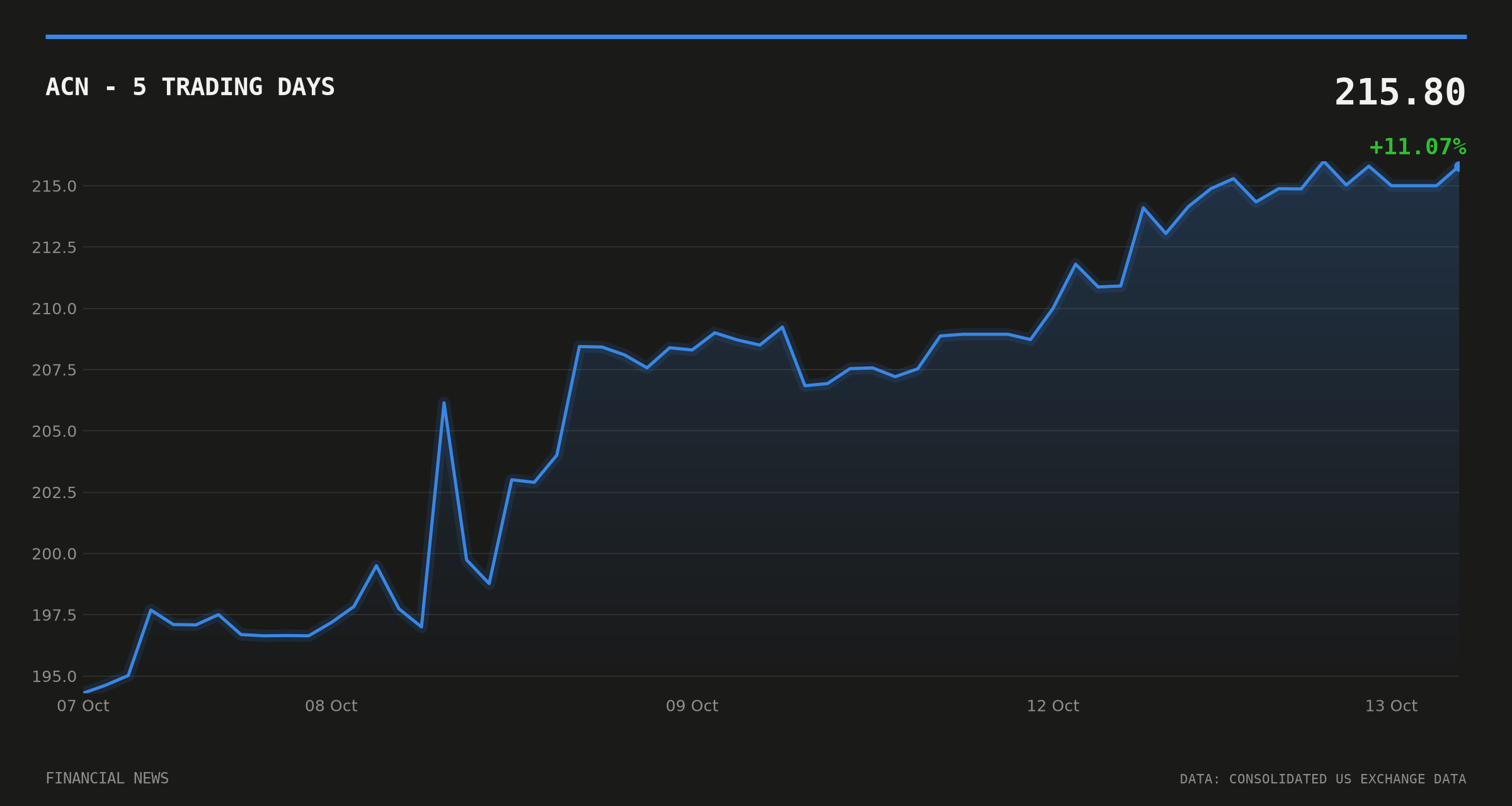
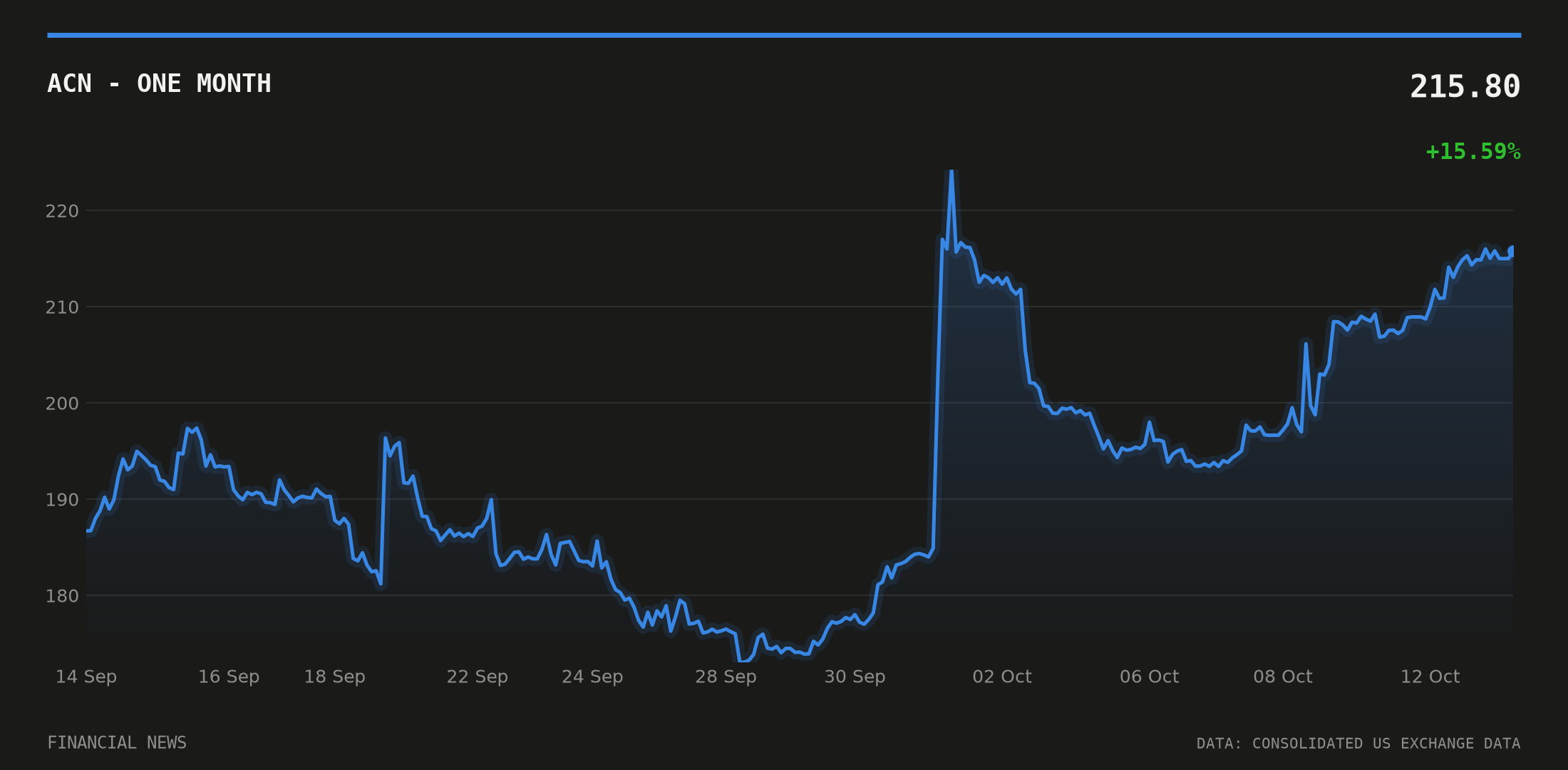
Accenture shares traded at $215.80 as of 11:00 UTC on 13 October, up 0.43% on the day. The stock has gained 13.6% over the prior 20 trading days, with trading volume running at just 17% of its 20-day average, consistent with a market that had already priced in the broader AI-services narrative before this specific announcement. The 20-day range runs from a low of $173.06 to a high of $224.27, putting the current level closer to the upper end of that band.
FINRA short-volume data show the daily short-sale ratio for Accenture held in a 0.51 to 0.71 range through the fortnight spanning the announcement, from 29 September to 12 October, with no spike coinciding with the deal. A separate SEC Form 4 filed on 9 October, covering routine equity activity by an Accenture officer, is unconnected to the Sagacity transaction.
Macro backdrop
The deal lands against a shifting US rate picture. The 10-year Treasury yield stood at 5.22% on 8 October, down from 5.28%, while the 2-year yield eased to 4.75% from 4.77%, according to Federal Reserve data. The spread between the two narrowed slightly to 0.44 percentage points. US unemployment ticked up to 4.2% in September from 4.1% the month before, a data point investors watching corporate technology spending are tracking alongside consulting demand.
For Accenture, the Sagacity purchase adds another line to a long list of small, capability-led acquisitions rather than a transformational move. Investors watching the stock’s run over the past month are more likely to focus on the next quarterly print, due under Accenture’s usual reporting calendar, than on a deal too small to need its own filing.
This article is for information only and is not investment advice or a recommendation to buy or sell any asset. Markets move quickly; figures are correct as sourced at the time of writing. Always do your own research before making financial decisions.
