

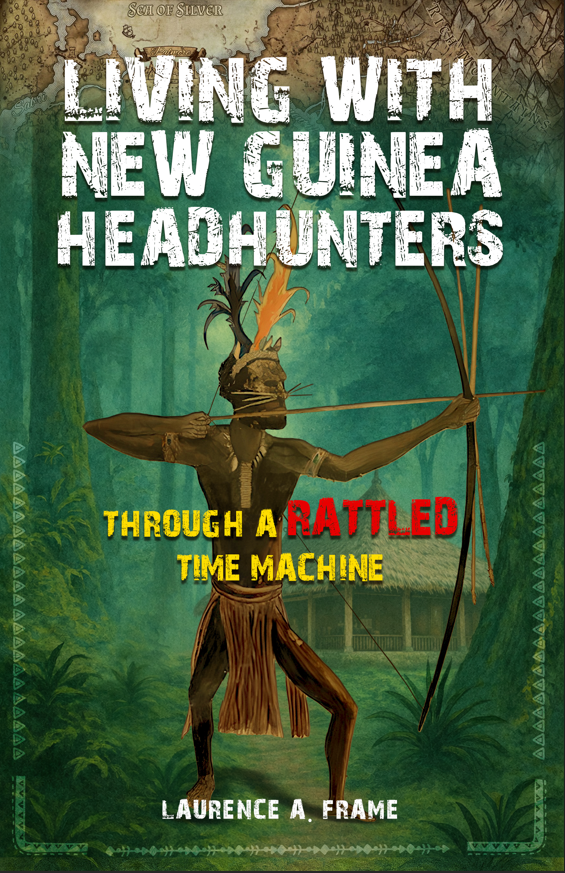
Sometime in the 1960s, Laurence Frame — an educator by training and an explorer by compulsion — walked into the Eastern Highlands of New Guinea and spent an extended period living with the Kuka-Kuka tribe, a people who worked stone-age tools and practised headhunting in a world that modernity had not yet reached.
Sixty years of carrying it.
The book that resulted, Living with New Guinea Headhunters Through a Rattled Time Machine, was announced on 28th January 2026 — a memoir and travelogue that Frame describes not as adventure writing but as a genuine crossing of temporal worlds. The title’s rattled time machine is both metaphor and method: Frame arrived among people whose daily reality existed in a different epoch, and the encounter forced him to navigate that gap with nothing but curiosity, courage and a spiritual faith he credits with keeping him alive.
Not institutional backing. Not a research brief. Just a teacher who kept saying yes.
Frame approached the Kuka-Kuka not as a conqueror seeking material or a journalist assembling dispatches, but as a curious observer trying to understand a way of life that had remained largely unchanged for millennia. His posture — humble, attentive, willing to be tested — places him in the tradition of adventure memoirists like Jon Krakauer, whose Into the Wild examined a different kind of radical encounter with the untamed, and Carl Hoffman, whose Savage Harvest documented the consumption of Michael Rockefeller by a neighbouring New Guinea culture. Frame’s account predates both and is, in some respects, more direct: he was actually there, living inside the world he describes rather than reconstructing it from the outside.
He shared food with the tribe, underwent ritual trials, faced situations the prose describes as genuinely life-threatening, and found in the process what the narrative argues are the universal threads running beneath the most extreme cultural distances: family, honour, survival, the search for connection. The Sepik River heat, the Highland mists, the vipers, the firelit ceremonies — Frame renders these with the precision of someone who was present and the reflection of someone who has spent decades understanding what being there meant.
He opens the book with a verse prelude — a poem of his own composition that sets the metaphysical register before the memoir proper begins. It is an unusual structural choice for a travelogue, and it signals from the first page that Frame is interested in more than chronology. His prose throughout is literary and descriptive, building tension across survival episodes without tipping into sensationalism. He has also produced the book’s illustrations himself — hand-drawn images that punctuate the narrative and carry an authenticity no stock photograph could provide.
New Guinea in the early 1960s was among the last places on earth where genuine first contact between industrial and pre-industrial cultures was still occurring. Frame arrived in a closing window. The Kuka-Kuka as he encountered them — using stone tools, conducting rituals that had persisted across thousands of years — were already beginning their irreversible change, as anthropologists, missionaries and government patrol officers moved through the Highlands in growing numbers. What Frame’s account preserves is specific and irreplaceable: a brief period when those two worlds collided, rendered by someone standing inside the collision.
But the book does not stop at the New Guinea border.
His broader journey continues through Mexico, Central America and South America, each region layering its own texture of danger and revelation onto a life clearly oriented toward the edges of the map. The account ends at the author’s one-room apartment perched on top of a water tower in rural El Centro, California — the door left open all summer, and something waiting inside that Frame describes as a haunting climax. It is either the book’s most bizarre detail or its most revealing one. Quite possibly both.
His background makes him an unusual guide through this material. Lifeguard, educator, teacher on Guam — his résumé is that of a man who accumulated experience rather than credentials, who placed himself in unfamiliar situations repeatedly and paid attention to what happened. The 1960s New Guinea encounter stands as the centrepiece of a life spent testing the proposition that the most significant discoveries lie just past the edge of the familiar.
The decades between Frame’s arrival in the Eastern Highlands and this book’s publication have carried that world away. The Kuka-Kuka tribe as he encountered them no longer exist in that form. What remains is the account of a teacher who walked in, paid attention and stayed long enough to understand something true.
Living with New Guinea Headhunters Through a Rattled Time Machine is available through Amazon, major online bookstores and major retailers.
Sixty years on, Frame’s time machine has finally delivered its cargo.

