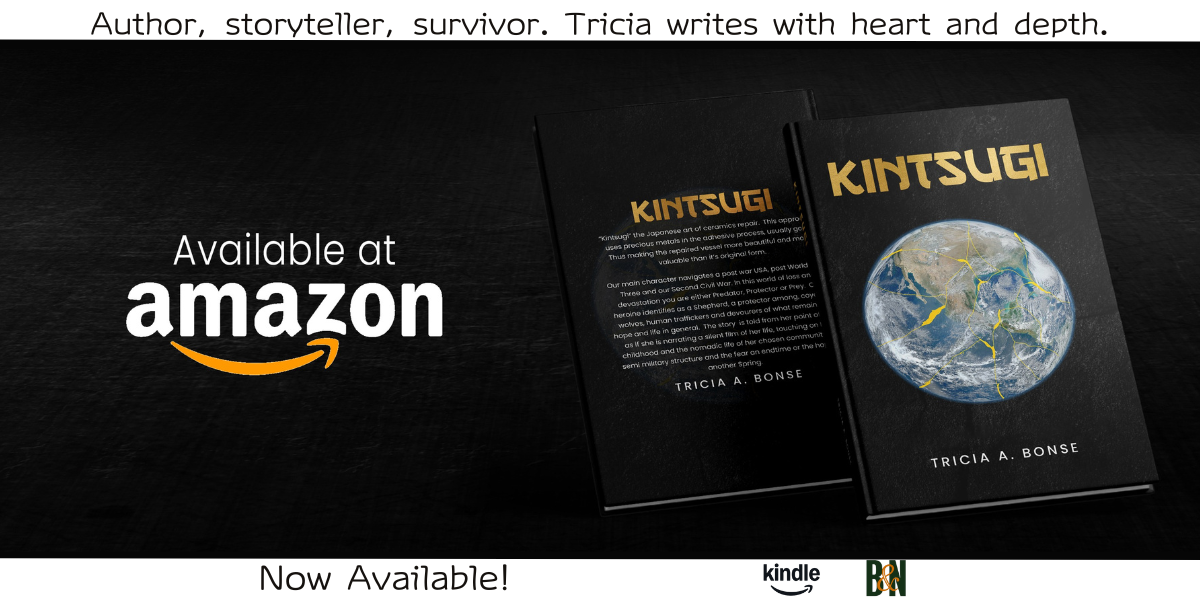
Tricia Bonse published her debut novel Kintsugi in October 2025 — a book whose title evokes the Japanese practice of repairing broken pottery with gold, and whose plot includes World War III, a second American Civil War, and the collapse of a government undone by its own entitlement.
That gap between title and content is not a mistake.
It is the entire point. The novel opens in the aftermath of a pandemic, where an authoritarian leader’s ambitions — to transform a free nation into a fascist state and extend his reach across the entire world — detonate catastrophically. His cabinet falls with him. The world’s population, human and otherwise, is decimated by what follows. Bonse presents these events not as the story but as the wound — the shattering that precedes the gold.
Because kintsugi begins with something broken.
The Japanese art form that gives the novel its title and its governing philosophy involves filling the cracks of shattered pottery with lacquer mixed with gold, silver or platinum. The repair does not disguise the damage. It illuminates it — making the fracture lines visible, permanent, beautiful. Bonse applies that logic to her characters, who emerge from the wreckage of war, displacement and political catastrophe not restored to their previous condition but remade into something that carries its damage honestly. Scars, the novel insists, are not evidence of weakness. They are the record of survival.
How Bonse handles this material is what makes Kintsugi distinctive.
A lesser novel might lean into the spectacle — the war, the collapse, the global catastrophe provide enough kinetic energy to sustain a thriller three times the length. Bonse does the opposite. Her prose is measured and lyrical, her pacing deliberate, her narrative built on restraint rather than momentum. The most significant changes in her characters occur in silence, in reflection, in the accumulated weight of small human moments rather than dramatic confrontation. For readers who came expecting the plot the back cover describes, the experience requires adjustment. For readers who stay with it, the restraint becomes the novel’s greatest strength.
In that sense Kintsugi sits in conversation with writers like Emily St. John Mandel — whose Station Eleven similarly used civilisational collapse as a backdrop for intimate stories of connection and continuity — and with the broader post-pandemic literary wave that has tried to find language for collective trauma. But Bonse’s approach is more philosophically specific than most. She is not simply asking how people survive catastrophe. She is asking what the evidence of that survival looks like, and whether it can be made beautiful rather than hidden.
The biographical engine underneath the novel is worth noting. Bonse grew up as a Navy BRAT — Born, Raised and Trained — moving every two to three years throughout her childhood, never staying long enough for any single place to become permanent. That upbringing shapes the novel’s central preoccupations directly. Displacement is not abstract for Bonse; belonging is something she had to construct rather than inherit. Her characters carry that same quality — people who have learned to form meaningful connections quickly, to hold identity lightly, to understand that home is less a place than a practice. The novel’s compassion for those who feel uprooted or unsure of where they belong comes from somewhere specific.
That specificity distinguishes the novel’s emotional register from the generic. Kintsugi does not sentimentalise its characters’ suffering, and it does not offer the comfort of easy resolution. Bonse trusts her readers to sit with discomfort and vulnerability rather than rushing them toward catharsis. The themes of belonging, emotional inheritance and resilience are present throughout, but they are earned slowly — through accumulation rather than revelation, through the quiet pressure of sustained attention rather than the release of a single climactic moment.
The novel’s final argument, stated in its structure as much as its prose, is that repair is not about returning to what once was. It is about acknowledging what happened and embracing what now exists. For readers who have felt fractured by loss, by displacement, by the particular disorientation of living through historical upheaval — which, by late 2025, describes a considerable portion of the reading public — that argument lands with the weight of something true rather than the lightness of something merely consoling.
Kintsugi is available now in print and digital formats through major online bookstores.
The pottery was broken. The gold is what you see now