

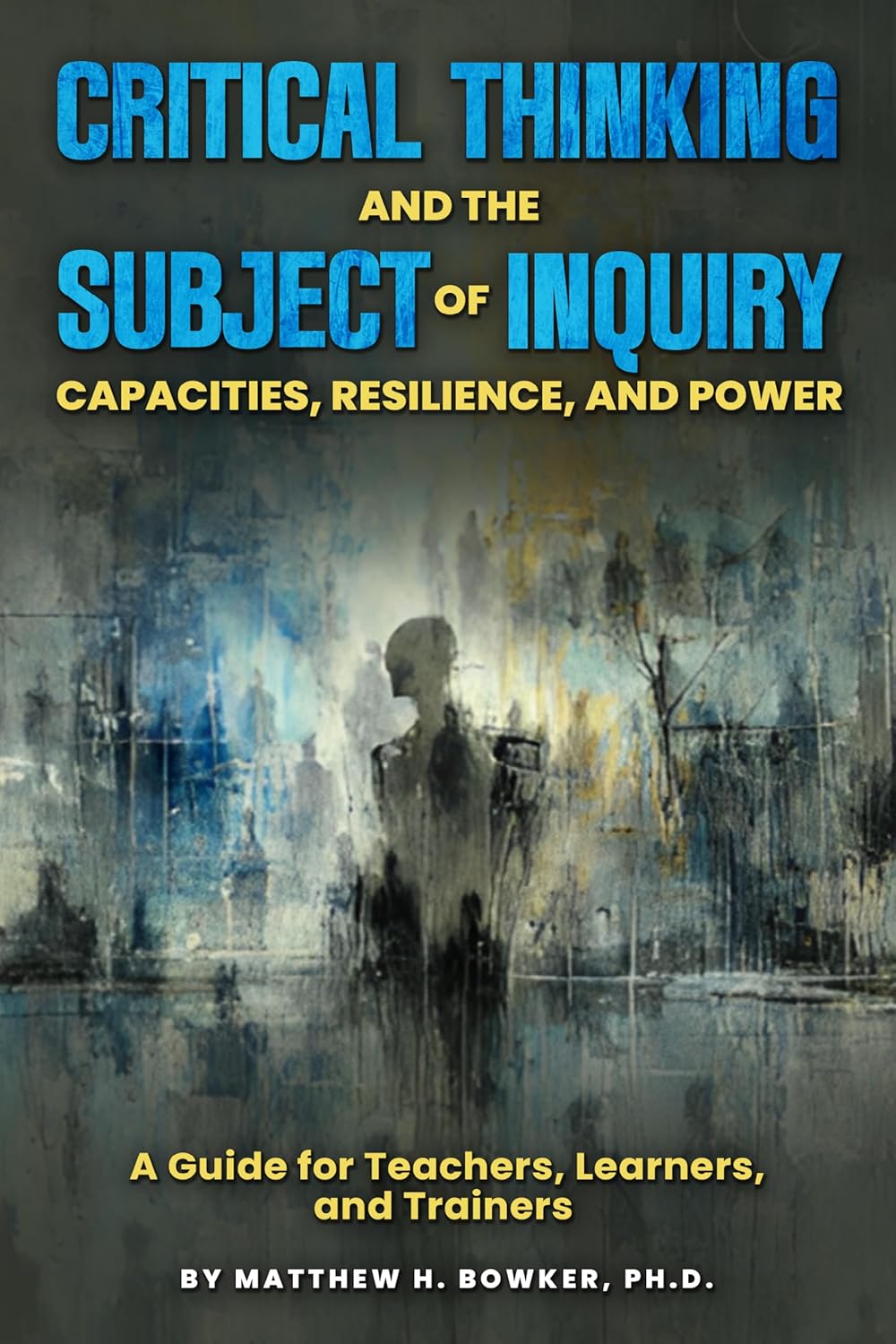
Matthew H. Bowker’s newly published Critical Thinking and the Subject of Inquiry — a two-part work drawing on thinkers from Plato and Epictetus to Camus and Kafka — arrives with a direct challenge to one of education’s most entrenched assumptions: that critical thinking is a set of learnable skills that can be tested, measured and delivered in standardised modules.
It cannot. Bowker argues it never could.
The critical thinking skills industry is large enough to seem like settled fact. PISA assessments rank nations by it. Corporate training sells it by the hour. Meanwhile, universities package it as a toolkit — and the underlying assumption running through all of it, that thinking critically is something you acquire like algebra then deploy when required, is precisely what Bowker, writing in the tradition of Paulo Freire, sets out to dismantle.
That tradition matters here.
Freire called the dominant model of education the “banking concept” — the idea that teachers deposit information into passive students, who accumulate it and reproduce it on demand. The skills-based approach to critical thinking, Bowker argues, reproduces that same logic: it treats thinking as content to be delivered rather than a capacity to be cultivated. What gets lost in that transaction is the actual subject of inquiry — the developing person whose relationship with thought, with doubt, with intellectual discomfort, is precisely what education should be building rather than bypassing.
The difference, in Bowker’s framing, is the difference between handing someone a hammer and teaching them to build.
Yet his alternative centres on what he calls an internal state of resilience — not grit or perseverance in the motivational poster sense, but a genuine psychological capacity to withstand the political, social and institutional pressures that routinely suppress independent thought. A student trained only in logical argumentation has no particular defence against a culture that punishes dissent, a classroom that rewards compliance, or a political environment that makes certain questions dangerous to ask. A student whose capacity for inquiry has been cultivated from the inside — whose relationship with uncertainty is one of engagement rather than anxiety — is a different kind of thinker entirely.
“This book is intended for teachers and learners of critical thinking who wish to engage in facilitative and substantive courses of study,” Bowker notes — a framing that signals something important about the book’s register. This is not a polemic or a policy paper. It is a working text, structured to model the kind of inquiry it advocates.
The book’s two-part architecture reflects that commitment. Part One addresses the philosophy of facilitation — how teachers can construct environments that foster genuine inquiry rather than the performance of it. Part Two provides substantive analysis of historical and literary texts, moving through Plato and Epictetus into Camus and Kafka, demonstrating how critical thought has been both exercised and suppressed across the span of Western intellectual history.
That second half is the book’s most unusual feature. Critical thinking texts rarely venture far from philosophy into literature — the assumption being that logic belongs to one tradition and narrative to another. Bowker rejects that division. Kafka’s bureaucratic labyrinths and Camus’s absurdist confrontations with meaningless authority are, on this reading, not merely literary objects but documents of what happens to the thinking mind under conditions designed to defeat it. They illustrate the stakes of Bowker’s argument in ways that formal philosophical analysis alone cannot.
The target readership spans educators, trainers and administrators seeking to shift their practice, alongside students and lifelong learners who want something more demanding than a checklist of reasoning fallacies. For teachers operating inside institutions that reward measurable outcomes and standardised results — which describes most institutions — the book makes an argument that is simultaneously theoretical and urgently practical: the tools they have been given to teach thinking may be systematically undermining the very thing they are trying to produce.
That tension is what gives Bowker’s argument its force beyond the academic. Resilience as an educational goal is not new. The specific claim — that resilience must be psychological and internal, cultivated through genuine inquiry rather than instilled through instruction — runs against the grain of most current practice in ways that will unsettle comfortable assumptions on both sides of the staffroom.
Critical Thinking and the Subject of Inquiry: Capacities, Resilience, and Power is available now through Amazon and major online retailers.
The skills-based approach has had decades to prove itself. Bowker is asking whether the results justify the method.

