
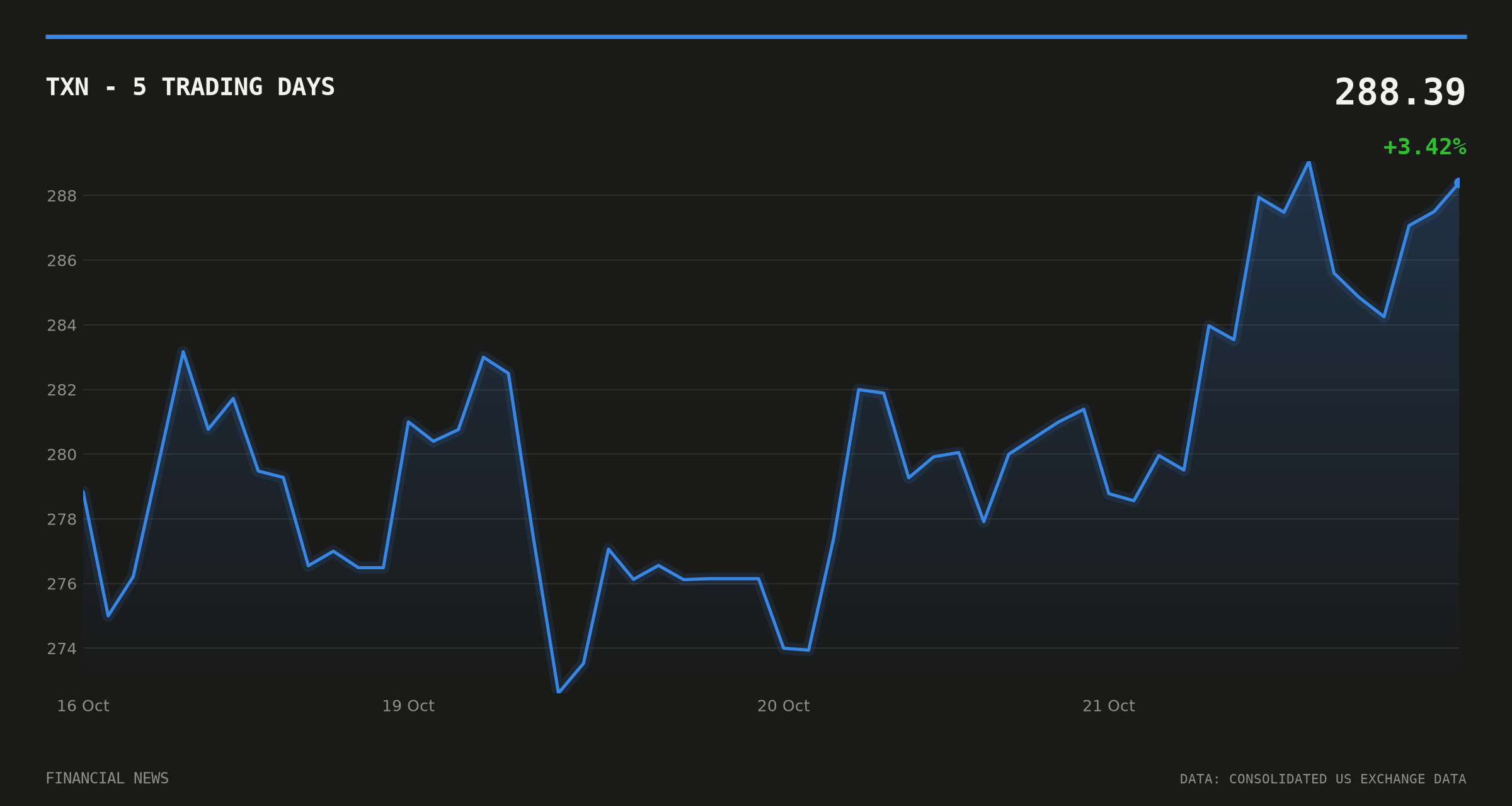

Texas Instruments (NASDAQ: TXN) reported third-quarter results on 21 October 2026 that beat Wall Street forecasts on both profit and sales. The Texas Instruments earnings beat saw diluted earnings per share come in at $2.62, against a consensus estimate of $2.41.
Revenue reached $6.06bn for the quarter, according to GuruFocus, which cited the company’s 8-K filing dated the same day. The chipmaker also cleared the bar on what Shacknews described as Wall Street’s informal ‘whisper number’, a closely watched unofficial benchmark that often runs ahead of published consensus.
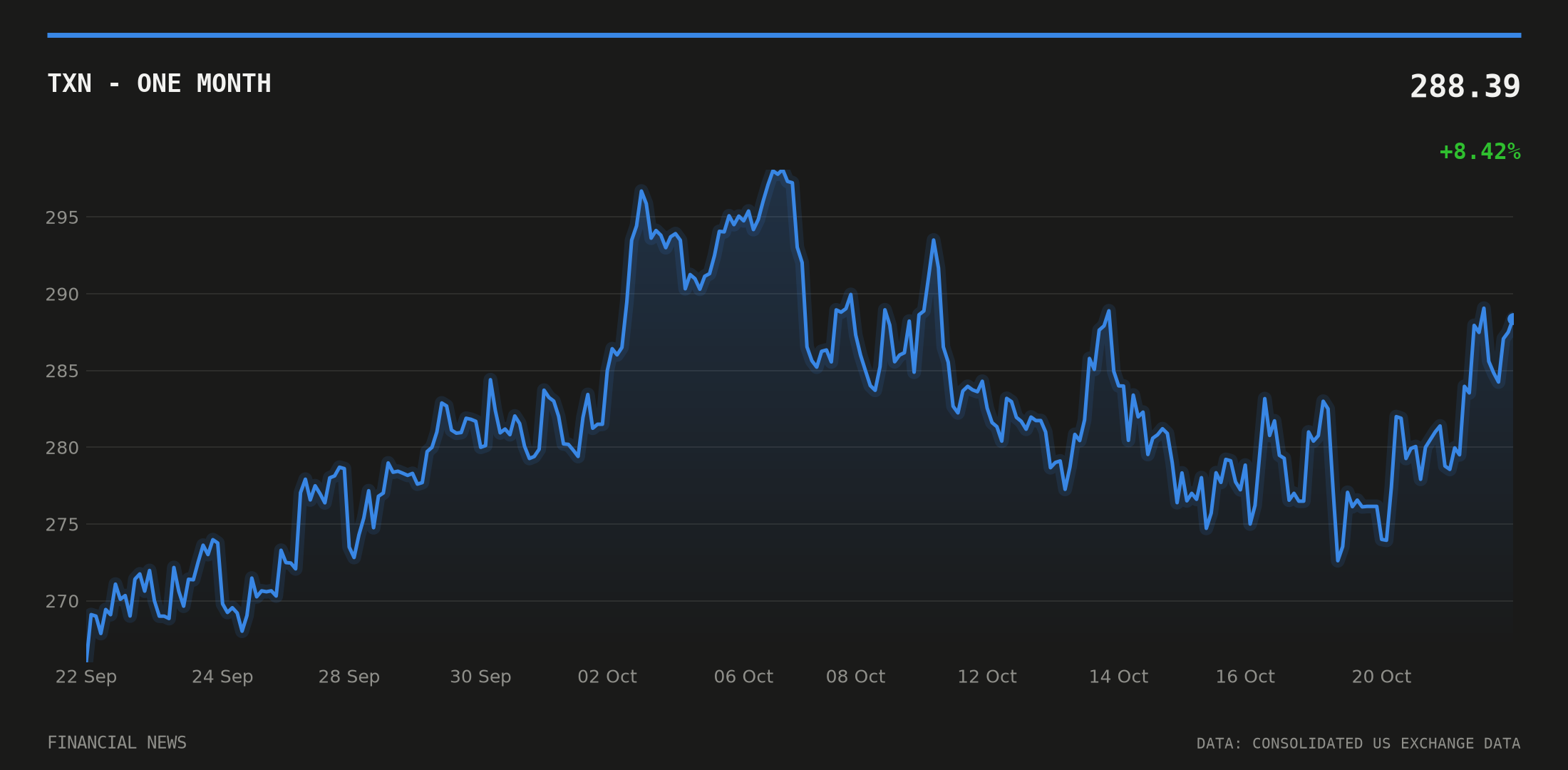
Shares closed at $288.39 on 21 October, up 0.32% on the day, according to consolidated US exchange data. Trading volume ran at 2.31 times the 20-day average, suggesting the print drew unusually heavy interest even if the share-price reaction was muted against the scale of the earnings beat.
Data centre growth drives the quarter
The earnings call highlighted broad-based strength across TI’s end markets. Industrial revenue hit a record, while the data centre segment grew 95%, as reported on the earnings call transcript carried by The Motley Fool. Executives framed the quarter as evidence of a broader cyclical recovery rather than an isolated beat.
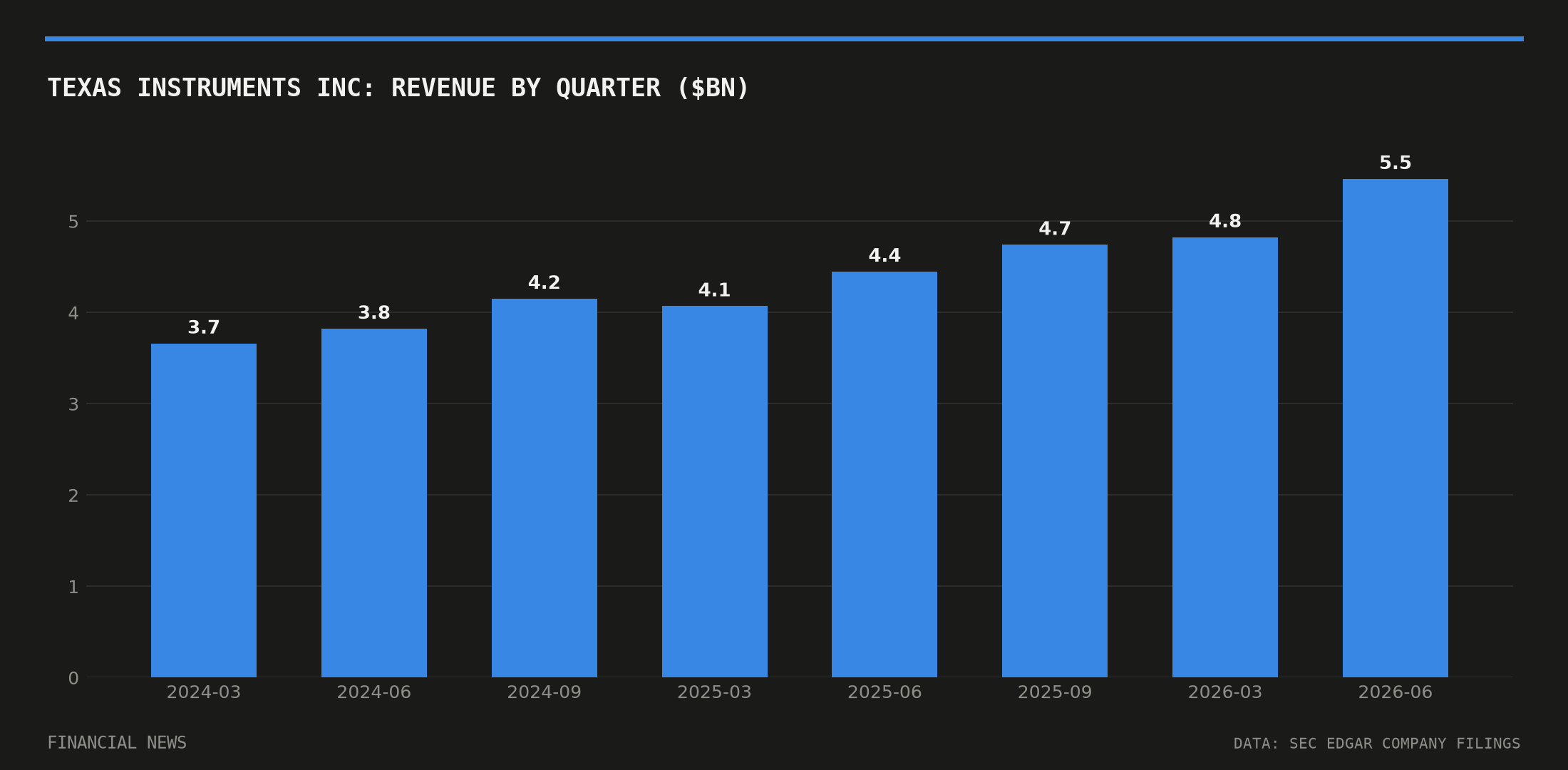
The scale of the improvement stands out against TI’s own recent history. Quarterly revenue reported to the Securities and Exchange Commission was $4.74bn in the third quarter of 2025, meaning the reported Q3 2026 figure implies year-on-year growth of roughly 28%. Diluted EPS of $1.48 a year earlier compares with the $2.62 now reported, a jump of around 77%.
A sequential climb since 2024
TI’s filings with the SEC show a run of sequential revenue gains stretching back through 2024 and into this year. Revenue climbed from $3.66bn in the first quarter of 2024 to $4.15bn by that September, then rose again through 2025, reaching $4.74bn in the third quarter and $4.83bn in the first quarter of 2026. The most recent filed quarter, covering April to June 2026, showed revenue of $5.46bn and net income of $1.98bn, with diluted EPS of $2.14, according to the company’s 10-Q filed on 24 July 2026.
That trajectory gives the reported Q3 2026 figures useful context. Rather than a one-off beat against a soft comparison, the numbers extend a pattern of quarter-on-quarter improvement that has held for roughly two years, from net income of $1.105bn in the first quarter of 2024 to the $1.98bn reported for the second quarter of this year. Whether the pace of that climb continues depends on the company’s next quarterly filing, due in the new year.
Positioning ahead of the print was mixed
FINRA short-sale volume data shows TI’s daily short-sale ratio bouncing between 0.407 and 0.599 in the fortnight before the report, easing to 0.431 on 19 October before climbing back to 0.538 on the day results were published. That pattern does not point to a clear bearish bet building into earnings, nor does it suggest traders were positioned heavily for a beat.
The results also landed against a firmer rate backdrop. The 10-year Treasury yield stood at 5.15% on 19 October, up from 5.09% previously, according to Federal Reserve data, while the gap between two-year and 10-year yields narrowed to 0.33 percentage points. Higher long-end yields have weighed on valuations across the chip sector this year, making earnings quality – rather than multiple expansion – the main lever for share performance.
Investors will next look to TI’s fourth-quarter guidance and the pace of industrial and data centre orders, both cited on the call as drivers of the current cycle. The company’s next scheduled quarterly filing will show whether the sequential revenue climb evident since early 2024 continues into the final quarter of the year.
This article is for information only and is not investment advice or a recommendation to buy or sell any asset. Markets move quickly; figures are correct as sourced at the time of writing. Always do your own research before making financial decisions.
