
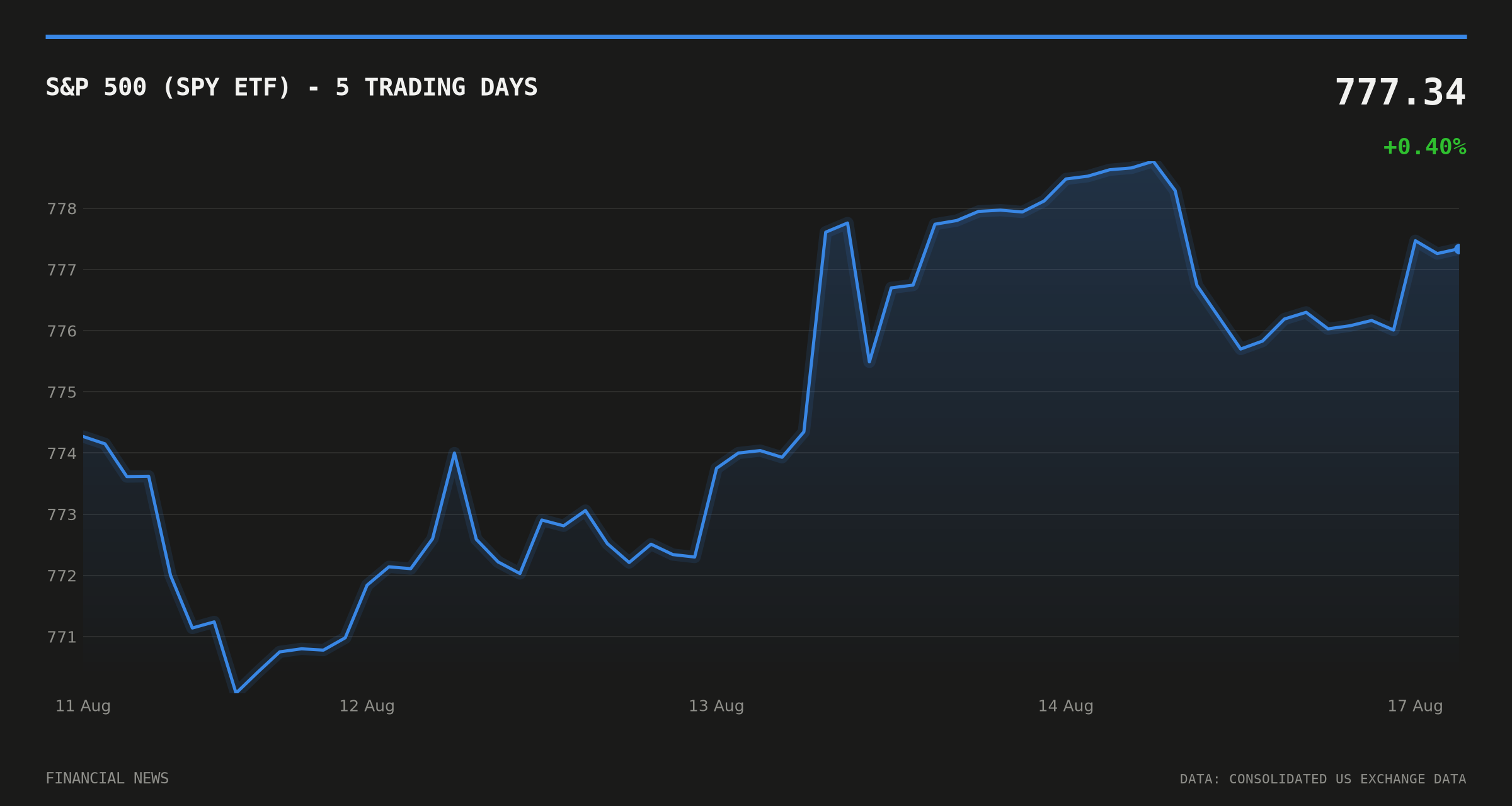

The S&P 500 weekly close for the week ending 17 August 2026 shows a modest 0.5% gain, but the headline number hides one of the sharpest sector splits of the year. Storage and chip names posted double- and triple-digit percentage swings while a handful of consumer and industrial names were marked sharply lower.
The S&P 500 (SPY ETF) finished the week up 0.5% at 777.40. The Nasdaq 100 (QQQ ETF) outpaced it, rising 1.45% to 734.46, while the Dow (DIA ETF) slipped 0.6% to 535.90 – a divergence that puts the week’s real story in the mega-cap tech and AI-infrastructure names rather than the broad index.
The scoreboard: a tale of three indices
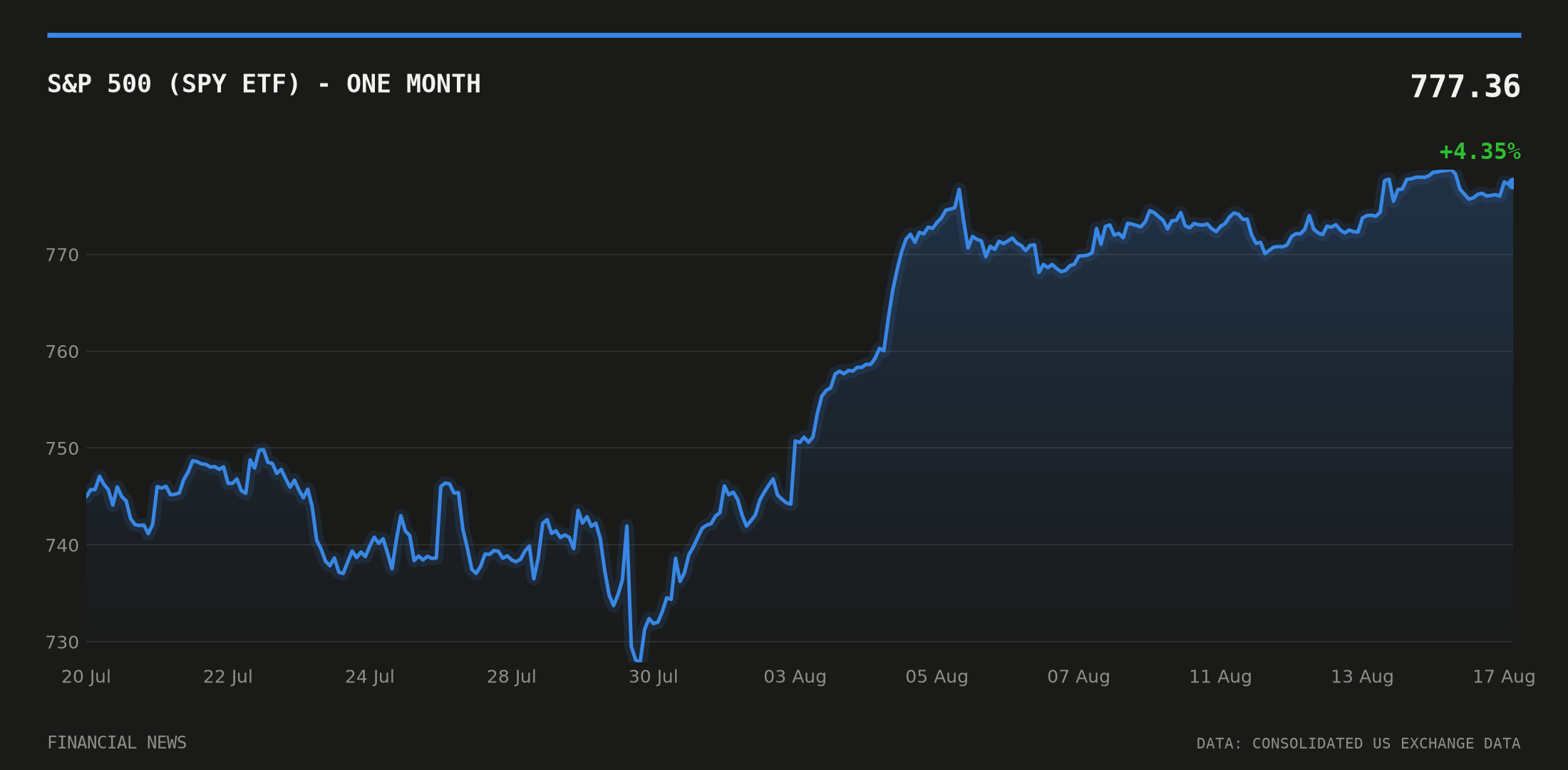
Large-cap tech did the heavy lifting for the S&P 500 weekly close. The Nasdaq 100’s 1.45% advance contrasts with the Dow’s 0.6% retreat, a gap of roughly two percentage points between America’s growth-heavy and value-heavy benchmarks. That split tracks a week in which semiconductor and data-storage suppliers rallied hard while several consumer-facing Dow and S&P names were sold down. The result: the broad market crept higher even as its components pulled in opposite directions.
Winners: the AI supply chain still has momentum
Nebius Group N.V. (NASDAQ: NBIS) led all large-cap movers, gaining 47.13% on the week to close at 277.35. Sandisk Corp (NASDAQ: SNDK) was close behind, up 36.97% to 1,656.00, with Seagate Technology Holdings Plc (NASDAQ: STX) adding 23.93% to finish at 999.00. All three sit in the storage and AI-infrastructure supply chain that has driven much of this year’s rally – a theme this outlet has also tracked in CoreWeave’s recent earnings beat and Cisco’s networking build-out.
Super Micro Computer, Inc. (NASDAQ: SMCI) rose 23.54% to 39.86, and Marathon Petroleum Corp (NYSE: MPC) climbed 18.38% to 356.54, rounding out the week’s five biggest gainers. The spread between the top and bottom of that list underlines how concentrated this rally has become in hardware tied to AI data-centre demand.
Losers: retail and clean energy names take the hit
Tapestry, Inc. (NYSE: TPR) was the week’s worst performer, falling 19.51% to 128.98. Coherent Corp. (NYSE: COHR) dropped 15.17% to 333.93, and First Solar, Inc. (NASDAQ: FSLR) fell 10.52% to 225.41. Ulta Beauty, Inc. (NASDAQ: ULTA) slid 9.73% to 505.51, and Applovin Corp (NASDAQ: APP) lost 9.29% to close at 316.13. The declines span retail, optics and solar – sectors with little in common beyond having missed the AI-hardware rotation that lifted this week’s gainers.
The insider ledger
No large disclosed insider sales crossed the wires among this week’s index movers, based on filings tracked through SEC EDGAR. That leaves the week’s story squarely in the price action rather than in executive selling – a quieter ledger than in recent weeks, when disclosures from names tied to AI infrastructure, including the stake disclosures flagged in AMD’s SpaceX stake filings, drew more attention.
The macro shift: yields ease, oil firms
Treasuries moved modestly in favour of risk assets. The 10-year Treasury yield eased to 4.63% on 13 August, down from 4.68% a session earlier, according to data from the Federal Reserve Bank of St. Louis. The 2-year yield fell to 4.15% from 4.20% over the same span, and the 10-year/2-year spread widened slightly to 0.51 percentage points from 0.48, a mild steepening that tends to accompany expectations of slower policy tightening.
Oil moved the other way. WTI crude rose to $84.77 a barrel on 11 August from $83.76 previously, a gain that sits alongside Marathon Petroleum’s 18.38% weekly advance – one instance where a single commodity move lines up neatly with an equity mover.
Number of the week
The number that stands out is 66.64 – the percentage-point gap between Nebius’s 47.13% gain and Tapestry’s 19.51% decline, arrived at by adding the two moves together since one ran up and the other ran down. Few weeks produce a spread that wide between the best and worst performers among large-cap names, and it captures the market’s current temperament: conviction in AI-linked hardware, indifference or worse toward names outside that trade. Whether that gap narrows or widens will likely hinge on how the next round of earnings from the storage and semiconductor suppliers lands, and on whether Treasury yields continue their gentle drift lower into the autumn.
This article is for information only and is not investment advice or a recommendation to buy or sell any asset. Markets move quickly; figures are correct as sourced at the time of writing. Always do your own research before making financial decisions.
