

Salesforce (CRM) told investors at its Dreamforce conference on 16 September 2026 that it expects revenue of more than $63bn in fiscal 2030. The figure beats Wall Street’s consensus estimate of $59.2bn tracked by LSEG, as CNBC reported.
The number is not new. Salesforce first disclosed the $63bn fiscal 2030 revenue target in its fourth-quarter results on 25 February 2026, when it said it was ‘well on our way to $63 billion in revenue in FY30’ – an upgrade from the ‘over $60 billion’ goal it had given as recently as October 2025.
A target six months in the making
Robin Washington, Salesforce’s chief operating and financial officer, repeated the $63bn figure at Dreamforce, according to the Wall Street Journal. Analysts who covered the event described it the same way. JPMorgan’s post-Dreamforce note said management had ‘reaffirmed the $63 billion-plus fiscal 2030 revenue target’, pairing it with guidance for organic growth to re-accelerate in the second half of fiscal 2027.
Oppenheimer’s note struck a similar note, saying management had reiterated rather than raised the guidance, and calculating that the $63bn goal implies an 11% compound annual growth rate alongside an operating margin of 39% or better.
Beating consensus, even if not itself
The gap with analyst forecasts is real, whatever the target’s age. LSEG’s $59.2bn consensus for fiscal 2030 sits roughly $3.8bn below the company’s own number, and even a separate Bloomberg-tracked estimate near $61.4bn falls short of it. Salesforce’s updated plan also folds in revenue from Informatica, the data-management group whose acquisition closed in November 2025.
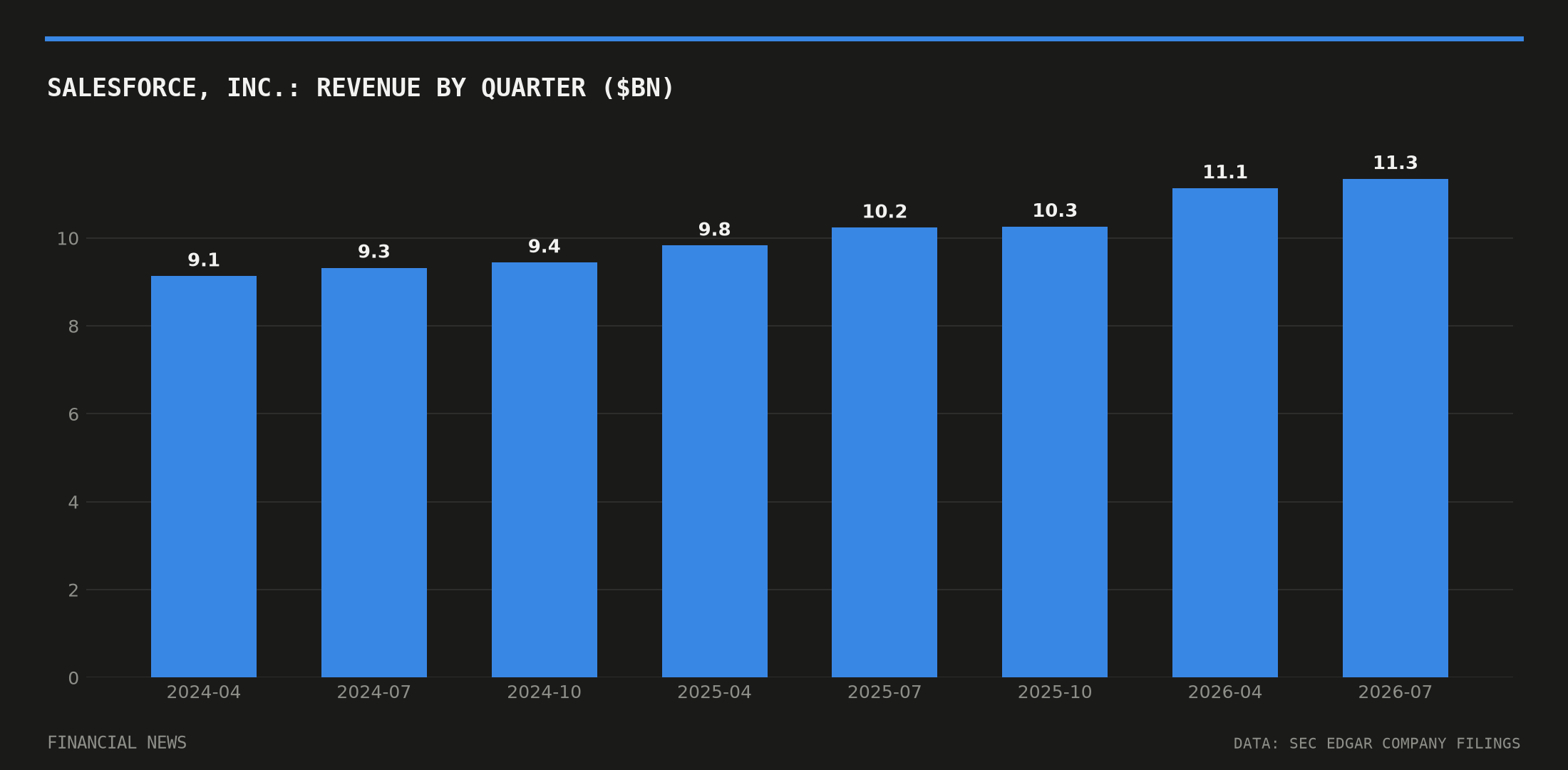
The underlying trajectory in Salesforce’s own filings supports the case that the target is at least plausible. Quarterly revenue has climbed steadily through fiscal 2027, reaching $11.35bn in the quarter ended 31 July 2026, up from $11.13bn three months earlier and from $9.13bn as recently as the quarter ended April 2024. Net income over the same run has moved from $1.53bn to $3.53bn a quarter, though the scale of that jump reflects one-off items as much as underlying operating performance.
Shares slip despite the beat
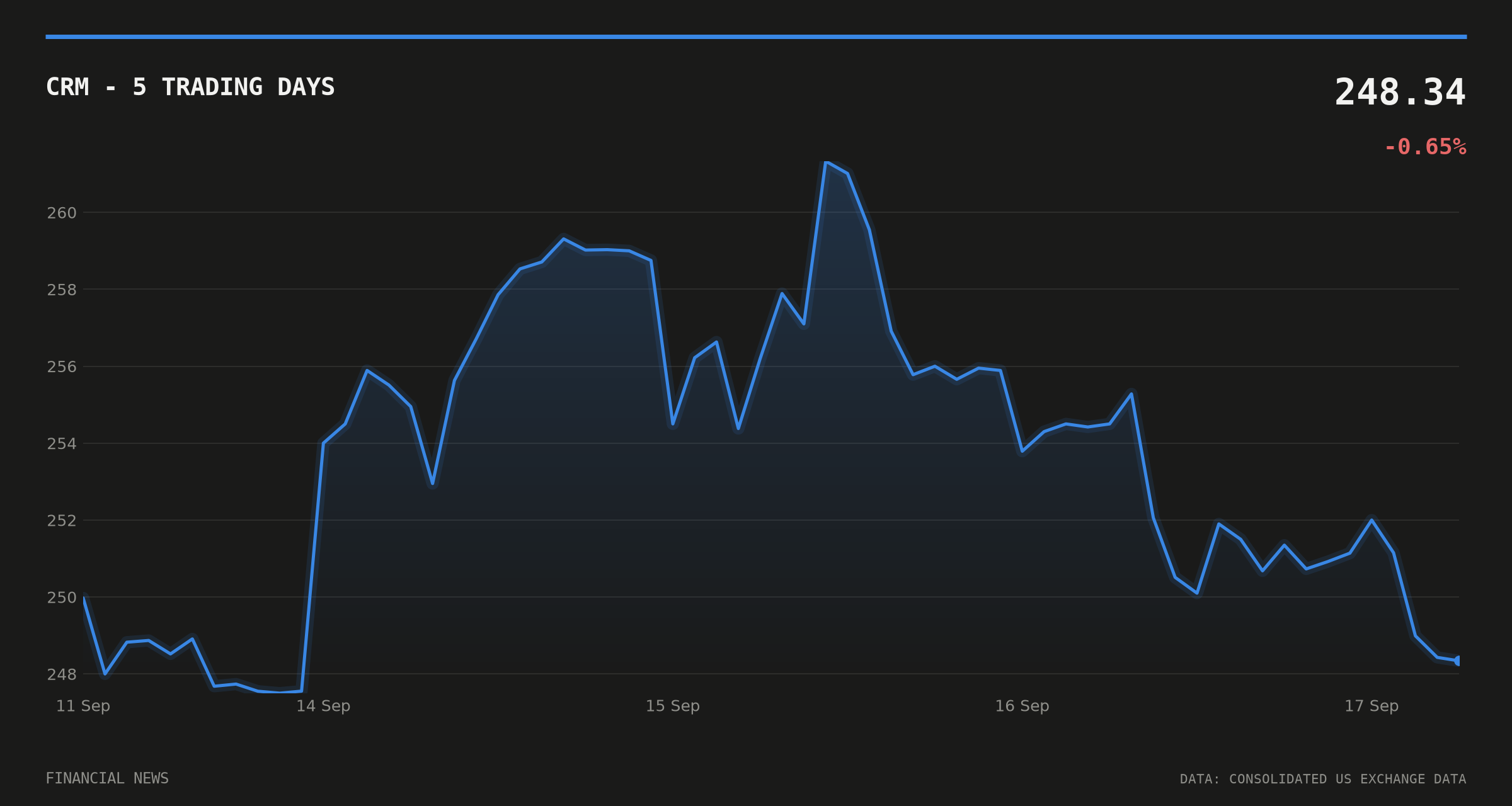
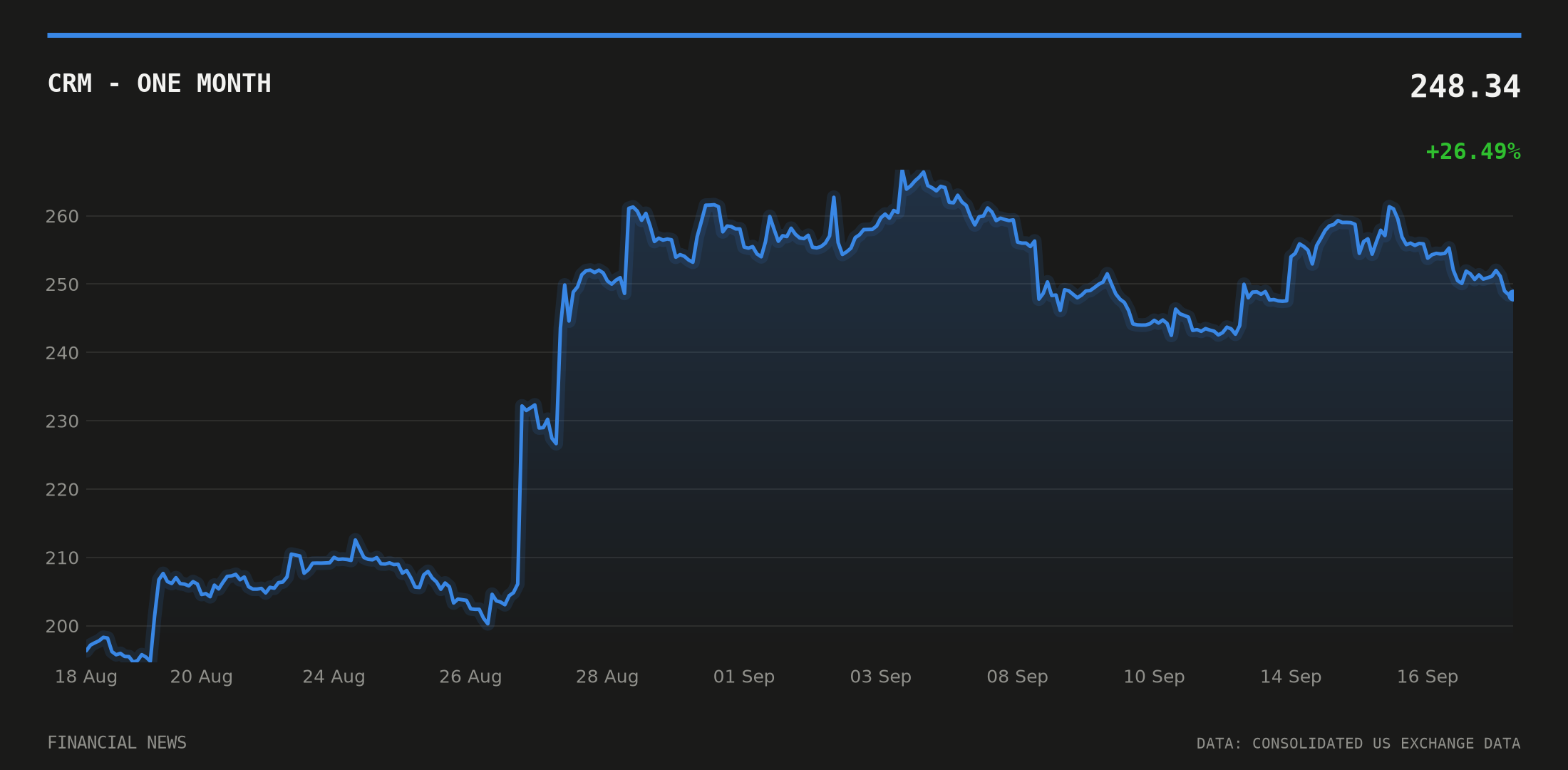
CRM closed above $250 on the day of the Dreamforce announcement but had eased to $247.74 by late morning UK time the next day, down 1.43% on the session, according to consolidated exchange data. The stock remains up 9.31% over the past 20 trading days, having ranged between $226.65 and $266.79 in that window – a pattern consistent with a mild pullback rather than a guidance-driven selloff.
The reaction sits against a backdrop of elevated borrowing costs that make investors wary of pricing in distant growth. The 10-year US Treasury yield stood at 5.00% on 15 September 2026, with the 2-year at 4.67%, according to Federal Reserve data. At those levels, a four-year revenue plan carries a heavier discount than it would in a lower-rate environment, even one that beats consensus on paper.
What the target actually signals
For Salesforce, restating the $63bn figure at its flagship conference keeps the number in front of customers and investors without committing to anything beyond what it already told the market in February. The company’s own filings show it has been closing the gap towards that goal steadily, quarter by quarter, rather than in a single step change.
Investors will get the next real test of the trajectory when Salesforce reports fiscal 2027 third-quarter results later this year, the first scheduled update against the reaffirmed target since Dreamforce.
This article is for information only and is not investment advice or a recommendation to buy or sell any asset. Markets move quickly; figures are correct as sourced at the time of writing. Always do your own research before making financial decisions.
