

Anthropic contacted the team behind ClawdBot earlier this year with a request that was polite but unambiguous: the name sat too close to Claude, the company’s own AI product, and it needed to go.
Fair enough. These things happen.
What the team did next is the more interesting part. Rather than simply swapping one name for another and moving on, they used the forced reset as an opportunity to relaunch the project entirely — rebuilding its identity around the biological process of molting, where growth requires shedding what no longer fits. ClawdBot became Moltbot AI. The project relaunched as a fully open-source, self-hosted personal automation platform with a new cloud deployment option at moltbotai.online and an ambition that extends considerably beyond its previous scope.
New name. New infrastructure. And a notably different proposition.
The platform Moltbot AI has become is built around a specific frustration with how most AI assistants currently work — they respond when asked, forget everything between sessions, and require the user to initiate every interaction. Moltbot AI runs continuously in the cloud instead, retaining contextual memory across conversations, monitoring connected tools and notifying users when tasks complete or conditions are met without waiting to be prompted. The distinction between a reactive chatbot and a proactive assistant sounds subtle. In practice it changes the entire relationship between user and tool.
Three capabilities sit at the core of the platform. Persistent memory means the system accumulates context over time — recognising recurring projects, communication patterns and user preferences rather than treating each session as the first. Proactive operation means the assistant acts on its own initiative within defined parameters, pushing notifications and completing tasks without manual triggers. And with more than 100 integrations spanning WhatsApp, Telegram, Slack, Gmail and Google Calendar, the automation reaches across the tools that actually constitute most people’s working day.
That last point matters more than the number suggests.
A hundred integrations is meaningless if none of them are the ones you use. Moltbot AI’s list covers the communication and productivity stack that founders, freelancers and professionals actually live inside — the inbox, the calendar, the messaging platforms where work gets done and dropped and done again. An assistant that connects those threads, remembers what was promised, and flags what was missed operates at a different level of usefulness than one that answers questions in a chat window. Open-source automation tools from AutoGPT to n8n have demonstrated genuine demand for agent-style AI; Moltbot AI enters that space with persistent memory and always-on cloud operation as its specific differentiators.
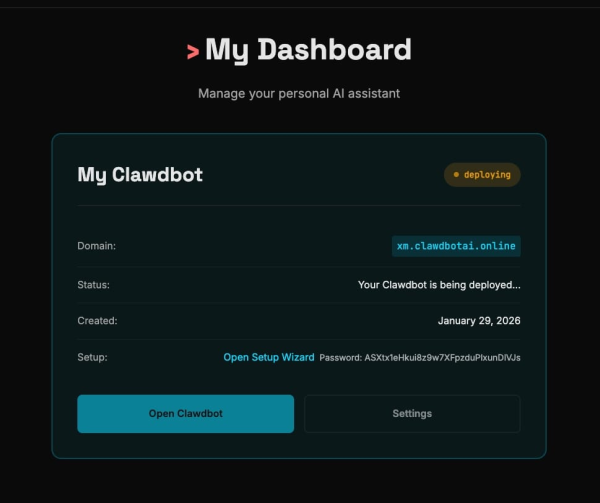
Deployment comes in two forms. The local, do-it-yourself option suits developers and technically confident users who want full control over their own hardware and infrastructure. The one-click cloud deployment at moltbotai.online spins up a private dedicated instance in under a minute, without server management or hardware maintenance — and according to the project team, it has become the option most professionals reach for first. The speed of that shift toward cloud preference is itself a signal about who is actually adopting these tools: not primarily hobbyists comfortable with self-hosting, but working professionals who need the assistant running before the next meeting starts.
Privacy sits underneath both options. Moltbot AI is self-hosted by design — each user’s instance runs independently, without data passing through a centralised platform. In an AI assistant market increasingly dominated by products that process user data on provider infrastructure, that architecture represents a meaningful alternative for anyone whose work involves sensitive communications or client confidentiality.
By the time Anthropic’s naming request arrived, ClawdBot had already been evolving toward something more substantial than its original form. The forced rebrand accelerated a transition that was coming anyway — and gave the project a name whose metaphor, molting as the price of growth, fits the trajectory more accurately than ClawdBot ever did. Whether the metaphor is inspired or slightly overwrought probably depends on your tolerance for brand mythology. Either way, it stuck.
Whether Moltbot AI’s proactive, always-on approach reflects what users actually want from personal AI — or whether the market ultimately prefers assistants that stay quiet until spoken to — is a question the next twelve months of adoption will begin to answer.
For now, the platform is open, the code is public, and the cloud instance spins up in under a minute.
The old name is gone. What replaced it is considerably more ambitious.
