

Cisco Systems (NASDAQ: CSCO) reported record fourth-quarter and full-year results on 12 August 2026, crediting an AI-driven networking boom for the surge. Its shares fell nonetheless.
Fourth-quarter revenue hit $17.3bn, up 18% year-on-year, according to the company’s earnings release. Full-year revenue reached $63.3bn, up 12%, with net income of $13.3bn, up 30%, per a separate earnings filing carried on PR Newswire.
Record numbers, Cisco AI supercycle orders climb
Cisco’s Q4 GAAP net income came to $3.9bn, or $0.97 a share; non-GAAP net income was $4.9bn, or $1.22 a share, the company said. Hyperscaler orders for AI infrastructure gear reached $4bn in the quarter, taking the full-year total to $9.3bn, according to a summary of the release carried by Pulse2. Cisco is targeting roughly $7.5bn in AI infrastructure revenue for fiscal 2027.
The company’s own language describes a ‘networking supercycle underway’, tying the demand explicitly to AI infrastructure build-outs rather than using the exact phrase ‘AI supercycle’ that has attached itself to the story in market commentary. The distinction is semantic rather than substantive: Cisco’s release makes clear AI-linked demand is the driver.
Guidance for fiscal 2027 came in ahead of what analysts had pencilled in, with revenue projected at $72.2bn to $73.4bn and non-GAAP earnings per share of $5.05 to $5.11, Cisco said. Even that forward-looking beat did not stop the shares from falling.
Stock drop despite the beat
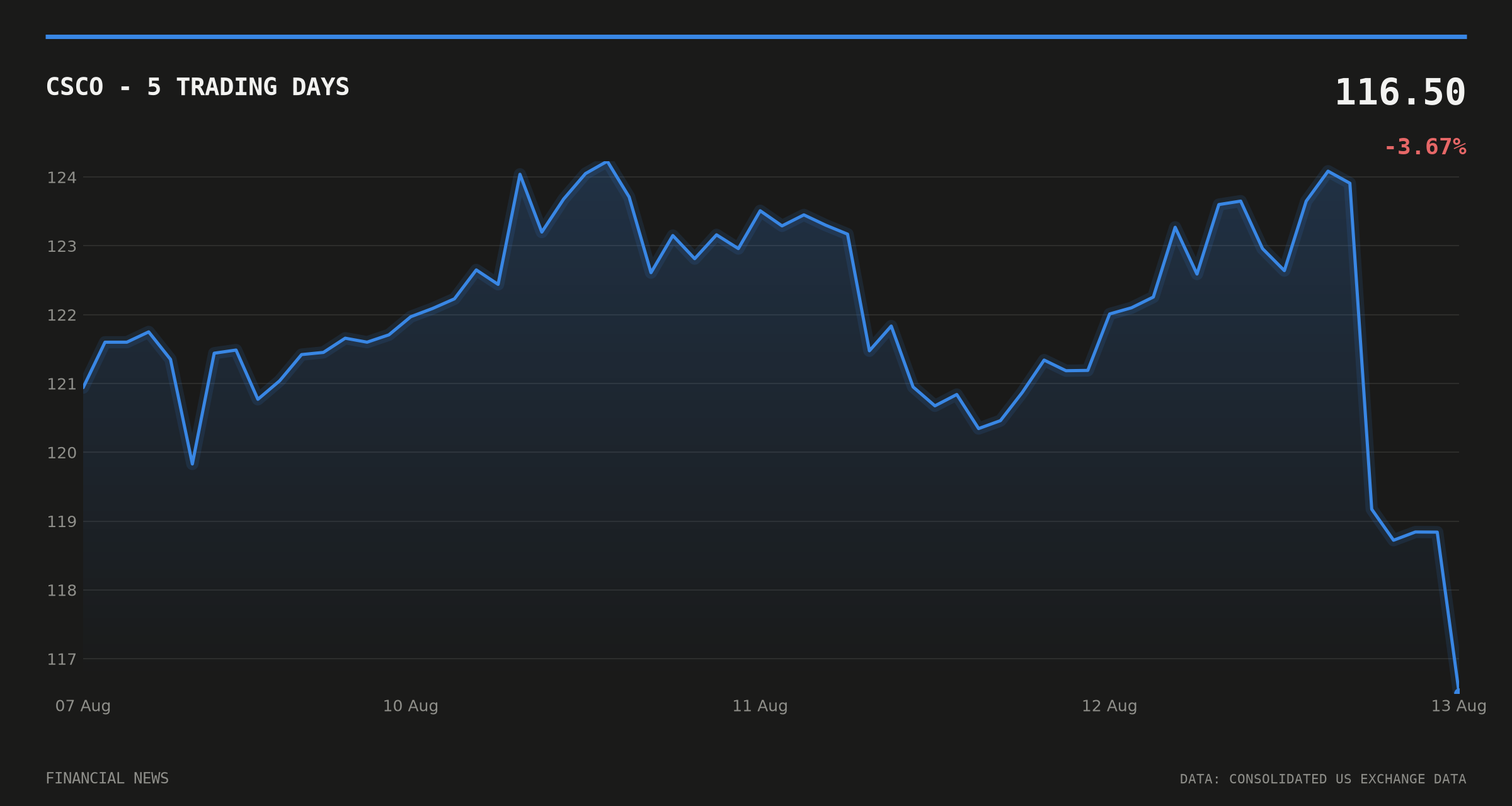
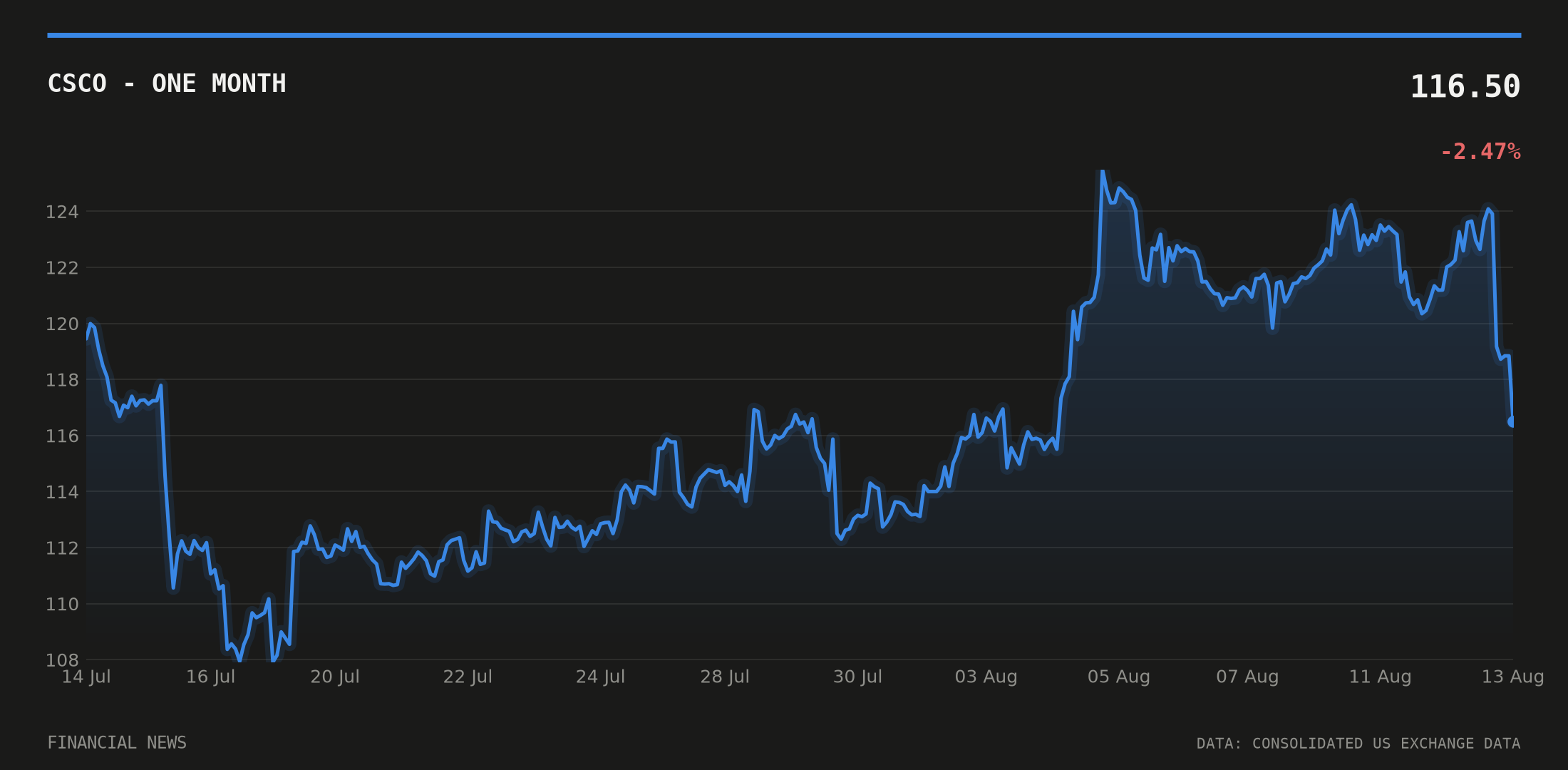
CSCO closed at $118.35, down 3.75% over 24 hours, as of 12 August at 22:00 UTC, according to consolidated exchange data cited by MarketWatch. Seeking Alpha put the extended-hours decline at roughly 4%, and CNBC independently reported the drop despite the top- and bottom-line beat.
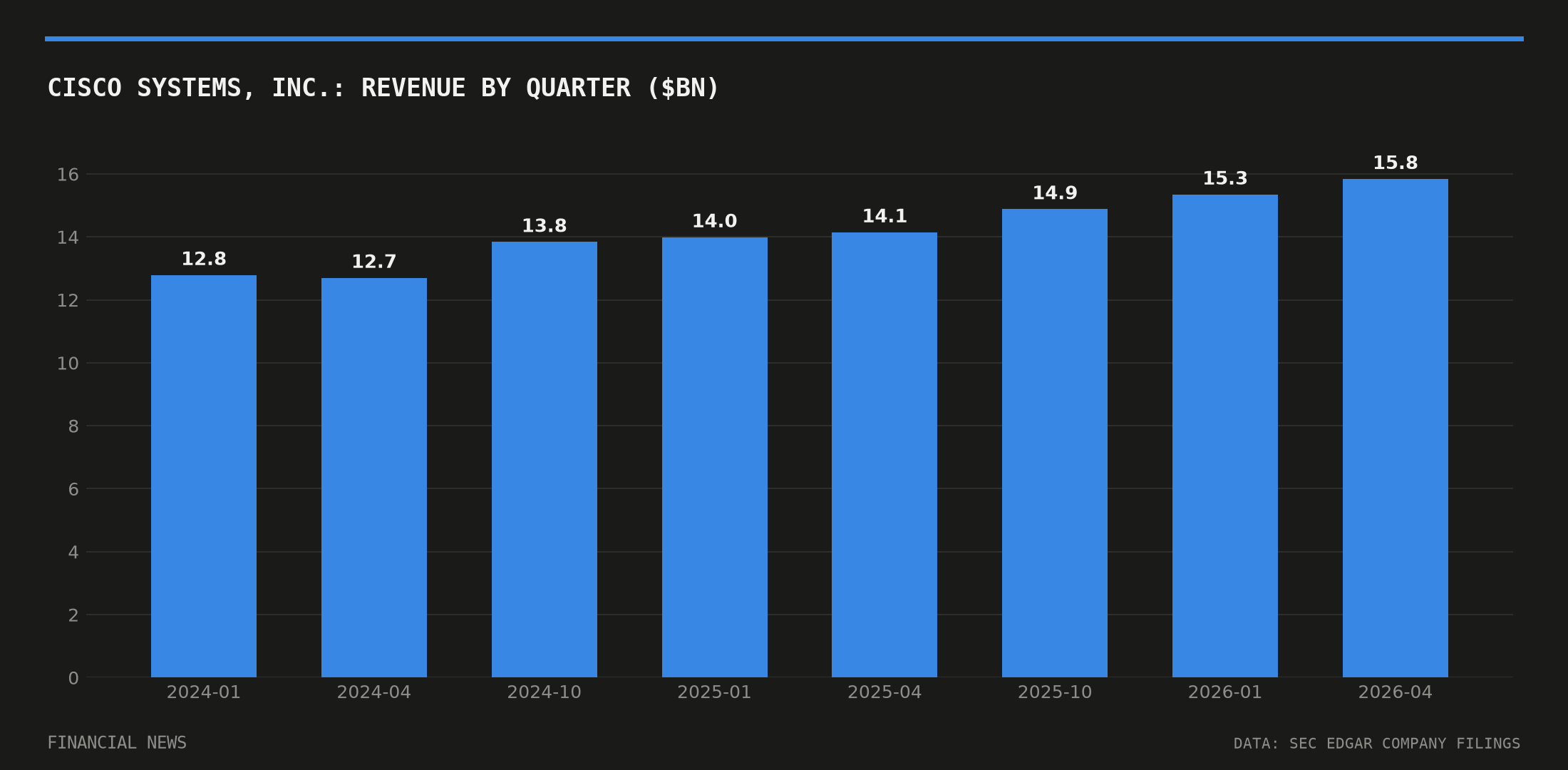
The reaction contrasts sharply with May 2026, when Cisco’s third-quarter report first popularised the supercycle framing and the stock jumped 13% in a single session, according to CNBC reporting at the time. That quarter’s revenue of $15.841bn was itself a sequential company record, according to Cisco’s 10-Q filed with the SEC on 19 May 2026, when chief executive Charles Robbins described it as ‘record quarterly revenue’ driven by AI demand.
Quarterly revenue has climbed steadily through the fiscal year: $14.883bn in the first quarter, $15.349bn in the second, and $15.841bn in the third, according to Cisco’s sequence of 10-Q filings. Net income tracked a similar path, from $2.86bn in Q1 to $6.035bn in Q2 and $9.408bn on a year-to-date basis by Q3.
Insiders file, macro backdrop tightens
Seven Cisco executives and directors, including Robbins and chief financial officer Mark Patterson, filed Form 4 disclosures within an hour of the earnings release on 12 August, standard post-results reporting rather than a signal of unusual activity.
FINRA’s daily short sale data shows CSCO’s short interest ratio has held in a tight 0.26 to 0.38 range through late July and early August, according to FINRA figures, indicating no unusual short positioning built up ahead of the report. The sell-off, in other words, looks like profit-taking on an already-run stock rather than a bet against it.
The broader rates backdrop offered a modest headwind. The 10-year US Treasury yield rose to 4.72% on 10 August, from 4.65% previously, according to Federal Reserve data, a move that tends to weigh on high-multiple technology names regardless of their own results.
What to watch next
Cisco’s fiscal 2027 guidance range of $72.2bn to $73.4bn in revenue and $5.05 to $5.11 in non-GAAP earnings per share, disclosed in the 12 August release, gives investors a benchmark for the next four quarters. Whether hyperscaler AI orders keep pace with the $9.3bn booked in fiscal 2026 will be a focal point of Cisco’s next quarterly filing with the SEC.
Market participants will also be watching whether the stock’s pullback proves durable or reverses, as it did after May’s supercycle rally, once trading settles beyond the immediate post-earnings window.
This article is for information only and is not investment advice or a recommendation to buy or sell any asset. Markets move quickly; figures are correct as sourced at the time of writing. Always do your own research before making financial decisions.
