Anthropic priced its initial public offering at $83 a share on 18 November 2026, above the range it had marketed to investors. The AI developer begins trading on Nasdaq under the ticker ANT on 19 November, according to Yahoo Finance.
The deal raised $81.3bn, surpassing SpaceX’s record-setting IPO earlier this year, CNBC reported. Anthropic sold roughly 980 million shares at the $83 print.
How the Anthropic IPO price cleared its range
Anthropic had guided investors toward a price of $70 to $78 a share, a range set out in Amendment No. 2 to its Form S-1, as Invezz reported. The $83 outcome sits well above the top of that band.
The size of the deal also grew sharply in the final stretch. Anthropic had originally planned to sell 825 million Class A shares at an estimated $70 to $78 each, per an earlier CNBC report. As late as 17 November, Amendment No. 3 to the S-1 still showed the $70-$78 range and the 825 million share count, according to mlq.ai. The final print added roughly 155 million shares to that total overnight.
At $83 a share, the implied valuation moves above the $1.4 trillion level Anthropic had previously targeted, CNBC said. Coverage of the pricing was consistent across outlets including the Wall Street Journal, Reuters and TechCrunch.
Anchor demand and the revenue jump
A group of anchor investors, including Google, Nvidia, AMD, Broadcom, Micron, Microsoft and TSMC, had agreed to buy $26bn of stock at the IPO price, Invezz reported. That commitment spans much of the chip industry supplying the infrastructure behind large language models, underscoring how directly Anthropic’s customers and suppliers are tied to its public listing.
The upsize followed a jump in Anthropic’s disclosed financials. Run-rate revenue stood at roughly $81bn at the end of October 2026, up $10bn from the prior month, according to an amended filing cited by CNBC. That pace of month-on-month growth, landing just weeks before pricing, is the kind of figure bankers point to when justifying a last-minute expansion of deal size and an above-range print.
A record raise against a tighter rate backdrop
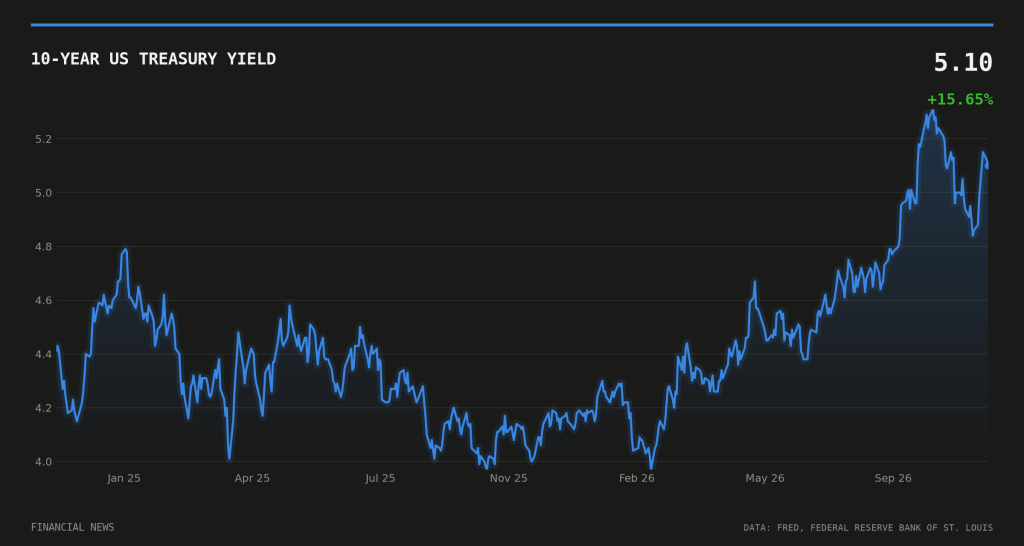
The pricing lands with the 10-year US Treasury yield at 5.10% as of 17 November, little changed from 5.12% a week earlier, according to data from the Federal Reserve Bank of St Louis. That is a relatively elevated rate environment for a mega-cap technology listing, raising the cost of capital against which investors weigh growth stocks such as Anthropic.
The 2-year Treasury yield stood at 4.80%, down slightly from 4.83%, while the gap between 10-year and 2-year yields narrowed to 0.27 percentage points from 0.30, per the same Federal Reserve data series. A modestly positive yield curve of that kind typically signals cautious optimism among bond investors rather than either strong growth expectations or recession fear, a backdrop against which the scale of demand for Anthropic’s shares stands out.
Separately, US consumer prices rose to an index reading of 337.476 in October from 336.298 the prior month, while the unemployment rate eased to 4.1% from 4.2%, according to Federal Reserve data. Neither figure moved sharply enough to reshape the macro picture investors were weighing heading into the pricing, but both point to an economy still expanding steadily rather than overheating or stalling, the kind of setting that has historically supported risk appetite for large new listings.
Anthropic’s own disclosures show the deal evolving fast in its final days: a $70-$78 range and 825 million shares as of the 17 November amendment, then an $83 print on roughly 980 million shares a day later. Market attention now turns to how ANT trades once dealing opens on Nasdaq, and whether the anchor book of chip and cloud investors continues to hold its stakes once the shares are freely tradeable.
This article is for information only and is not investment advice or a recommendation to buy or sell any asset. Markets move quickly; figures are correct as sourced at the time of writing. Always do your own research before making financial decisions.