
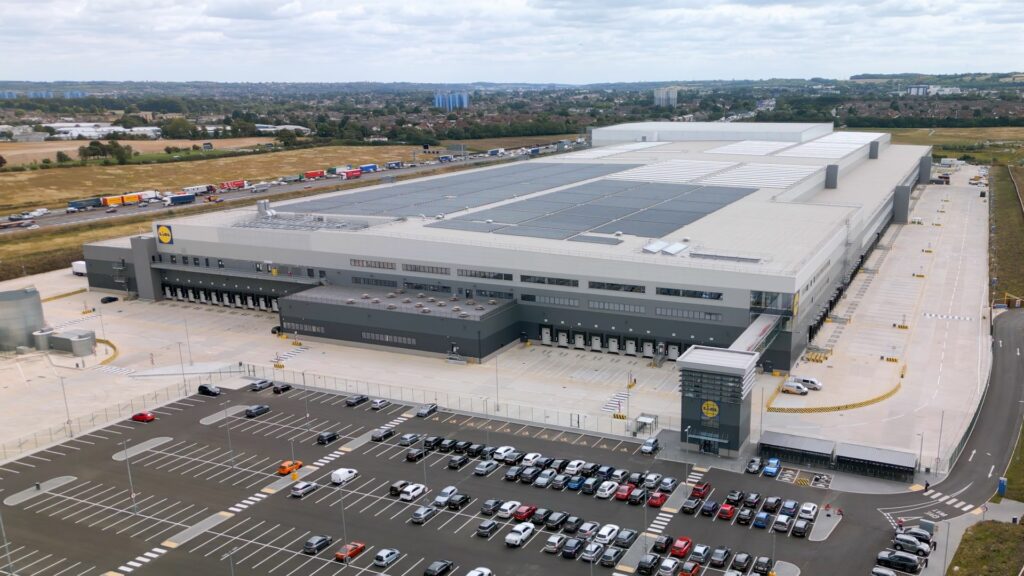

Lidl has set a new benchmark with the opening of its largest global warehouse in Houghton Regis, Luton. This substantial facility is expected to transform the company’s logistics and supply chain dynamics.
This state-of-the-art distribution centre exemplifies Lidl’s commitment to sustainability and growth, supported by a £300 million investment. The warehouse will play a critical role in servicing a broad network of stores across Great Britain.
Unveiling the New Facility
In a landmark development, Lidl has inaugurated what is now its largest warehouse globally, a project realised after an ambitious £300m investment. The massive facility, sprawling over 1.2 million square feet, is strategically located in the Houghton Regis area of Luton. This centre is set to handle an impressive volume, delivering over 9,400 pallets daily across 150 stores—a significant scale-up from the typical 60 to 80 stores serviced by its other distribution centres.
Pioneering Automation and Sustainability
The warehouse is notable not just for its size but also for its technological advancements. It marks Lidl’s first foray into automation within Great Britain, significantly increasing the centre’s capacity and efficiency by enhancing storage capabilities and optimising operational workflows.
Sustainability is at the core of this new facility. The integration of solar panels, which are expected to generate 2,000,000 kWH annually, exemplifies this commitment. During specific periods, the facility will operate solely on solar power. Furthermore, Lidl’s delivery fleet will run on bio gas derived from food waste, aligning with their ambition to eradicate diesel use in their logistics by 2030.
Economic Impact and Job Creation
The opening of the distribution centre comes as a boon to the local economy, forecasting the creation of up to 1,500 jobs. Such employment opportunities are significant in terms of enhancing the economic landscape of the Luton area. Moreover, the facility underscores Lidl’s strategic commitment to the UK market, helping to meet increasing consumer demand and fuelling future growth.
Richard Taylor, Lidl GB’s Chief Development Officer, highlighted the importance of this new centre, describing it as a “seminal moment for Lidl GB.” He emphasised that the demand for Lidl’s services has never been higher, necessitating the expansion to cater to the growing customer base.
Government Support and Strategic Importance
The UK government has welcomed Lidl’s investment with open arms. Chancellor of the Exchequer, Jeremy Hunt, lauded the initiative, recognising it as a substantial contribution to the UK economy and labour market. He remarked on the positive implications for well-paid job creation as the UK strives to halve inflation and bolster its economic standing.
Such investments are pivotal, offering confidence to other potential international investors considering the UK as a favourable business environment. Lidl’s strategic decision to situate its largest warehouse in Great Britain speaks volumes about the potential for growth and demand within the region.
Enhanced Capacity and Future Growth
This facility represents a significant leap in Lidl’s operational capabilities. By automating processes, it boosts the efficiency and speed of operations, pivotal for accommodating the rising volumes required by the expanding number of Lidl stores in the UK.
The use of cutting-edge technology not only aids in immediate efficiency gains but also positions Lidl favourably for future technological developments. This comprehensive modernisation supports Lidl’s long-term strategic objectives and sets a benchmark for other industry players. Further expansions and innovations are likely as Lidl continues to assert its market position.
Lidl’s Strategic Vision
Lidl’s strategic expansion is a testament to its robust business model and strong consumer appeal. The opening of the Houghton Regis warehouse reflects its proactive approach to scaling up operations to match growing demand while maintaining cost-effectiveness.
The investment in state-of-the-art logistics infrastructure demonstrates Lidl’s forward-thinking approach, positioning itself as a leading discounter in a competitive market. This move not only serves current supply chain needs but also anticipates future trends and demands, ensuring sustainability and growth.
Concluding Remarks
Lidl’s latest venture in Luton is a definitive manifestation of its long-term strategic commitment to the UK market. The resultant economic benefits, combined with sustainable innovations, mark a significant milestone in Lidl’s journey towards expanding its footprint and enhancing operational efficiency.
The opening of this cutting-edge facility underlines Lidl’s strategic growth and operational ambitions within the UK. As it propels the local economy and integrates sustainable practices, Lidl sets a prominent example for the industry.
