
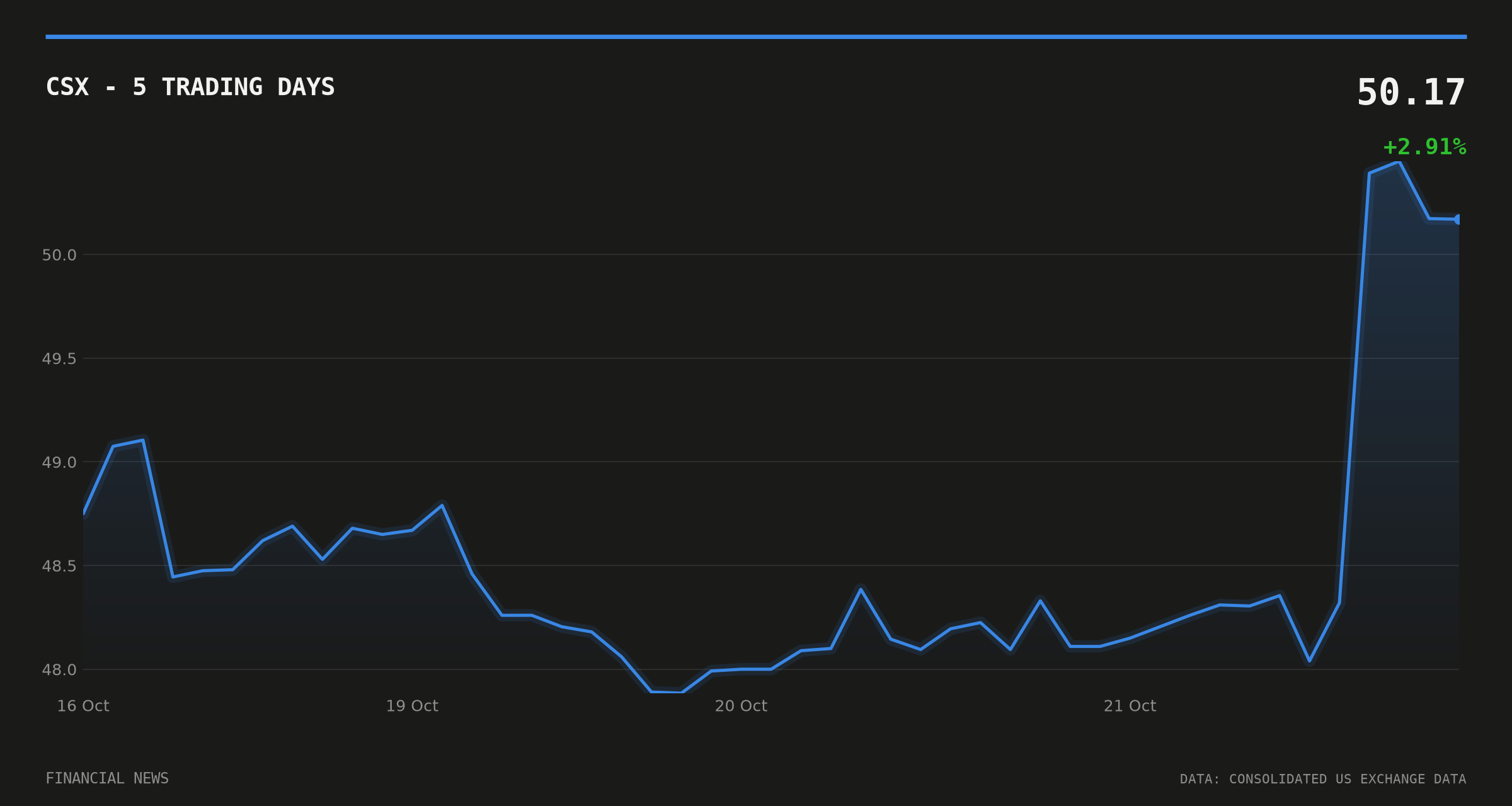

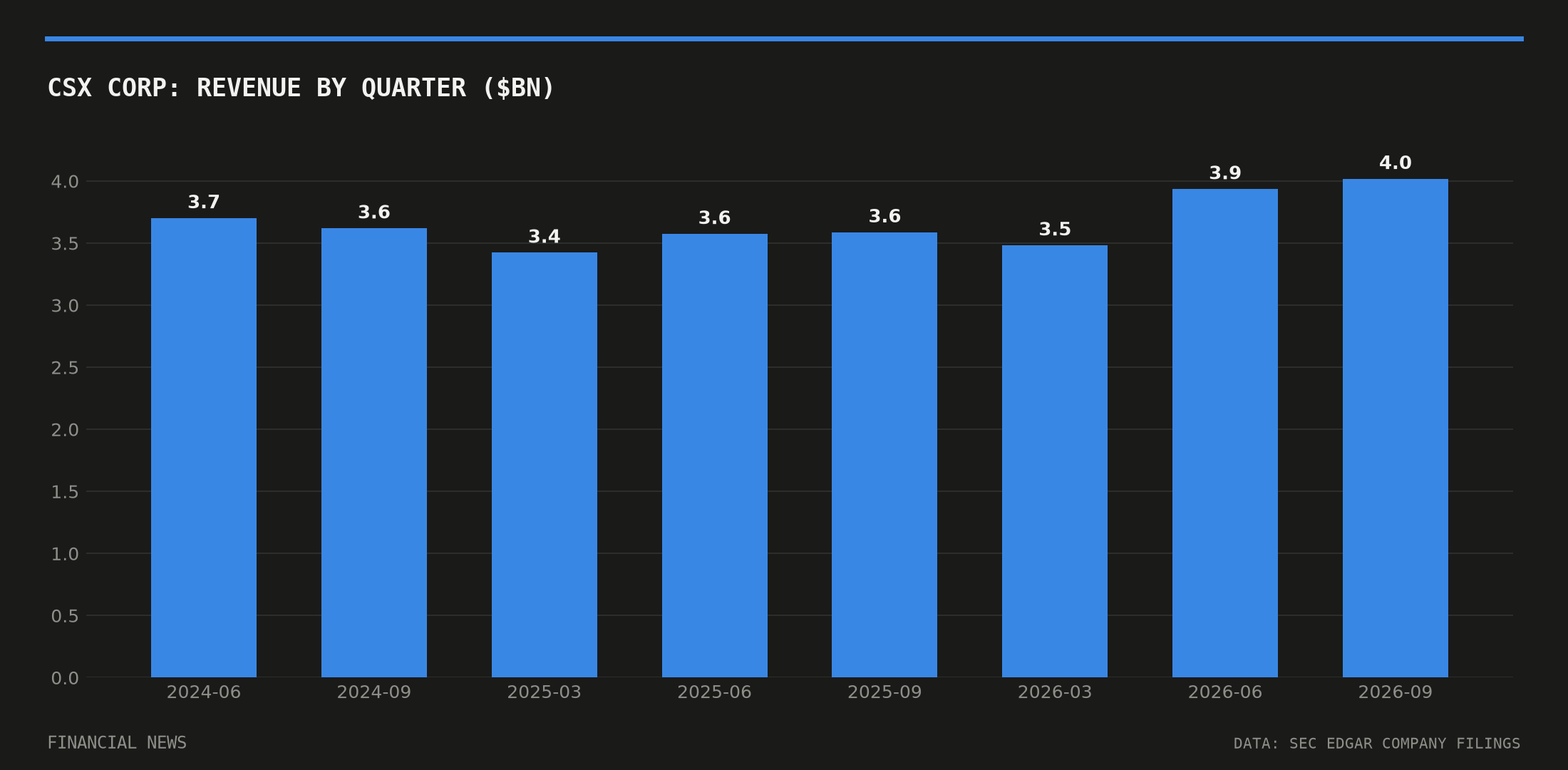
CSX Corp (NASDAQ: CSX) reported record third-quarter revenue of $4.02bn on 21 October 2026, up 12% year-on-year. The US rail freight operator’s third quarter 2026 results beat analyst expectations and sent shares up 3.86% to close at $50.17.
Net earnings came in at $1.05bn, or $0.57 a diluted share, against $694m and $0.37 a year earlier. Operating income rose to $1.57bn from $1.09bn.
CSX third quarter results beat consensus on both lines
The $0.57 diluted EPS figure topped the $0.53 consensus estimate tracked by FactSet, according to MarketScreener. Revenue also cleared Wall Street’s roughly $3.96bn forecast by some $60m.
CSX’s own 10-Q filing confirms the $1,052m net-earnings figure and the $0.57 EPS tag through its quarterly disclosures lodged with the SEC. The prior-year comparison period, the three months to 30 September 2025, carried net earnings of $694m and EPS of $0.37, figures drawn from CSX’s 2025 third-quarter filing.
That 2025 comparison was muddied by a one-off charge. CSX took a $164m non-cash goodwill impairment on its Quality Carriers trucking unit in the third quarter of 2025, a writedown the company has linked to a prolonged downturn in trucking demand. Stripping that out, adjusted operating income, net earnings and EPS for the 2025 quarter were $1.25bn, $818m and $0.44 respectively. Measured against those adjusted figures, the latest quarter’s growth works out at 25% for operating income, 29% for net earnings and 30% for EPS.
A recovery from a soft start to the year
The scale of the improvement stands out against CSX’s own recent run of quarters. Revenue dipped as low as $3.42bn in the first quarter of 2025 and climbed only as far as $3.59bn by that year’s third quarter, based on the three 2025 periods disclosed in CSX’s SEC filings; the company’s fourth-quarter 2025 figures are not covered in those disclosures. Net earnings over the same three quarters ran from $646m to $829m, well below the $1.05bn now reported.
The turnaround accelerated earlier this year. Revenue reached $3.94bn in the second quarter of 2026 and net earnings hit $1.00bn, already a marked step up from the first quarter’s $807m. The third-quarter figures extend that trajectory, with revenue crossing $4bn for the first time in the periods disclosed and operating margin, according to the research into CSX’s own exhibits, expanding to 39.1%, up roughly 880 basis points on the year.
Shares react, short interest had been easing
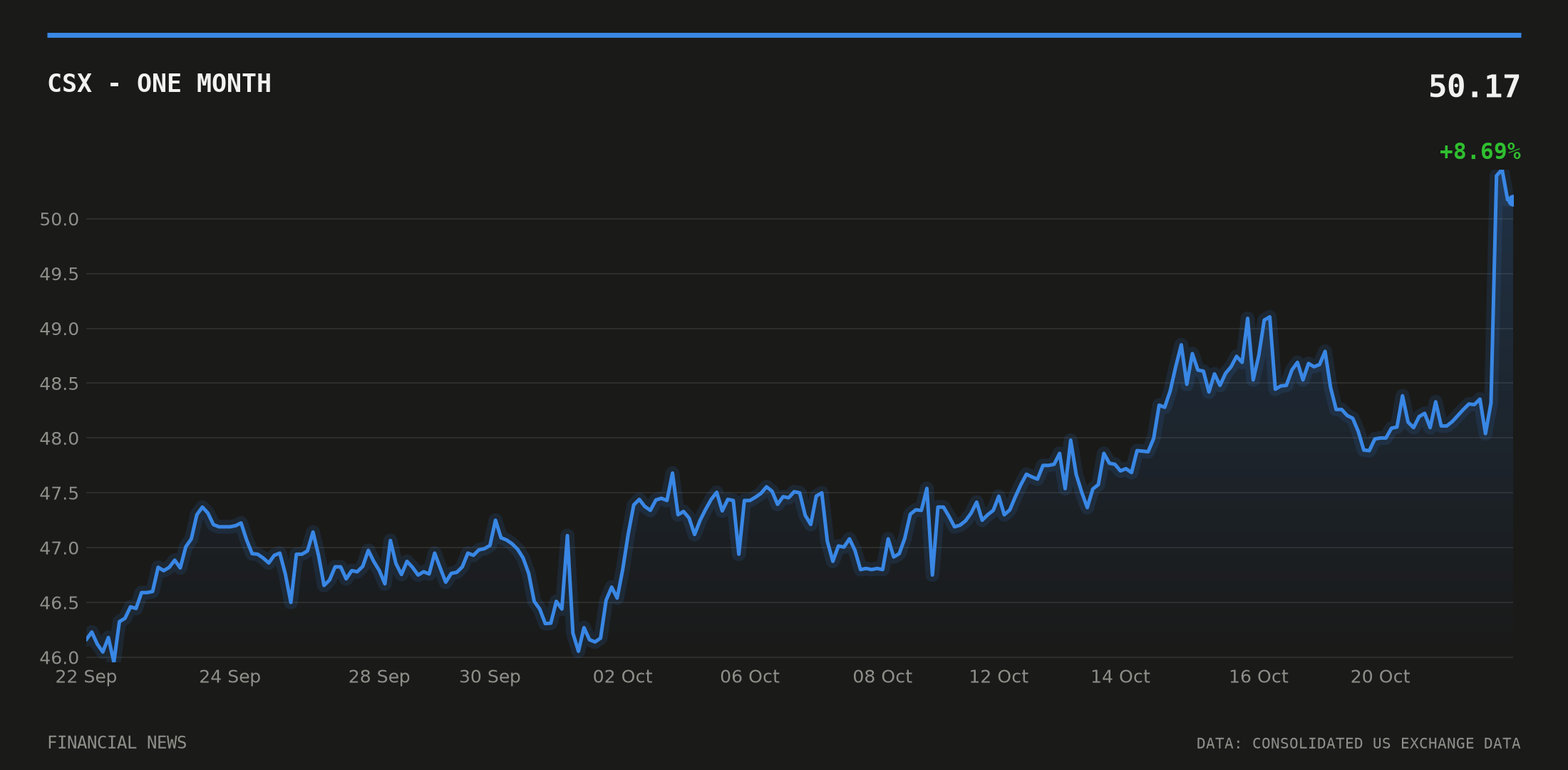
CSX stock traded up to $50.45 intraday against a 20-day range that had bottomed at $46.06, with volume running at nearly double the 20-day average. The rally followed a period in which FINRA’s daily short-sale data showed the stock’s short-volume ratio drifting down from 0.59 in mid-October to 0.46 the day before results, before ticking back up to 0.50 on the day of the release itself, according to FINRA figures.
The results land against a backdrop of still-elevated borrowing costs. The 10-year US Treasury yield stood at 5.15% as of 19 October 2026, up from 5.09% a week earlier, according to data from the Federal Reserve Bank of St. Louis. That keeps financing costs on rail capital spending and any buyback programme relatively high even as CSX’s own margins widen.
What the numbers mean for the rest of the year
Executives addressed the results on an earnings call the day after publication, a transcript of which was carried by Seeking Alpha. Independent coverage of the quarter, including from Railway Age, corroborated the adjusted 30% EPS growth figure CSX highlighted alongside the headline numbers.
Investors will now watch whether CSX can sustain the margin gains into the fourth quarter, with the next scheduled update due when the company files its 2026 annual results. The comparison base gets easier before it gets harder: Quality Carriers’ 2025 impairment drops out of the trailing twelve-month figures entirely once the fourth quarter rolls over, removing a drag that has flattered year-on-year growth rates through 2026.
This article is for information only and is not investment advice or a recommendation to buy or sell any asset. Markets move quickly; figures are correct as sourced at the time of writing. Always do your own research before making financial decisions.
