
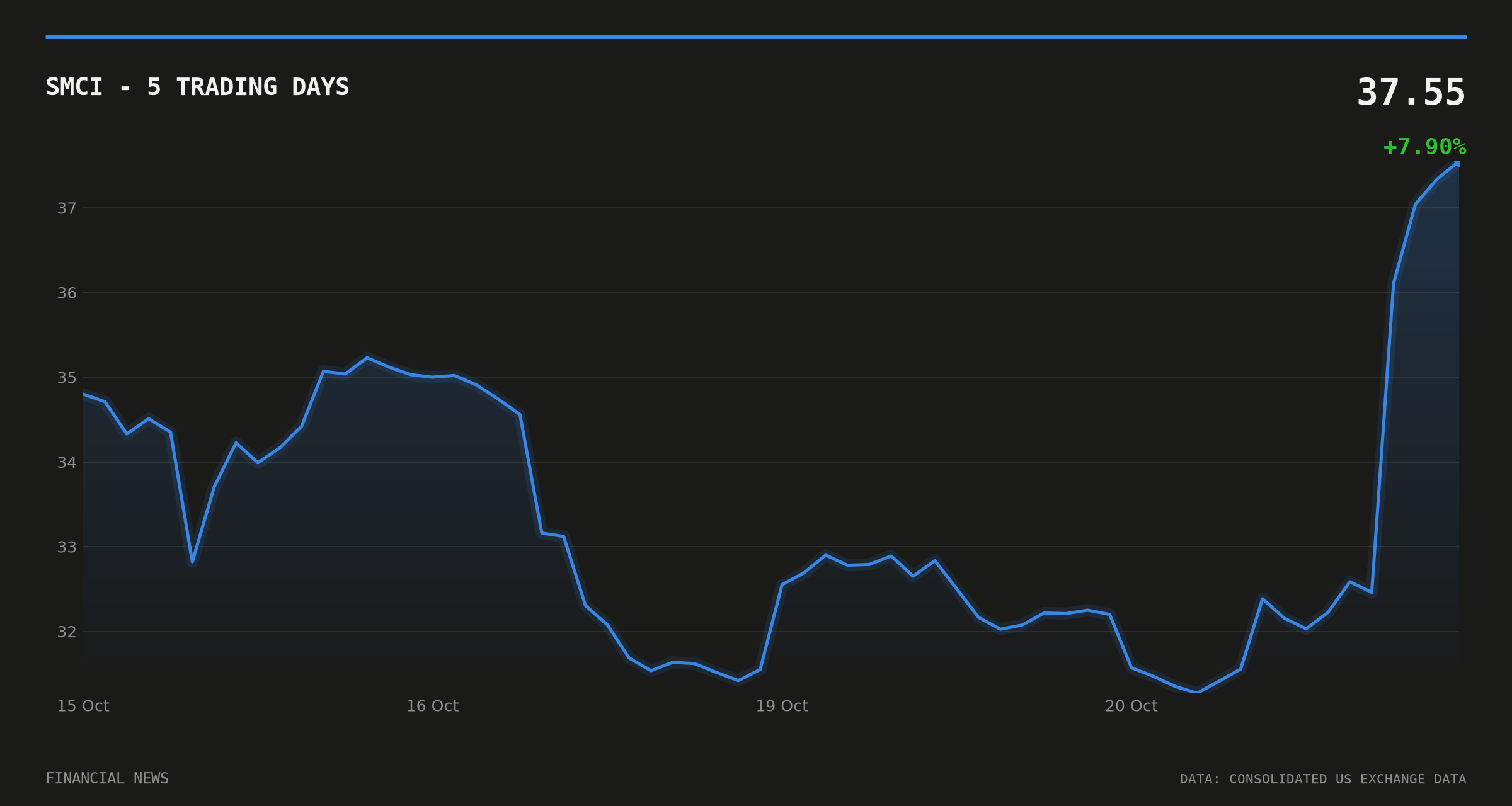

Super Micro Computer (NASDAQ: SMCI) stock surged on 20 October 2026 after the company unexpectedly lifted its revenue and margin guidance, dragging Dell Technologies (NASDAQ: DELL) and Hewlett Packard Enterprise shares higher in sympathy.
SMCI shares closed 17.23% higher at $37.55, according to Reuters, which put the after-hours move at 11.3%. The gap reflects different measurement windows around the close.
What triggered the Super Micro stock surge
Supermicro filed an 8-K with the SEC disclosing a preliminary business update for its fiscal first quarter of 2027. The company now expects revenue of $18.5bn to $19.5bn, up sharply from prior guidance of $14.5bn to $15.5bn.
Gross margin guidance also rose, to 12.0%-12.5% from 10.4%-10.8%, Supermicro said in the filing, also published via its investor relations site. The figures are preliminary and unaudited; Supermicro has scheduled its full results call for 3 November 2026.
Dell and HPE shares rose in tandem on the read-through to the wider AI-server supply chain. Reuters reported gains of 3.5%-4.9% for the pair, while TradingView News cited early post-market moves of 3.3% for Dell and 2.7% for HPE.
A reversal, not just a rally
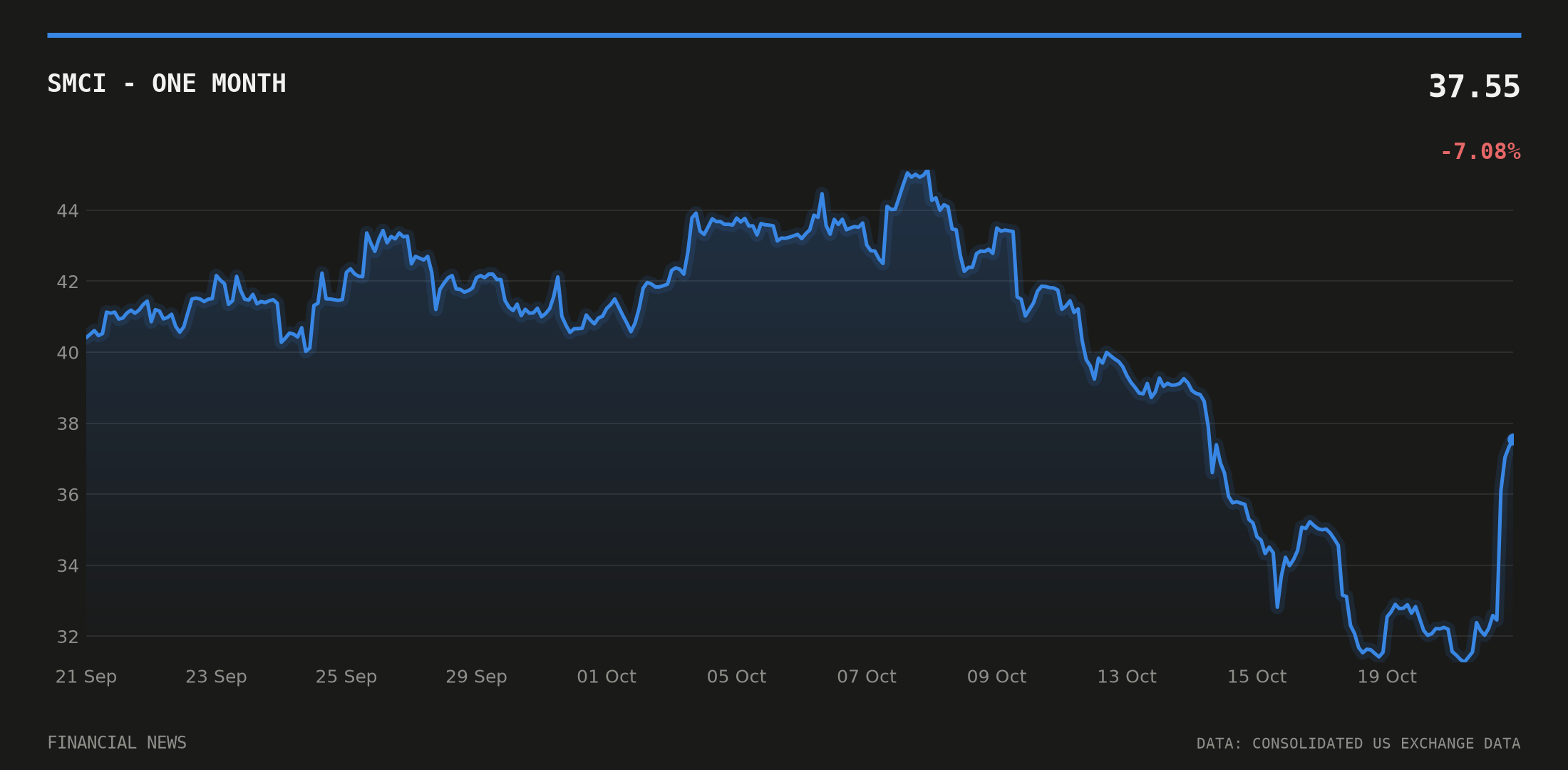
The jump partly unwound a recent slide. SMCI shares had fallen roughly 8.42% over the prior 20 trading days before Tuesday’s move, consolidated exchange data show, with the stock trading as low as $31.27 and as high as $45.15 in that window.
Volume on the day ran at 1.83 times the 20-day average.
The move also follows a rough week for the sector. 24/7 Wall St. reported that Dell and HPE had fallen after Barclays downgraded both to Equal Weight on valuation grounds, flagging possible pressure on server and storage margins as memory prices normalise. Supermicro’s own guidance revision appears to have directly countered that thesis, at least for one trading session.
Volatile earnings history underscores the stakes
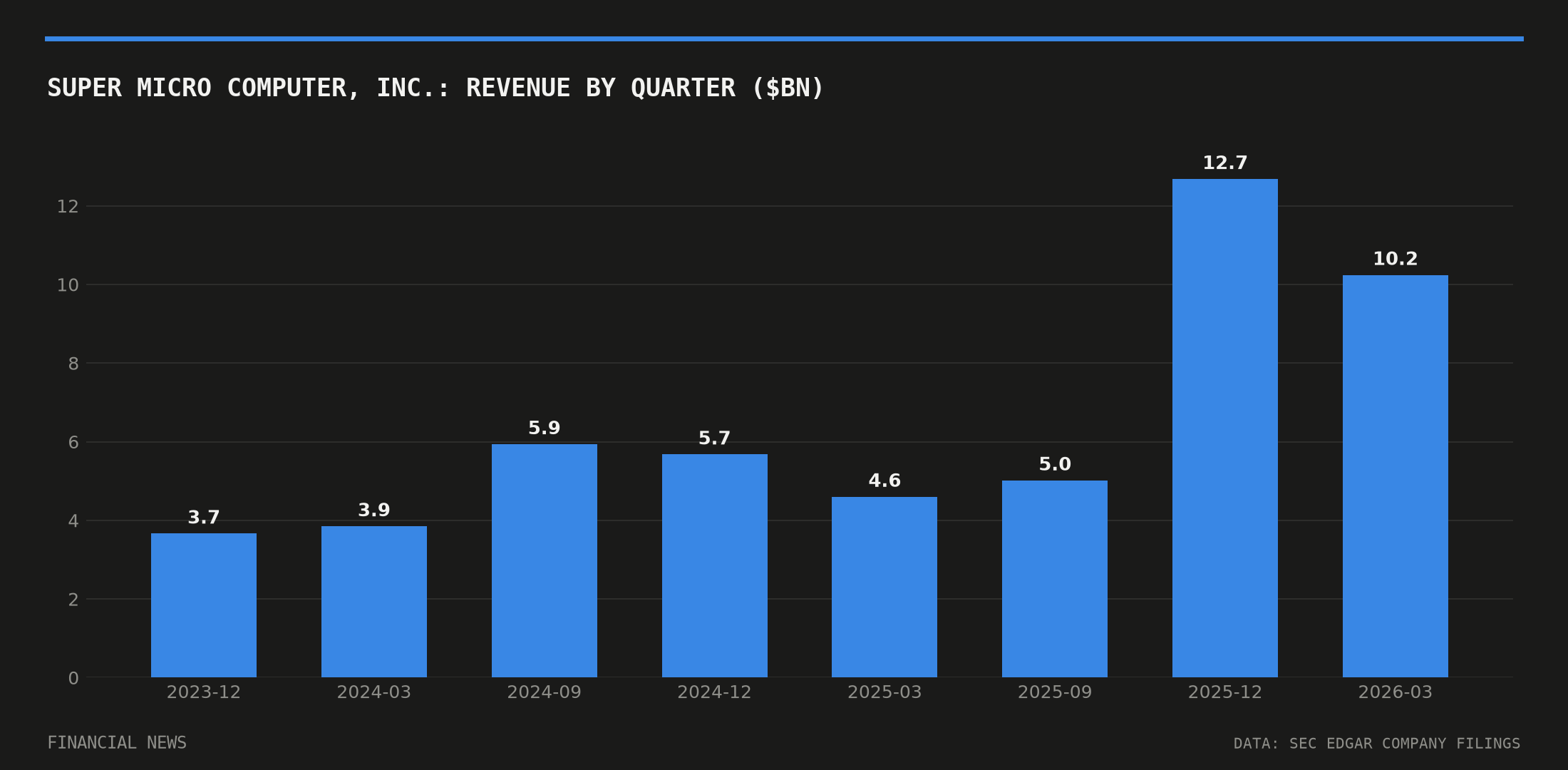
Supermicro’s quarterly results have swung widely over the past two years, a pattern that helps explain why each guidance update moves the stock so sharply. Net income came in at $483.4m, or $0.72 a diluted share, in fiscal third-quarter 2026, filings show, against $108.8m, or $0.17 a share, in the same quarter a year earlier.
Revenue has been similarly uneven: Supermicro reported $12.68bn in fiscal second-quarter 2026, filed with the SEC on 6 February 2026, before slipping to $10.24bn the following quarter. Two years earlier, in fiscal second-quarter 2024, the company reported just $3.66bn in revenue, illustrating how quickly the AI-server build-out has scaled the business.
Four Form 4 filings from Dell insiders, including Silver Lake-affiliated entities and director Richard Troy Sharp, were lodged with the SEC the evening before Supermicro’s announcement. Those filings relate to routine insider and SPV transactions and are unconnected to the rally, according to the filings themselves.
Positioning and the macro backdrop
FINRA’s daily short-sale data show SMCI’s short-volume ratio held in a narrow range of 0.421 to 0.552 in the ten sessions before the update, before ticking up only modestly to 0.47 on the rally day itself. That suggests the surge was not primarily a short-covering squeeze.
The move also came against a backdrop of rising long-term borrowing costs: the 10-year US Treasury yield stood at 5.15% on 19 October, up from 5.09% a session earlier, according to Federal Reserve data, with the 10-year/2-year spread narrowing to 0.33 percentage points from 0.38.
Supermicro’s full fiscal first-quarter results, due on 3 November, will show whether the preliminary figures hold once audited. Until then, the revised guidance stands as the company’s own forecast rather than a confirmed outcome, and investors in Dell and HPE are, for now, betting that the AI-server demand picture Supermicro described extends across the wider supply chain.
This article is for information only and is not investment advice or a recommendation to buy or sell any asset. Markets move quickly; figures are correct as sourced at the time of writing. Always do your own research before making financial decisions.
