

Activist fund Toms Capital Management has sent Devon Energy (NYSE: DVN) a letter urging the company to explore strategic alternatives, including an outright sale, CNBC reported on 23 September 2026.
Devon shares rose 3.03% to $48.385 by 14:00 UTC that day, according to consolidated US exchange data, after the report broke.
Toms Capital Devon Energy pressure has been building for months
The letter is not a new opening move. Reuters reported in June that Toms was already pressing Devon privately to speed asset sales or put itself up for sale, citing five sources familiar with the matter, US News reported via Reuters. Days later, Devon said it planned to ‘optimise its portfolio’ around its core Permian position, with a strategic and financial review already under way.
Toms Capital, which the fund says manages just over $4bn in assets, states in the letter it is now among Devon’s top five shareholders, having stood outside the top ten as recently as the end of June, according to CNBC. Neither Toms nor Devon has offered on-the-record comment beyond the letter’s contents, and no version of the document has surfaced in an SEC 13D filing.
That gap matters. The specific figures – the $4bn asset base, the top-five ranking, the scale of any valuation discount – trace to CNBC’s description of a document ‘viewed by’ the network, not to a filed disclosure. Separate reporting on the underlying Coterra transaction that Toms’s campaign centres on has also diverged sharply, with some outlets describing a ‘$25bn’ deal and others putting it at ‘$58bn’ – a discrepancy no source resolves.
A second activist is already in the building
Toms is not the only investor pushing Devon. Kimmeridge Energy Management has separately urged the company to streamline its property portfolio and avoid what it has called a ‘conglomerate discount’ following the merger, according to TipRanks. Devon is now managing two simultaneous activist campaigns while still digesting a tie-up that reshaped its balance sheet earlier this year.
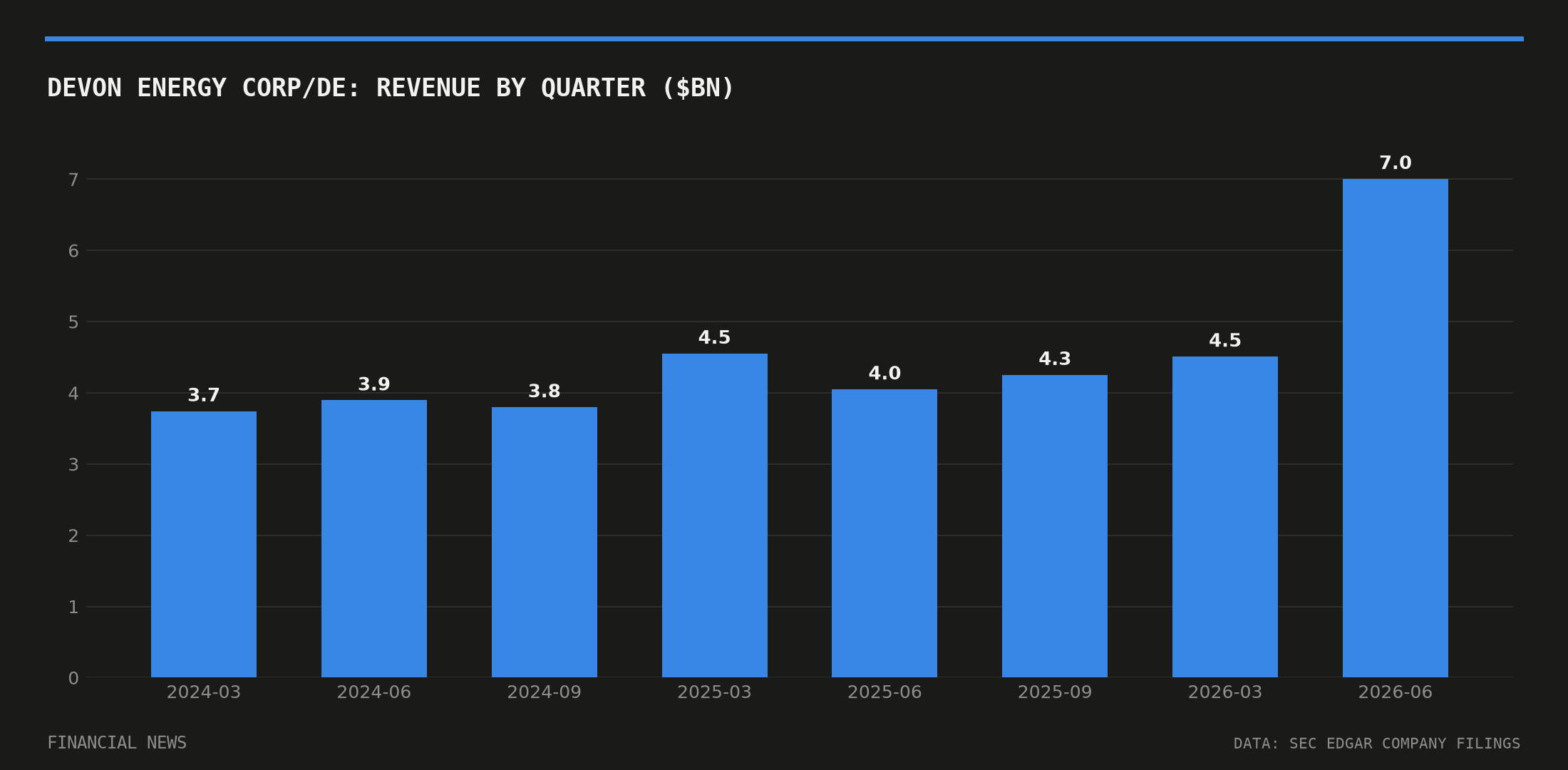
The merger’s financial footprint is visible in Devon’s own filings. Quarterly revenue jumped from $4.508bn in the first quarter of 2026 to $7.003bn in the second, while net income rose from $120m to $1.911bn over the same period, consistent with the Coterra business consolidating into Devon’s results from the second quarter. That step-change in scale is the backdrop against which both activists are now arguing that shareholders, not Devon itself, are bearing the risk of unwinding unwanted assets.
Permian dealmaking has provided the wider context for the push. Total transaction volume in the basin has reached $362bn since the start of 2026, a 39% increase on the prior-year period, according to Hedgeweek – a backdrop that has made buyers of scale assets easier to find, and made minority holders more impatient with slow-moving divestiture plans.
Positioning shifted before the letter went public
Trading data suggest some investors had already begun repositioning ahead of the report. Devon’s daily short-sale ratio, tracked by FINRA, ran between 0.55 and 0.59 through mid-September before falling to 0.29 on 22 September, the session before the letter’s contents became public. The stock had also been range-bound over the prior 20 sessions, moving between $46.84 and $51.58, before Tuesday’s jump took it back toward the top of that band.
The macro backdrop was steady rather than a driver of the move: the 10-year Treasury yield stood at 4.96%, down marginally from 5.01% the prior session, and the US unemployment rate held at 4.1% in August, according to Federal Reserve data. Tuesday’s rally in Devon shares tracks the company-specific news rather than any shift in rates or the broader economic picture.
What comes next
Toms Capital’s letter argues that a strategic acquirer would be better placed than Devon’s own shareholders to absorb the execution risk of subsequently divesting unwanted assets, according to reporting cited by Quartz. Wolfe Research has framed Devon’s next earnings report as a test of whether merger synergies can satisfy that demand for faster action, according to Investing.com. With two activists now pushing publicly and a merger integration still under way, the company’s response – due in disclosures around that earnings date – will show whether Devon opts for asset sales, a broader review, or resistance to both.
This article is for information only and is not investment advice or a recommendation to buy or sell any asset. Markets move quickly; figures are correct as sourced at the time of writing. Always do your own research before making financial decisions.
