

Most investors are familiar with a certain version of Warren Buffett, the one who steered clear of tech stocks for decades, famously passed on Google and Amazon when they were still struggling, and favored See’s Candies and BNSF Railway over anything that had a silicon chip. Over the past year, Buffett has quietly and methodically changed that version of himself. Additionally, the revision is estimated to be worth $28 billion.
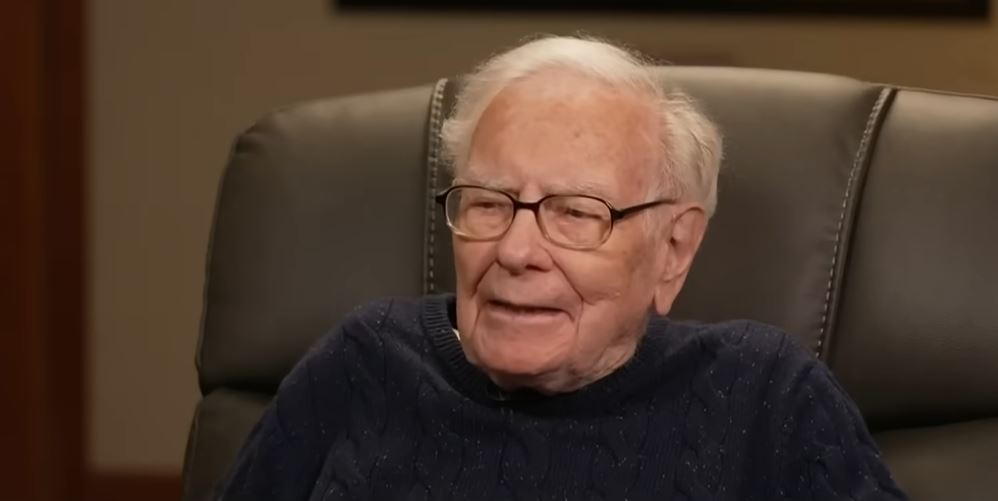
One of the conglomerate’s five biggest equity holdings is currently Berkshire Hathaway’s stake in Alphabet, the parent company of Google. It’s not just the magnitude of the stakes that makes it truly fascinating. Who made the call is what matters. Buffett acknowledged that he was the one who started the investment in a recent CNBC interview. Not his chosen successor, Greg Abel. Not Todd Combs or Ted Weschler, the two portfolio managers who oversee a portion of Berkshire. Buffett himself. The man continues to choose billion-dollar stocks at the age of 95.
In the third quarter of 2025, Berkshire made a covert acquisition of approximately 17.85 million shares, which at the time of its November disclosure were valued at approximately $4.93 billion. The investment community took notice, but some thought it was a lieutenants’ trade—the kind of incremental role Combs or Weschler might take without going up the chain. Buffett’s remarks on CNBC disproved that theory.
It’s important to consider how long this specific decision truly took. According to Buffett, he first became interested in Alphabet years ago when GEICO, one of Berkshire’s most valuable assets, was heavily investing in Google advertising and producing quantifiable revenue from it. He observed the economics of the search engine from the perspective of a consumer. That seems almost archaic: a man observing the expenditure of advertising funds and wondering why they were so successful. For more than ten years, that observation lingered in the back of his mind.
It appears that a particular belief about artificial intelligence—not the speculative kind, but the durable kind—was what ultimately moved him. Buffett has long stated that he seeks out companies that can generate large returns on investment over a long time frame. He seems to think that Alphabet’s AI infrastructure meets that criteria. Some investors are genuinely concerned about the company’s projected $200 billion in capital expenditures in 2026 alone. Apparently, Buffett is not one of them.
Some context for that confidence can be found in Alphabet’s second-quarter results. For the sixth straight quarter, revenue increased by 24% to $119.8 billion. Cloud revenue increased by 82%, an increase that Microsoft and Amazon have not recently been able to match. At $40.8 billion, operating income increased by 31%. These figures don’t represent a business struggling with an AI spending cycle. These are the figures of a business that appears to be making money off of its investments.
Additionally, Alphabet has a unique strategic feature that isn’t given enough attention. The company produces its own chips, known as Tensor Processing Units, which are currently the second most popular AI accelerators after Nvidia’s GPUs, rather than merely purchasing AI infrastructure from other suppliers. Alphabet is starting to sell TPUs directly to external clients rather than only renting them through Google Cloud, CEO Sundar Pichai recently informed analysts. That’s a real-time opening of a new revenue stream. Buffett may have seen this full-stack strategy—chips, cloud, models, and applications—as the kind of long-term competitive advantage he has always pursued. The early signs are difficult to ignore, but it’s still genuinely unclear if it will remain at that scale for five or ten years.
After officially taking over as CEO of Berkshire, Greg Abel tripled Alphabet’s position in the second quarter. Approximately 6% of Berkshire’s U.S. equity portfolio is represented by the stake, which is currently close to $28 billion. The forward price-to-earnings ratio of Alphabet’s shares is about 22, which is reasonable given the company’s growth trajectory and less expensive than many much slower-growing companies. Due in large part to the upwardly revised capex guidance, the stock has declined by roughly 7% since the Q2 earnings call. Spending is sometimes penalized by markets. Throughout his career, Buffett has wagered that the right investment at the right business is precisely what you want to own.
It’s difficult to ignore the fact that this investment also represents a philosophical development. It appears that the man who previously claimed he didn’t invest in things he didn’t understand now has a solid understanding of Alphabet. or sufficient to write a big check, at the very least.
