Analog Devices (NASDAQ: ADI) agreed on 9 September 2026 to acquire Alif Semiconductor in an all-cash deal, the company said.
The headline price is $1.35bn, though a filing shows ADI could pay up to a further $200m in contingent consideration, taking the maximum total to $1.55bn, according to a Form 8-K exhibit filed with the SEC.
What the Alif Semiconductor acquisition brings
Alif makes AI-native microcontrollers and fusion processors designed to run inference directly on devices rather than in data centres. ADI’s press release frames the target market as “Physical Intelligence” – systems that must interpret motion, sound, vibration and radio signals in real time, under strict power and latency limits.
The Alif Semiconductor acquisition adds those chips to ADI’s existing sensing and signal-processing lines, the company said, aiming to build systems that sense, process and decide locally rather than sending data to the cloud.
The deal was reported by Reuters and confirmed by the Wall Street Journal under the same $1.35bn figure. ADI expects the transaction to close before the end of calendar 2026, subject to customary conditions and clearance under the Hart-Scott-Rodino Act, the 8-K exhibit shows.
Advisers and structure
PJT Partners advised ADI on the deal, with Wachtell, Lipton, Rosen & Katz as legal counsel. Qatalyst Partners advised Alif, with DLA Piper acting as its legal adviser, according to the same filing.
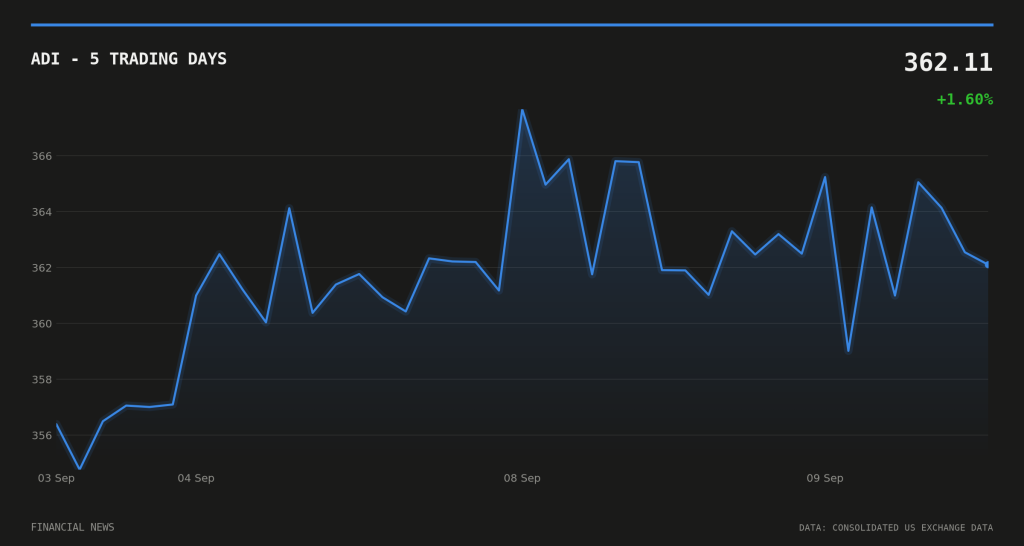
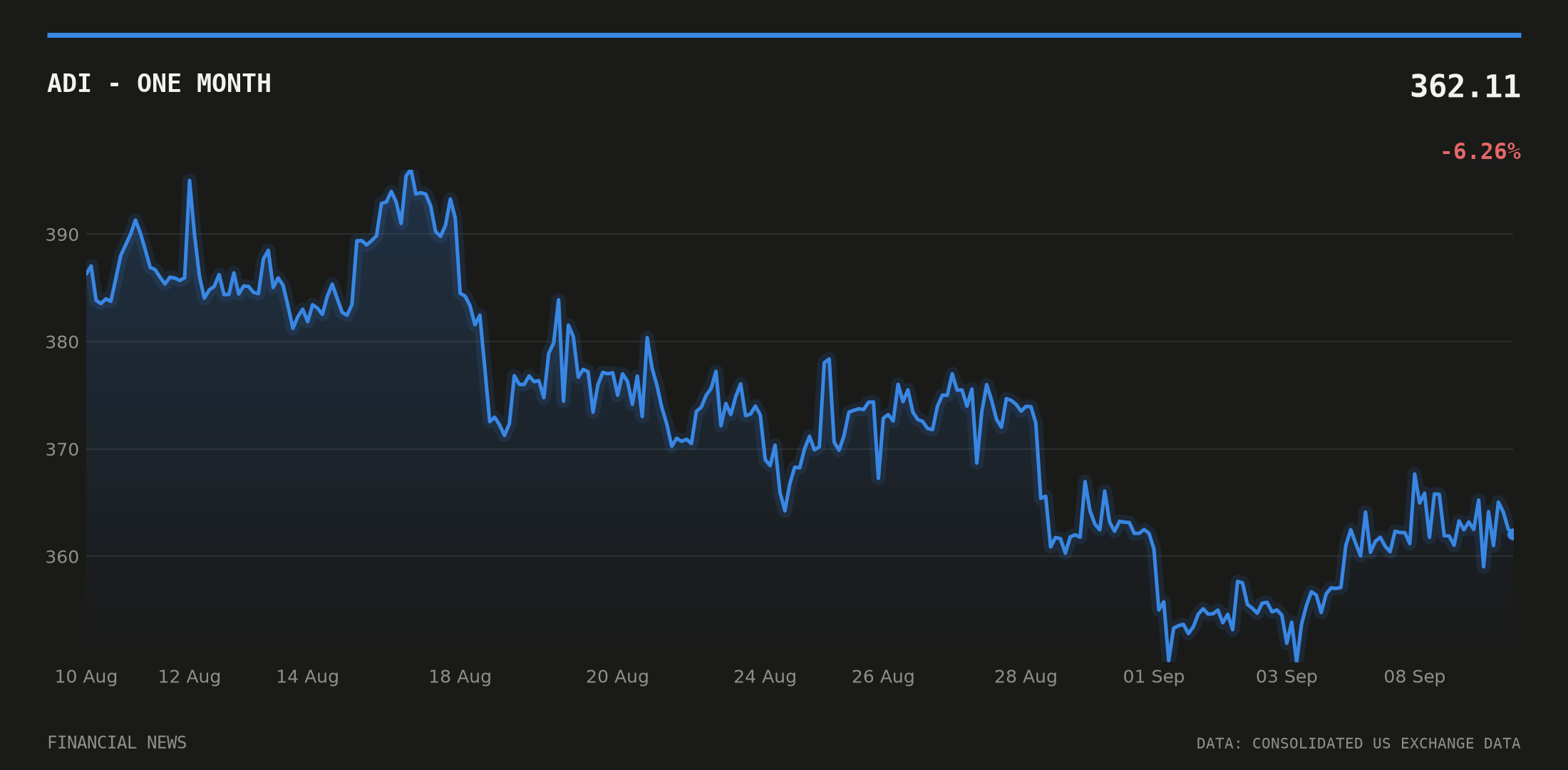
ADI shares closed at $361.655 on 9 September, down 0.98% on the day and 4.17% over the prior 20 trading sessions. Volume ran at just 38% of the 20-day average, a subdued reaction for a company of ADI’s size taking on a deal worth roughly a third of its most recent quarterly revenue.
Balance-sheet capacity
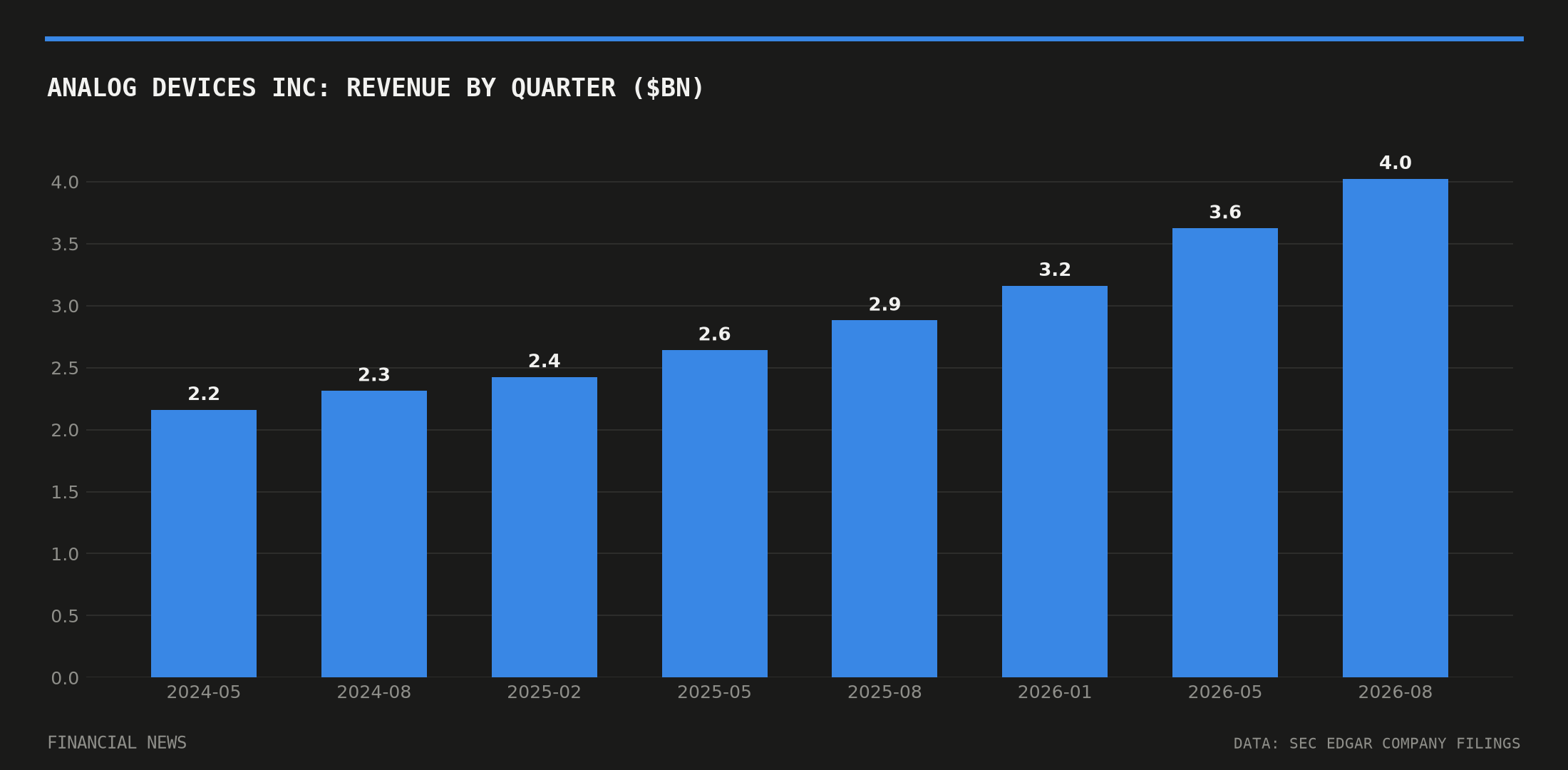
ADI’s most recent quarterly filings suggest headroom for an all-cash purchase of this size. Net income for the fiscal quarter ended 1 August 2026 was $1.34bn on revenue of $4.02bn, according to its 10-Q filed with the SEC in August. That compares with net income of $1.18bn on revenue of $3.62bn the quarter before, and $830.8m on revenue of $3.16bn in the quarter that opened fiscal 2026.
The trend stretches back further. In the second quarter of fiscal 2024, ADI reported net income of $302.2m on revenue of $2.16bn; by the third quarter of fiscal 2025, that had risen to $518.5m on revenue of $2.88bn. Diluted earnings per share moved from $0.61 in that 2024 quarter to $2.74 in the quarter ended August 2026, tracking the same climb in profitability. Against that backdrop, a $1.35bn cash outlay – with a further $200m contingent on performance – looks close to one quarter’s net income rather than a stretch on the balance sheet.
Rates backdrop and trading activity
The deal lands with financing costs still elevated. The 10-year Treasury yield stood at 4.78% on 4 September 2026, against 4.37% on the 2-year, a spread of 0.41 percentage points, Federal Reserve data show. Those levels keep borrowing costs for larger, debt-funded acquisitions a live consideration industry-wide, though ADI is funding this purchase from cash rather than new debt.
Separately, FINRA data show ADI’s short-sale volume ratio rose from 0.338 on 3 September to 0.624 on 8 September, the trading day immediately before the announcement. A rising short ratio ahead of a deal is not evidence of anything improper on its own – such moves can reflect hedging, options activity or unrelated positioning – but it is the kind of pattern market participants tend to note after the fact.
ADI has not disclosed integration timelines for Alif’s product lines beyond the expected year-end close. Investors will get a fuller picture of how the deal is being funded and structured when ADI reports its next quarterly results, and when the transaction moves through HSR review in the coming months.
This article is for information only and is not investment advice or a recommendation to buy or sell any asset. Markets move quickly; figures are correct as sourced at the time of writing. Always do your own research before making financial decisions.