
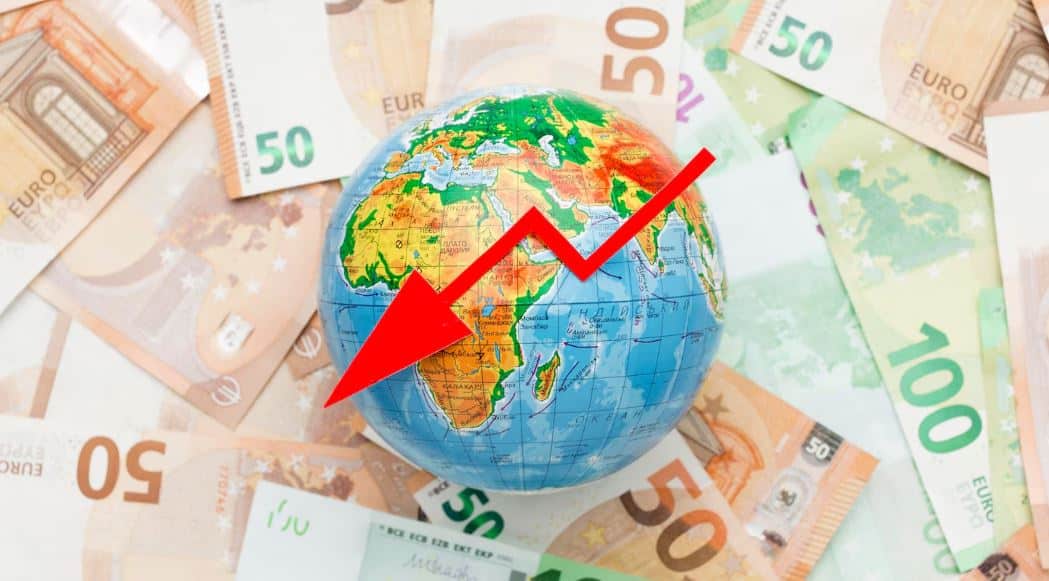

The idea that a twenty-one-mile-wide body of water could bring the world economy to its knees is almost unbelievable. However, that is precisely what has occurred in the Strait of Hormuz since late February, when Iran sealed one of the world’s most vital shipping lanes in retaliation for coordinated airstrikes by the United States and Israel. The estimated daily cost to the global economy reached $14 billion by the beginning of May. On certain days, it rises higher. Prices are not getting any cheaper these days.
After a short while, the numbers become difficult to comprehend. Every day, about twenty million barrels of oil—roughly 25% of all seaborne oil trade—pass through the strait. The same channel is used for about 20% of the world’s liquefied natural gas. By early March, ship transits had fallen to single digits from an average of 129 vessels per day in early February. Traffic was essentially nonexistent by the end of March. Twenty thousand sailors are waiting for a war to end while stranded somewhere in the Persian Gulf on idle ships.
| 2026 Strait of Hormuz Crisis — Key Information | Details |
|---|---|
| Location | Between Iran and Oman, Persian Gulf |
| Width at Narrowest Point | 21 miles (34 km) |
| Closure Began | February 28, 2026 |
| Estimated Daily Global Cost | ~$14 Billion |
| Pre-Crisis Daily Oil Transit | ~20 million barrels per day |
| Share of Global Seaborne Oil Trade | ~25% |
| Share of Global LNG Trade | ~20% |
| Brent Crude Peak Price | $126 per barrel (March 2026) |
| Stranded Mariners | ~20,000 |
| Stranded Vessels | ~2,000 ships |
| Damaged Merchant Ships | At least 17 |
| Active Parties | Iran, United States, Israel, shipping companies |
| IMF 2026 Growth Forecast Cut To | 3.1% |
The way the financial markets responded is difficult to ignore. For the first time in four years, Brent crude broke $100 per barrel on March 8 and continued to rise, reaching a high of $126. The data shows that the biggest increase in oil prices in a single month ever occurred in March. In less than two weeks, gas prices in Europe increased by 74%. The IMF, which has never been the most dramatic organization, quietly lowered its forecast for global growth in 2026 to 3.1 percent and threatened to make more cuts if the impasse persisted.
The price is measured in more than just dollars per barrel. About 33% of the world’s helium, half of its seaborne sulfur, 23% of its ammonia, and about 9% of its aluminum come from the Gulf. Helium may seem like a specialized issue, but keep in mind that MRI scanners and semiconductor factories depend on it. Fertilizer is produced using ammonia and sulfur, and fertilizer supports entire agricultural economies. Over half of Sudan’s fertilizer imports come from this area. The list of nations at risk, which includes Mozambique, Kenya, Pakistan, and Sri Lanka, resembles a map of people who just cannot afford the next shock.
The oil crisis of the 1970s is the historical parallel that keeps coming up, and it’s not hyperbole. This is the biggest disruption to the global energy supply in fifty years, according to analysts at the Kiel Institute. Observing the news cycle, it seems as though we’ve entered a phase that many politicians have secretly hoped would remain closed for decades. On April 12, President Trump announced a blockade of the strait, turning an already extraordinary situation into what observers now refer to as a “dual blockade”—Iran blockading the Gulf and the United States blockading Iran.
The macro figures are broken up by the human details. A tugboat went down. 17 merchant ships were damaged. Twelve sailors were killed or reported missing. A Bahraini port worker was killed. In the midst of a maritime disaster, Iran made the strange diplomatic move of allowing seven Malaysian ships to pass through while referring to them as “friends” in early April. The cost of insurance for tankers traveling across the strait has increased four to six times. When transit occurs at all, the war-risk premium alone now costs the biggest oil carriers a quarter of a million dollars.
How this ends is still up in the air. A brief ceasefire broke down. Discussions in Islamabad were unsuccessful. Operation Project Freedom was started by the US to protect neutral ships, but it might take years to rebuild the underlying conflict, the destroyed refining capacity, and the damaged trust. The global supply chains will bear the consequences for a very long time, even if shipping starts up again tomorrow.
