

The US National Highway Traffic Safety Administration opened a Tesla Cybercab probe on 4 September 2026, days after the driverless vehicle’s commercial debut on the streets of Austin, Texas.
The audit covers close to 1,000 Cybercabs, the regulator said, examining how Tesla (TSLA) certified the vehicle’s compliance with federal safety rules despite it having no steering wheel, pedals or mirrors.
What the Tesla Cybercab probe is testing
NHTSA’s investigation targets the legal basis for Tesla’s approach rather than a specific crash or defect. The agency said it wants to “examine the process and technical data on which Tesla relied when certifying the Cybercab and related issues,” according to TechCrunch.
Federal Motor Vehicle Safety Standards, written for conventional cars, generally assume the presence of manual controls. Tesla opted to self-certify the Cybercab against those standards rather than apply for the exemption process that companies such as Waymo and Zoox have used for steering-wheel-free vehicles.
That route matters because self-certification sidesteps the 2,500-unit annual production cap attached to the exemption pathway. Tesla vice president of vehicle engineering Lars Moravy has said the Cybercab is not subject to that cap because the company certified compliance directly rather than sought an exemption, according to Electrek.
NHTSA opened the probe within hours of Tesla putting the first production Cybercabs onto public roads in Austin. Ahead of the formal announcement, an agency spokesperson told Reuters, as carried by Yahoo Autos, that “NHTSA is in contact with Tesla and is evaluating the situation.”
Scale of the audit versus the fleet on the road
The nearly 1,000-vehicle figure describes the scope of NHTSA’s audit, not the number of Cybercabs actually carrying passengers. Tesla had 420 autonomous vehicles registered in Texas as of Friday morning, and only 45 of those were Cybercabs, according to a Reuters wire report carried by SRN News.
The gap between the audited population and the deployed fleet reflects Tesla’s broader production run rather than the Austin rollout itself. It is the first time regulators have tested this specific self-certification strategy for a vehicle built without manual controls from the outset.
This is not Tesla’s only open matter with the regulator. NHTSA is pursuing at least two other ongoing investigations into possible safety defects in the company’s partially automated driving systems, CNBC reported.
Not every inquiry ends in enforcement, however. NHTSA closed a separate, unrelated three-year probe into roughly 120,000 2023 Model Y vehicles over steering-wheel detachment risk without requiring any action from Tesla, days before the Cybercab launch, according to Teslarati.
Shares fall as scrutiny lands
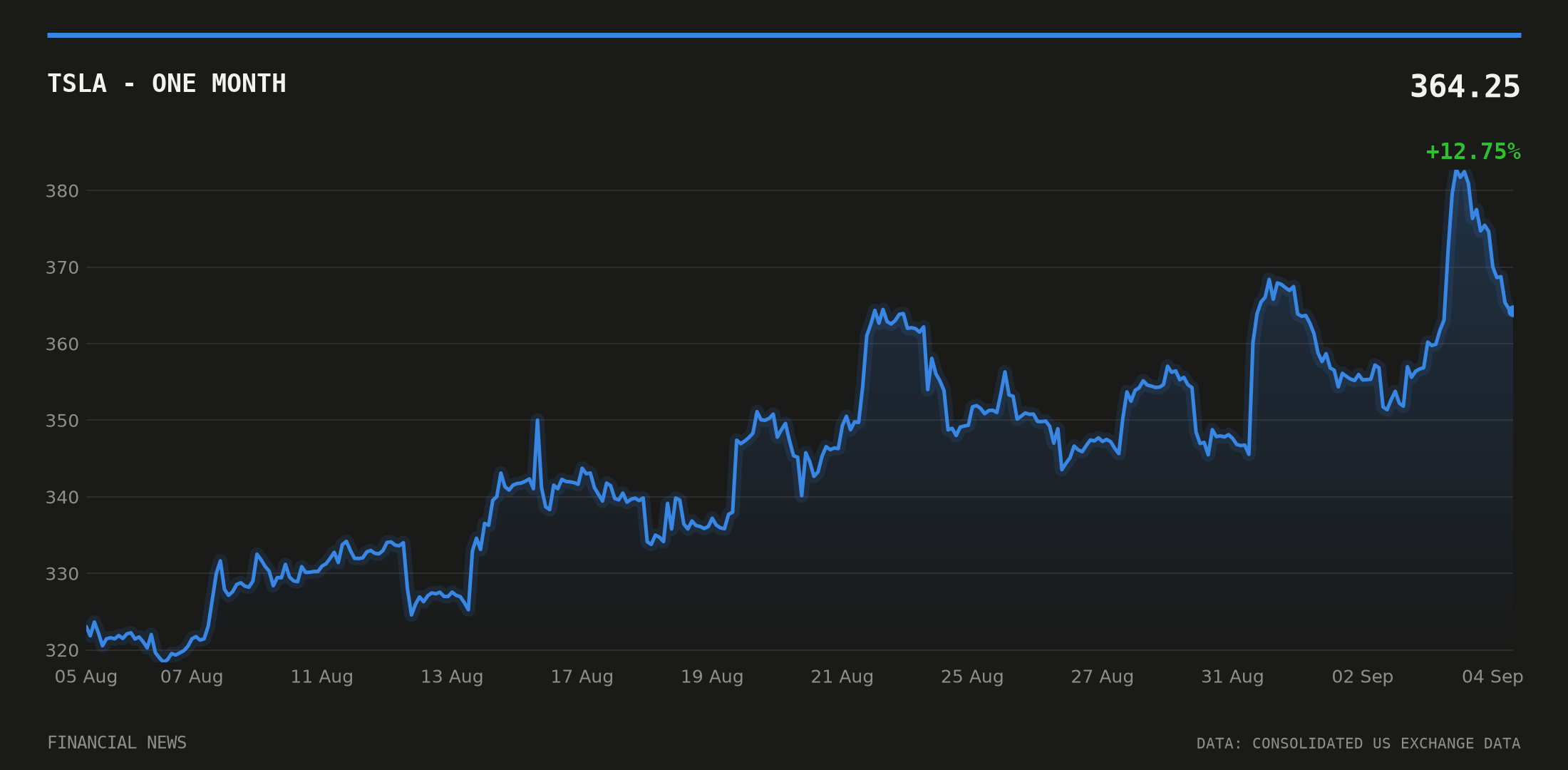
Tesla shares last traded at $364.03, down 3.04% on the day as of 1pm UTC on 4 September, coinciding with the fuller probe announcement. The stock had already slipped roughly 1% overnight after an earlier Reuters report that NHTSA was “evaluating” the rollout, before sliding further once the formal audit was confirmed.
The move looks company-specific rather than macro-driven. Treasury yields were essentially flat into the session, with the 10-year yield at 4.79% and the 2-year at 4.39%, both unchanged from the prior reading, suggesting broader rate markets played no part in the drop.
Separately, the US Department of Transportation has proposed removing the FMVSS requirement for manual controls such as brake pedals in vehicles designed to be driven autonomously, a rule change that would bear directly on the Cybercab’s legal footing if adopted. NHTSA has not set a timeline for concluding its audit, leaving the question of whether Tesla’s self-certification approach survives regulatory review unresolved for now.
This article is for information only and is not investment advice or a recommendation to buy or sell any asset. Markets move quickly; figures are correct as sourced at the time of writing. Always do your own research before making financial decisions.
