


JPMorgan processed $1.5 trillion in tokenized transactions through its Kinexys network by the end of 2024, a figure that, taken alongside BlackRock, Goldman Sachs and BNY Mellon all launching tokenised funds within the same period, confirms that institutional finance has moved well beyond experimentation and into active deployment of blockchain-based asset infrastructure.
Retail investors, for the most part, watched from the outside.
Mey Real, a platform constructed on the Mey Network and centred on fractional ownership of institutional-grade real estate, represents one attempt to close that gap by converting multi-million dollar properties into affordable investment units that carry both rental income exposure and capital appreciation potential for investors who previously had no realistic route into those assets.
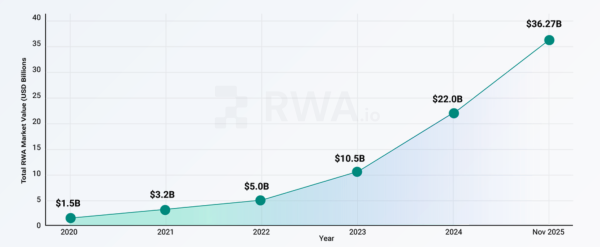
The sector those platforms now compete within has grown at a pace that still surprises analysts accustomed to traditional finance’s slower cycles, with Canton Network research recording $36 billion in total real-world asset tokenisation by late 2025 — a 2,200% expansion since 2020 — while separate data from RedStone and RWA.xyz tracks the market climbing from $5 billion in 2022 to $24 billion by mid-2025 alone. Standard Chartered projects that trajectory will carry the market to $30 trillion by 2034, and Boston Consulting Group places its own forecast at $16 trillion by 2030, numbers suggesting the current $36 billion represents less than a quarter of one percent of where the sector could eventually sit.
Real estate commands particular attention within that trajectory, with ScienceSoft predicting the tokenised real estate market alone will reach $3 trillion by 2030 — equivalent to 15% of all real estate assets under management globally — while Prophecy Market Insights values the current sector at $3.14 billion and forecasts growth to $21.82 billion by 2035 at a 21.2% annual rate. Institutional appetite reinforces those projections, with Deloitte research revealing that 12% of real estate firms globally had already implemented tokenisation solutions by mid-2024, and another 46% running active pilot programmes — meaning that more than half the industry had moved from observation to engagement within a single market cycle.
Against that backdrop, Mey Real’s Property Token Offering platform targets high-yield properties in emerging markets near major infrastructure developments and expanding business districts, a positioning strategy resting on the thesis that demographic shifts and economic expansion around key development zones will generate returns that justify the technology layer tokenisation adds to the investment process. Before any property reaches the platform, the company subjects it to analysis covering market dynamics, competitive positioning and legal standing, a process the company argues ensures token holders carry genuine ownership stakes with legally enforceable rights rather than synthetic exposure offering no clear legal recourse.
Fractional tokenisation changes the arithmetic.
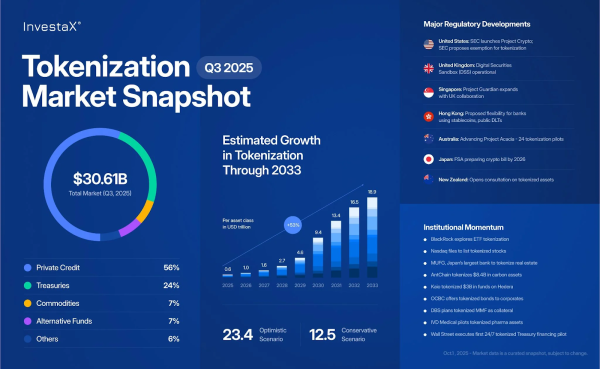
By splitting a multi-million dollar asset into smaller digital units, a platform like Mey Real can offer exposure to institutional-grade properties at price points retail investors can actually reach, while maintaining the rental income stream and capital appreciation potential that made those assets attractive to institutions in the first place. Within the broader RWA market, private credit currently commands the largest share — 58% of total value, or approximately $14 billion according to Investax — with US Treasuries representing a further 34% at $8.2 billion, a distribution that reflects the speed with which institutional investors have moved to tokenise yield-bearing assets while real estate tokenisation continues building its own infrastructure layer.
What Mey Real has not yet published includes founding dates, named executives, specific portfolio properties or independent regulatory approval for the compliance mechanisms it describes — gaps that matter in a sector where the distance between a credible tokenisation platform and an unregistered securities offering can narrow quickly without proper disclosure. That claim about token holders possessing genuine ownership stakes with enforceable rights carries weight only within a specific jurisdiction under a specific regulatory framework, neither of which appears in the current public materials, and given that the platform targets global investors, the question of which legal system backstops those rights is not a minor one.
The legal structure deserves scrutiny.
The broader market context Mey Real cites throughout its materials is real — JPMorgan, BlackRock and Goldman Sachs have genuinely moved into tokenised asset deployment, and the growth figures from Canton Network, BCG and Standard Chartered reflect actual market activity rather than projection-based speculation — but institutional validation of the sector does not automatically extend to any individual platform operating within it. That distinction matters more here than in most sectors. Retail investors entering fractionalised real estate through blockchain infrastructure carry the same fundamental risks as any property investment — market cycles, vacancy rates, jurisdiction-specific legal exposure — plus the additional layer of technology risk that no amount of institutional sector growth removes from any individual platform’s own ledger.
The RWA sector’s trajectory, from $36 billion today toward Standard Chartered’s $30 trillion projection, will produce real winners and real failures, and distinguishing between them will require exactly the kind of specific, verifiable disclosure that the strongest platforms in this space have begun providing — and that prospective investors should demand before committing capital to any of them.

