Orlando, USA, April 28th, 2026, FinanceWire
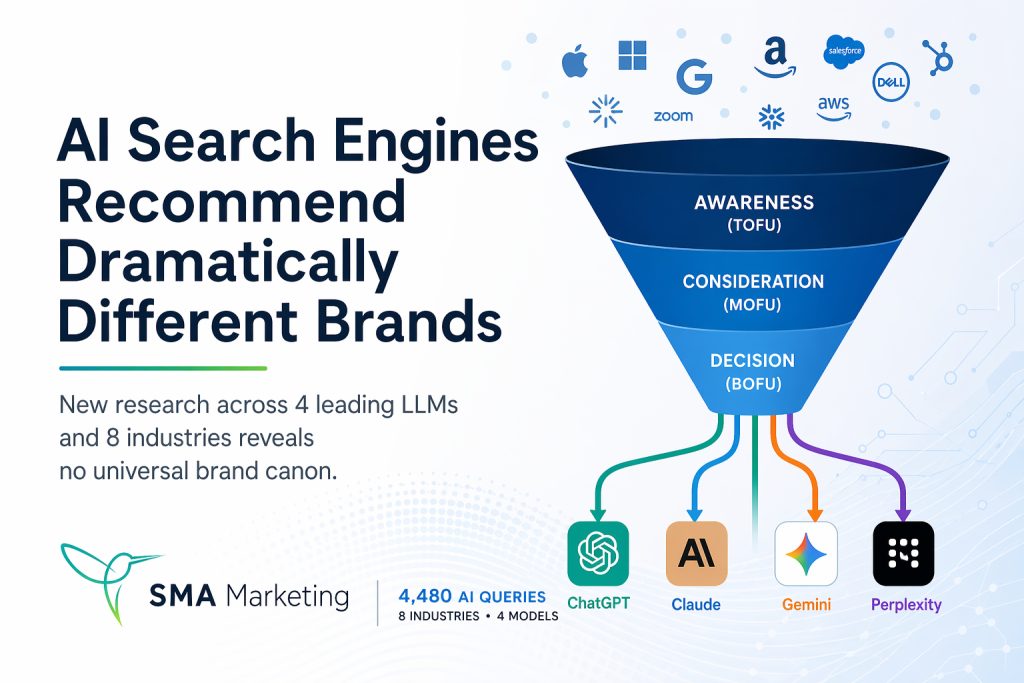
SMA Marketing, an AI-first search marketing agency, today published original research testing whether AI-powered search engines genuinely converge on a narrow set of brand recommendations as users move toward purchase decisions. The study, “Testing the ‘Dark AI’ Theory: Does Brand Convergence Actually Drive AEO Influence?”, replicates and expands on a January 2026 preliminary study by Demand Genius across four leading large language models and eight industry verticals.
Using 4,480 fully documented API calls across ChatGPT (GPT-4o), Claude (Sonnet 4), Gemini (2.0 Flash), and Perplexity (Sonar Pro), the research confirms the directional convergence pattern but reveals critical variation that reshapes how brands should approach Answer Engine Optimization (AEO) and Generative Engine Optimization (GEO).
Key Findings
- Convergence is real but model-dependent. All four LLMs show greater brand consistency at the bottom of the funnel (BOFU) than at the top (TOFU), but convergence strength varies by approximately 6x. Claude and ChatGPT converge strongly, while Gemini barely converges at all.
- There is no universal brand canon. At the decision stage, the average cross-model agreement on top brands (measured by Jaccard similarity) is just 0.15. A brand optimized for ChatGPT visibility may be entirely absent from Claude, Gemini, or Perplexity results.
- The “MOFU trough” is a behavioral mode switch, not a funnel. Models produce their longest, most detailed responses in the middle of the funnel while mentioning the fewest brands. At the decision stage, they switch abruptly to shorter, list-heavy responses—a finding that reframes AEO content strategy entirely.
- Citations are architectural, not funnel-driven. Perplexity cites sources 73% of the time, regardless of buyer stage; ChatGPT and Gemini cite 0%. Citation behavior reflects model architecture, not intent.
- Vertical context matters enormously. SaaS and Construction show meaningful cross-model consensus (Jaccard 0.30–0.35). Legal and Marketing show near-zero agreement (0.03).
Significance of Findings
“The Demand Genius team gave the industry useful conceptual vocabulary for something marketers were already sensing,” said Ryan Shelley, founder and lead strategist at SMA Marketing. “What we wanted to know is whether it holds up when you stress-test it across the models buyers actually use and categories beyond B2B tech. The answer is yes, but the practical implications change completely once you look across models. Optimizing for ‘AI visibility’ isn’t one problem. It’s at least four.”
The findings suggest that brands tracking visibility on a single AI platform see at most 25% of the competitive landscape, and that the AEO strategy must be tailored not just to the funnel stage but also to model architecture and vertical density.
Reproducibility
Every prompt, model version, parameter, and analysis step in the study is documented. All 112 prompts used in the research are available in the published dataset, so other researchers and practitioners can independently verify or extend the findings.
About SMA Marketing
SMA Marketing is an AI-first search marketing agency specializing in SEO, GEO/AEO, PPC, and content strategy. The agency treats marketing as applied data science, publishing original empirical research to advance how brands understand and win visibility in AI-mediated search. Headquartered in Central Florida, SMA Marketing serves clients across SaaS, Defense, Legal, Construction, Real Estate, Manufacturing, and Higher Education.
Read the full study: https://www.smamarketing.net/research/does-brand-convergence-drive-aeo-influence
Contact
Ryan C Shelley
SMA Marketing, INC.
ryan@smamarketing.net